If you work in a preschool, daycare, or family childcare setting — or you’re trying to break into the field — you already know that earning early childhood education units online is one of the most practical steps you can take for your career. But with dozens of programs out there, it’s easy to feel overwhelmed by the options, costs, and credential requirements.
This guide cuts through the noise. Whether you need 12 units for a California Associate Teacher permit, continuing education credits to maintain your license, or a full pathway toward a CDA credential, you’ll find clear, honest answers here — written by someone who understands what early childhood educators actually need.
Suggested Guide for you!
How to Open an Early Childhood Education Franchise: The Complete Step-by-Step Guide
My Son Can’t See! How Do I Explain Colours To Him?
What Are Early Childhood Education Units Online?
Early childhood education (ECE) units are college-level credits earned through coursework in child development, family dynamics, curriculum design, health and safety, and related subjects. When earned online, these units offer the same academic credit as in-person courses — but you complete them on your own schedule, from anywhere.
Online ECE units matter for several reasons:
- State teaching permits: Most states, including California, require a specific number of ECE or Child Development (CD) units to qualify for teaching and director permits.
- Employment eligibility: Many childcare centers and Head Start programs require verified ECE units as a hiring condition.
- CDA credential: The nationally recognized Child Development Associate credential requires 120 hours of professional development, much of which can be completed through ECE coursework.
- Salary advancement: In many districts and programs, each level of permit or credential unlocks higher pay.
Online delivery makes all of this possible without quitting your job, moving cities, or rearranging your family schedule.
Who Needs Early Childhood Education Units Online?

A common misconception is that ECE units are only for people just entering the field. In reality, several groups of working professionals benefit from earning early childhood education units online:
New entrants to the field
Need foundational units (typically 12) to qualify for an entry-level teaching permit.
Currently employed childcare workers
Those who need annual continuing education hours to stay compliant with state licensing requirements.
Experienced teachers moving up
Who are working toward a Master Teacher, Site Supervisor, or Program Director permit — each of which requires progressively more units.
CDA candidates
Who needs to document 120 hours of professional development across eight subject areas.
Family childcare providers
Must meet state-mandated training requirements to maintain their operating license.
Career changers
with backgrounds in education, social work, or healthcare who want to formalize their knowledge of early childhood development.
How California’s ECE Permit System Works (and Why Units Matter)
California is one of the most structured states when it comes to ECE credentials, and many other states model their systems similarly. Understanding how it works helps you make smarter choices when selecting a program.
The California Commission on Teacher Credentialing (CTC) issues five levels of Child Development permits:
| Permit Level | ECE/CD Units Required | General Ed Units |
|---|---|---|
| Associate Teacher | 12 | None |
| Teacher | 24 | 16 |
| Master Teacher | 24 + 16 specialization | 16 |
| Site Supervisor | 24 + 6 administration | 50 |
| Program Director | 24 + 6 administration | 60 |
The 12 units needed for the Associate Teacher permit — the most common starting point — must cover specific subject areas: Child/Human Growth and Development, Child, Family, and Community, and Programs/Curriculum. Most accredited online providers align their courses directly to these requirements, but it’s worth confirming before you enroll.
Outside California, every state has its own requirements. The good news is that accredited online ECE units transfer widely, and the CDA credential is recognized in all 50 states.
What to Look For in an Online ECE Program
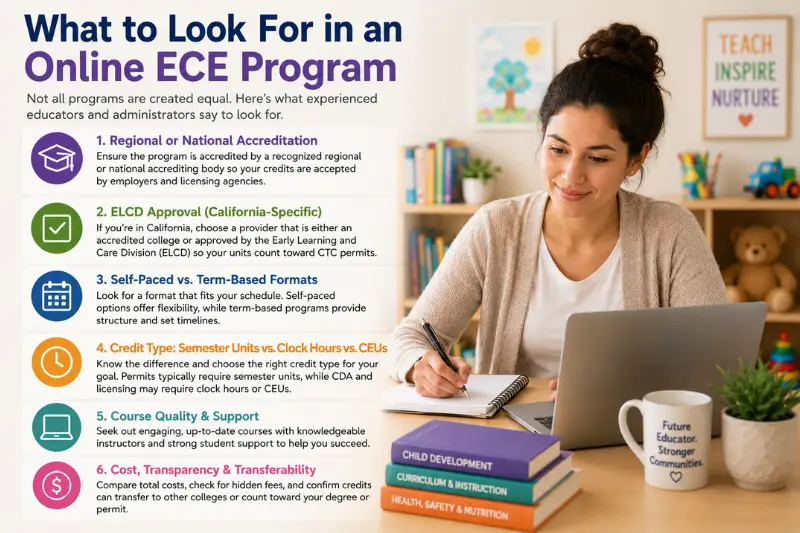
Not all programs are created equal. Here’s what experienced educators and administrators say to look for — and what the marketing materials often leave out.
Regional or National Accreditation
This is the single most important factor. Accredited programs are recognized by state licensing agencies, the CDA Council, and employers. Look for regional accreditation (e.g., WASC, NECHE) or, for vocational programs, national accreditation from a recognized body. Programs without accreditation may be cheaper, but credits often can’t be transferred or applied to permits.
ELCD Approval (California-Specific)
In California, if you want your coursework to count toward a CTC permit, the provider should either be an accredited college or hold approval from the Early Learning and Care Division (ELCD) of the California Department of Education. Check the CDE’s approved provider list before enrolling with any non-college provider.
Self-Paced vs. Term-Based Formats
Some programs run on semester schedules with fixed start dates. Others are fully self-paced — you can start any week and finish as quickly as your schedule allows. If you’re working full-time, self-paced or accelerated formats give you more control. Just confirm that the credit type is identical; some self-paced programs issue clock hours or CEUs, not semester units, which don’t satisfy CTC permit requirements.
Credit Type: Semester Units vs. Clock Hours vs. CEUs
These are not the same thing, and confusing them is one of the most common mistakes people make:
- Semester units (also called college credits): What CTC permits and most degree programs require. One semester unit = approximately 54 total hours of instruction and coursework.
- Clock hours / training hours: Used for CDA applications and many state licensing requirements. 120 clock hours are required for the CDA.
- CEUs (Continuing Education Units): Used for license renewal in some states. 1 CEU = 10 contact hours.
Always confirm which type of credit you’re receiving — and verify it will satisfy your specific goal — before paying.
Instructor Qualifications and Support
Online doesn’t have to mean isolated. Quality programs employ instructors with real ECE field experience, offer email or phone support, and provide feedback on assignments. This matters both for learning quality and for your ability to cite your training in professional settings.
Transparent Pricing
Tuition for ECE units varies widely — from free (through state-subsidized programs) to $350+ per course at private colleges. Be wary of programs that hide pricing behind a contact form. Legitimate providers publish their tuition. Also watch for enrollment fees, technology fees, and per-unit charges that inflate the base cost.
The Best Options for Earning Early Childhood Education Units Online
Here is an honest look at the main categories of providers where you can earn early childhood education units online, and what each is best suited for.
Accredited Community Colleges (Best Overall Value)
California’s community college system offers ECE courses online for in-state residents at roughly $46 per unit — making a full 12-unit certificate cost around $550. Many districts offer reduced fees or waivers for low-income students. Courses are accredited, recognized by the CTC, and can count toward a two-year or four-year degree.
Community colleges run on semester schedules, which means fixed start dates. If you can plan ahead, this is the most affordable and most transferable path available.
Best for: Anyone who wants the most credits for the least money and can work within a semester schedule.
UCLA Extension
UCLA Extension’s online Early Childhood Education – Associate Teacher certificate is one of the most recognized non-community-college options in California. It’s designed explicitly to meet the 12 ECE/CD semester units for the CTC Associate Teacher permit and is available entirely online. The program also offers bilingual delivery in English and Spanish — a meaningful differentiator for the many Spanish-speaking educators in California’s workforce.
The UCLA brand adds weight to a resume, particularly if you’re applying to larger programs or organizations that value institutional prestige.
Best for: California educators who want a recognized certificate from a major university and value bilingual instruction.
Laguna Technical College
Laguna Technical College has offered accelerated online ECE courses in California for over 20 years and holds a BBB A+ rating. Courses are $350 each, with a $25 discount per course when enrolling in four or more at once. The accelerated hybrid format is designed for working adults who want to complete units faster than a traditional semester allows.
Their course catalog maps to California CTC permit requirements, and they also offer a job board — useful if you’re actively looking for placement after completing your coursework.
Best for: Working California educators who want an accelerated pace and transparent pricing.
Care Courses
Care Courses is one of the most established national online training providers for childcare workers, operating in all 50 states. It offers courses in both online and book formats, with unlimited free instructor support. Pricing is affordable, and a subscription model is available for providers who need multiple courses per year.
One important caveat: Care Courses primarily issues clock hours and CEUs, not semester units. These satisfy CDA training requirements and many states’ annual licensing hours — but they do not count as college credit for CTC permits. Confirm your goal before enrolling.
Best for: CDA candidates, providers seeking annual clock hours, and educators in states outside California.
ChildCareEd
ChildCareEd is a comprehensive online platform with courses, CDA certification training, instructor-led Zoom sessions, and even a first aid/CPR blended option. They’ve built a strong content presence around free resources for California providers, which makes them easy to find through a Google search.
Like Care Courses, their courses primarily issue training hours and CEUs. They also offer an employer-facing director platform, making them a good fit for center directors managing staff compliance training.
Best for: Directors managing team training, CDA candidates, and providers who prefer live instructor sessions via Zoom.
Pacific Oaks College
Pacific Oaks College in California offers B.A., M.A., and Ed.D. programs in early childhood education, both online and on-campus. These are degree programs — not certificate courses — and come at degree-level tuition. Financial aid and scholarships are available. The college has a strong identity around anti-bias education and social justice, which aligns well with educators working in diverse, underserved communities.
Best for: ECE educators pursuing a four-year degree or graduate-level credential who want a values-driven institution.
State-Subsidized Programs (Colorado, New York, and Others)
Several states have invested public funds to make ECE units free or nearly free for their workforce. Colorado’s CDEC partnered with the Colorado Department of Higher Education to fully subsidize ECE 1011 and 1031 courses at public community colleges — 6,614 students enrolled between 2021 and 2023. New York’s ECETP through the University at Albany offers free e-learning, health and safety certifications, and scholarship support through the Early Intervention Program.
If you live outside California, search your state’s child care licensing agency website for subsidized training programs before paying out of pocket. Demand for these programs is high, and funding changes frequently — but they are often the best-kept secret in ECE professional development.
Best for: Educators in Colorado, New York, or other states with active subsidized programs.
How Many Units Do You Actually Need?
The answer depends entirely on your goal. Here’s a practical breakdown:
- To get a California Associate Teacher permit: 12 ECE/CD semester units covering the three required subject areas.
- To get a California Teacher permit: 24 ECE/CD semester units + 16 general education units + 50 days of work experience.
- To earn a CDA credential: 120 clock hours of professional development spread across eight CDA subject areas, plus work experience and a professional portfolio.
- For annual California childcare licensing compliance: CDSS-licensed family childcare providers and center staff must complete 16 hours of health and safety training and 15 hours of continuing education annually (requirements vary by role).
- For a college degree in ECE: Typically 60 units for an A.A., 120 for a B.A.
If you’re unsure what you need, the quickest way to get clarity is to contact your state’s licensing agency or the California CTC directly. They can tell you exactly which units you’re missing and which approved programs can fill that gap.
Subjects Covered in Online ECE Courses
Regardless of which provider you choose, accredited early childhood education units online typically cover these subject areas:
- Child Growth and Development — physical, cognitive, social, and emotional milestones from birth through age 8; theories from Piaget, Vygotsky, Bronfenbrenner, and Erikson.
- Child, Family, and Community — the role of family structure, cultural background, and community context in shaping child development; family engagement strategies.
- Programs and Curriculum — how to design developmentally appropriate learning environments; lesson planning; play-based and project-based approaches.
- Health, Safety, and Nutrition — first aid, CPR, safe sleep practices, food allergies, sanitation protocols, and licensing compliance.
- Observation and Assessment — documentation methods, developmental checklists, anecdotal records, and how to use assessment data to guide teaching.
- Infant and Toddler Development — specialized coursework for those working with children under three, including attachment theory and responsive caregiving.
- Administration and Leadership — budget management, staff supervision, licensing compliance, and program quality improvement (required for Site Supervisor and Director permits).
- Diversity, Equity, and Inclusion — anti-bias curriculum, culturally responsive teaching, and working with dual-language learners.
Cost Comparison: What You’ll Actually Pay
Here’s a realistic cost picture for the most common goals:
- 12 units at a California community college: approximately $550–$700 (in-state tuition + fees)
- 12-unit online certificate at UCLA Extension: varies by course; typically $1,200–$2,000
- Per-course pricing at Laguna Technical College: $350/course; 4 courses (12 units) = $1,400 before discount, $1,300 with the 4-course discount
- CDA training through Care Courses: varies by package; typically $150–$400 for the required clock hours
- Subsidized programs (CO, NY): Free or near-free for eligible residents
- B.A. completion through Pacific Oaks College: Full degree tuition; financial aid available
A note on financial assistance: California’s Child Care Initiative Project, the California Head Start Association, and many local First 5 commissions offer training stipends and tuition reimbursement for ECE educators. Check with your county’s First 5 office or your employer’s HR department — funding that goes unused every year is significant.
5 Questions to Ask Before You Enroll
Before submitting payment or an application, get clear answers to these five questions:
- Is this program accredited? By which accrediting body, and is that body recognized by your state licensing agency or the CTC?
- What type of credit will I receive? Semester units, clock hours, or CEUs? Which does my permit or credential require?
- Are these courses approved in my state? In California, confirm CTC or ELCD alignment. In other states, check with your child care licensing agency.
- What is the total cost? Ask about enrollment fees, technology fees, and per-unit costs beyond the advertised tuition.
- What support is available? Can you speak with an instructor? Is there a phone number? How are questions answered?
Common Mistakes to Avoid
- Enrolling in a non-accredited program: Units from non-accredited providers often cannot be applied to state permits, transferred to a college, or counted by an employer. Always verify accreditation first.
- Confusing clock hours with semester units: A 15-clock-hour training and a 3-unit semester course are very different things. Both matter — but not interchangeably.
- Waiting until the last minute: If you need units for permit renewal or annual compliance, don’t wait until the deadline. Many online programs take 8–16 weeks to complete, and grading/transcript processing adds more time.
- Not requesting official transcripts: Completing a course is not the same as having it on record. Always request official transcripts from your provider and keep copies for your own files.
- Overlooking free funding: As noted above, stipends and reimbursement programs exist specifically for ECE professionals. Always check for available funding before paying out of pocket.
A Note on Quality vs. Speed
It’s tempting to choose the fastest, cheapest program that checks the permit box. But the knowledge you gain from well-designed ECE coursework directly shapes how you interact with children every day.
Instructors who draw on real classroom experience, assignments that ask you to observe and reflect on actual children, and curriculum that engages you with current research — these things matter beyond the certificate. The children in your care are the long-term beneficiaries of high-quality professional development. That’s worth a little extra time in choosing well.
Frequently Asked Questions
Can online ECE units be used for the California CTC permit?
Yes, as long as the program is an accredited college or an ELCD-approved provider. Confirm this with the specific institution before enrolling.
How long does it take to complete 12 ECE units online?
At most community colleges, 12 units across one semester takes approximately 16 weeks. Accelerated programs like Laguna Technical College offer faster completion. Self-paced programs vary based on how much time you dedicate.
Do online ECE units expire?
College units don’t expire. However, some state licensing requirements specify that continuing education hours must be completed within a certain time period (usually annually or every two years).
Can I take ECE units online from another state?
Yes, in most cases. Accredited colleges in any state can issue transferable units. However, always confirm that your state licensing agency or the CTC will accept units from out-of-state institutions before enrolling.
Is financial aid available for online ECE courses?
At accredited colleges, federal financial aid (Pell grants, subsidized loans) is available to eligible students. Some ECE-specific platforms do not qualify for federal aid but may offer payment plans or scholarships. First 5 county commissions and some childcare resource and referral agencies offer stipends.
Early Childhood Education Jobs: Your Complete Career Guide
Legacy Childhood Education Centers: Everything Parents Need to Know
Final Thoughts
Navigating professional credentialing and earning early childhood education units online requires careful attention to program accreditation, state permit alignment, and curriculum standards, ensuring your coursework supports both career advancement and fundamental physical education objectives in early learning settings.
Start with your specific goal. Know exactly which units, hours, or credential you need. Then find an accredited provider that explicitly aligns with that requirement. Check for funding assistance. And don’t sacrifice quality for speed — the children you work with deserve an educator who is learning, not just credentialing.
The field of early childhood education is demanding, often undercompensated, and profoundly important. The fact that you’re seeking more knowledge and credentials speaks to the kind of professional you already are.