
Choosing a daycare is one of the most consequential decisions you will make as a parent. And if you have been researching your options, you have almost certainly landed on KinderCare — one of the largest child care chains in the United States. But is KinderCare actually better than other daycare centers, or does it just have the biggest marketing budget?
This guide gives you an honest, side-by-side look at KinderCare vs. other daycare centers — including local private centers, Montessori schools, church-based programs, and employer-sponsored options. We walk through curriculum, cost, teacher quality, safety, and the real-world parent experiences that matter most.
What Is KinderCare and How Big Is It?
KinderCare Learning Centers is a nationwide chain operated by KinderCare Learning Companies, which also runs The Crème School (a premium brand) and Champions (before-and-after school care). With more than 1,500 locations across the U.S., it is one of the most recognized names in early childhood education.
KinderCare serves children from six weeks old through school age — infant care, toddler programs, preschool, pre-K, kindergarten, and school-age before-and-after care. The company has also built a significant employer-partnership business, providing on-site and near-site childcare for corporate clients.
Understanding that scale matters when comparing KinderCare to other daycare centers — because scale brings both advantages (consistency, accreditation, resources) and disadvantages (less personalization, corporate culture, staff turnover).
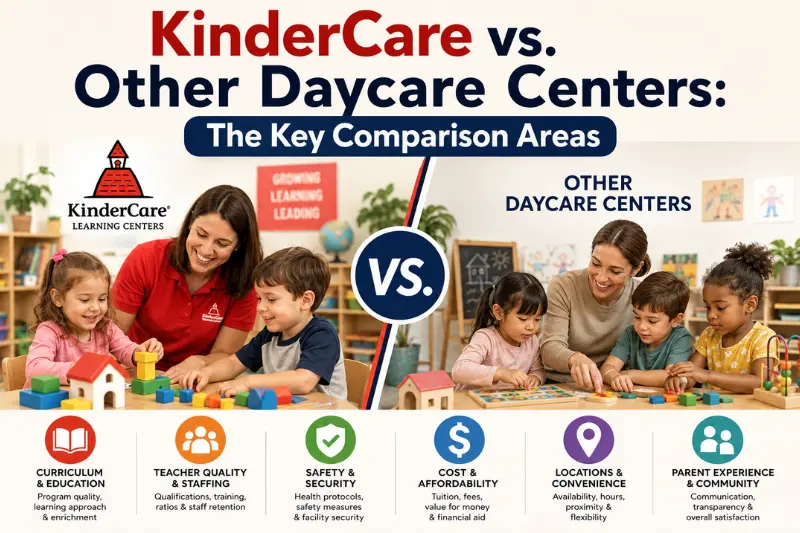
KinderCare vs. Other Daycare Centers: The Key Comparison Areas
Curriculum and Educational Approach
KinderCare
uses its proprietary Early Foundations® curriculum, developed by an in-house team of early childhood education specialists. The program is a whole-child model addressing academic, physical, and social-emotional development across all age groups. Key features include STEM learning areas, literacy corners, dramatic play zones, and enrichment add-ons like Phonics Adventures® and Cooking Academy™. KinderCare publishes outcome data, claiming that their kindergartners score nearly two months ahead of national expectations on developmental assessments.
Local and private daycare centers
vary enormously in their educational philosophy. Many operate on established frameworks — Montessori, Reggio Emilia, Waldorf, or HighScope — that have been independently researched and refined over decades. A high-quality independent center often delivers a more individualized, inquiry-based learning experience than a standardized chain model. The trade-off is inconsistency: a strong independent center can outperform KinderCare significantly, while a weak one will fall well short.
Church-based preschools
(which account for roughly 46% of preschool programs in some regions) blend faith values with early academics. They often have strong community ties and attentive staff, though academic rigor varies.
Montessori schools
Take a self-directed, mixed-age approach that research consistently links to stronger executive function and reading outcomes by the end of kindergarten. They typically cost more than KinderCare but are worth seriously considering for children between 2.5 and 6 years old.
Takeaway: KinderCare’s curriculum is solid and standardized — a reliable floor. But a well-accredited independent center or Montessori school can offer a ceiling that KinderCare rarely reaches.
Teacher Quality and Staff Retention
This is where the KinderCare vs. other daycare centers debate gets most heated among parents.
KinderCare hires teachers who love children and invests in ongoing engagement through annual Gallup® staff surveys. The company promotes internal advancement and provides training, though it does not require a four-year degree for all classroom roles.
The honest reality, however, is that large chains — including KinderCare — struggle with staff turnover. Childcare workers are chronically underpaid nationally, and high-volume centers experience teacher changes that can disrupt the consistency children need, especially infants and toddlers. Parents in online forums frequently cite this as their single biggest frustration with chain daycare centers.
Independent centers and family-owned programs often have lower turnover because directors are owners, teachers feel more invested in the community, and class sizes tend to be smaller. A family-owned center where the director greets your child by name every morning provides a qualitatively different experience than a corporate location with quarterly staff changes.
- What to look for when visiting any center: Watch how teachers greet each child arriving in the morning. Do they crouch down to eye level? Do they know the child’s name before you say it? These behaviors are the strongest signal of genuine attachment-based care.
Cost: Is KinderCare Cheaper or More Expensive Than Other Options?
The “why is KinderCare so cheap?” question circulates in parenting forums regularly — and it reveals something important: pricing is highly location-dependent and not a reliable quality signal.
Here is a general breakdown of childcare costs to frame the comparison:
- Center-based preschool care (ages 3–5): $6,239–$11,050 per year nationally, depending on county size
- Center-based infant care: $7,461–$15,417 per year (U.S. Department of Labor, 2023)
- Home-based care: Generally 10–20% lower than center-based
KinderCare sits in the mid-range of this spectrum in most markets. It is typically more expensive than home daycares and church preschools, roughly comparable to other national chains (Bright Horizons, The Learning Experience), and often less expensive than premium private or Montessori programs.
Important cost factors most parents overlook:
- Enrollment and registration fees — most centers charge these on top of monthly tuition
- Supply and activity fees — often billed quarterly at chain centers
- Part-time vs. full-time rates — KinderCare offers both at most locations, but part-time slots fill quickly
- Financial assistance — childcare subsidy vouchers, state-funded pre-K, and employer tuition assistance can dramatically reduce out-of-pocket costs at both KinderCare and independent centers
- Year-end tax credits — the Child and Dependent Care Tax Credit applies to qualifying childcare expenses at any licensed center
Always get the full all-in annual figure when comparing centers, not just the weekly rate.
Health, Safety, and Facility Standards
KinderCare has invested heavily in health and safety infrastructure. Its centers carry the WELL Health-Safety Rating™, a third-party certification verifying that indoor environments meet standards for air quality, sanitation, hand hygiene, and emergency preparedness. The company works with pediatric emergency physicians to advise its safety protocols — a resource most independent centers cannot access.
Other daycare centers are licensed and inspected by state agencies, but requirements vary significantly by state. Some states run robust inspection regimes with unannounced visits; others are more lenient. When comparing KinderCare to other daycare centers in your area, always:
- Check your state’s childcare licensing database for inspection history and any cited violations
- Ask about staff-to-child ratios (KinderCare follows NAEYC guidelines; not all centers do)
- Ask specifically about sick-child policies and how illness outbreaks are communicated to families
- Note turnover in administrative and director roles — a stable director usually indicates a safer, more consistent center
One area where independent centers sometimes have the edge: smaller facility size. A center with 40 children has fewer illness vectors and more opportunity for adults to notice physical or behavioral changes in individual children.
Accreditation: What It Means and Why It Matters
When comparing KinderCare vs. other daycare centers, accreditation is one of the clearest objective quality signals available to parents.
NAEYC accreditation
(National Association for the Education of Young Children) is the gold standard in early childhood education. It requires a comprehensive self-study, an on-site evaluation, and compliance with standards across 10 program areas. Many strong independent centers and some KinderCare locations hold this credential.
KinderCare pursues accreditation at the individual center level — some locations are NAEYC-accredited, others are not. The WELL Health-Safety Rating is a facility-level certification, not a curriculum or teaching quality certification. These are distinct, and it is worth asking specifically which credential a given location holds.
When touring any center, ask directly: “Is this location NAEYC accredited?” If yes, request the most recent accreditation report. If not, ask what quality standards they are evaluated against and by whom.
Flexibility and Convenience
This is one category where KinderCare consistently outperforms most alternatives:
- Extended hours: most locations open around 6:30–7 a.m. and close around 6 p.m.
- Year-round enrollment: no summer break disruption
- School break coverage: spring, summer, and winter break programs for school-age children
- KinderCare App: real-time updates on daily activities, meals, nap times, and photos
- Multiple locations: if you relocate or change jobs, you can often transfer to a nearby center with maintained records
Independent centers and church preschools often operate on school-year calendars, close for holidays, and may not offer extended hours — which can be a significant logistical problem for working parents.
Employer-sponsored childcare, available through KinderCare Learning Companies’ B2B division and a handful of other national providers, is worth asking about at your workplace. Employer-subsidized care can reduce costs substantially and often guarantees enrollment priority.
Parent Experience and Community Feel
This is the hardest factor to quantify and often the most important in practice.
KinderCare centers, being part of a corporate chain, have a consistent but sometimes impersonal feel. Standardized signage, corporate policies, and staff rotation can make the experience feel transactional. That said, individual centers vary dramatically based on their director and lead teachers — a great director can transform the culture of any location.
Local, family-owned daycare centers tend to score higher on relational warmth. You are more likely to get a phone call rather than a form letter, a director who knows your child’s allergies without checking a screen, and a parent community where families actually know one another.
From parenting forums and community reviews, the most common complaints about chain daycare centers like KinderCare include:
- Staff turnover disrupting children’s sense of security
- Inconsistent communication between teachers and parents
- Feeling like a customer rather than a partner in their child’s care
And the most common complaints about small independent centers include:
- Unexpected closures when staff call in sick
- Less rigorous curriculum documentation or outcome tracking
- Limited extended hours or year-round availability
Neither model is perfect. The best approach is to visit multiple options — chain and independent — and trust what you observe about whether the adults in the room genuinely love their work.
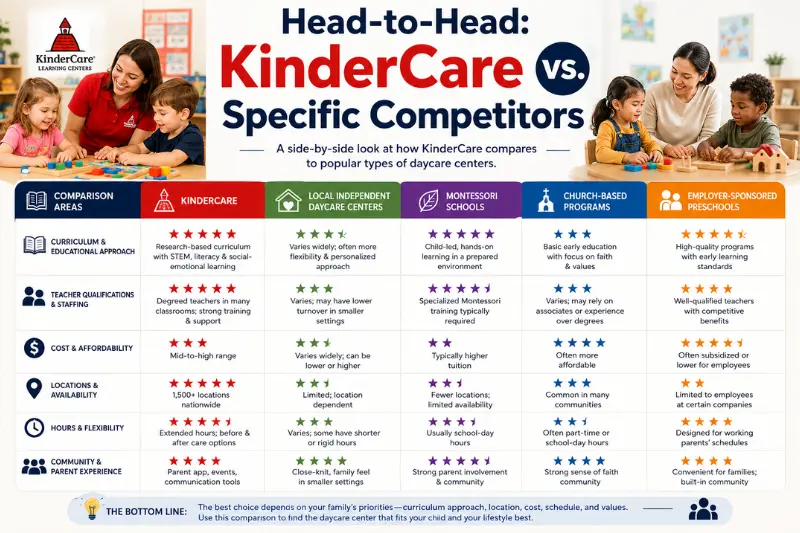
Head-to-Head: KinderCare vs. Specific Competitors
KinderCare vs. Bright Horizons
Bright Horizons is KinderCare’s most direct national competitor, sharing a similar corporate structure and employer-partnership model. Bright Horizons typically commands higher tuition and appears more frequently inside or adjacent to corporate campuses. Its curriculum (World at Their Fingertips®) is research-based and broadly comparable to KinderCare’s. If your employer already partners with Bright Horizons, that employer benefit can make it the financially dominant choice regardless of brand comparison.
KinderCare vs. The Learning Experience
The Learning Experience (TLE) is a fast-growing franchise chain emphasizing Spanish immersion, character education, and a proprietary curriculum. Centers tend to be newer facilities. Quality varies more by individual franchise owner than with KinderCare, making an in-person visit especially important before enrolling.
KinderCare vs. Local Montessori Schools
Montessori programs consistently produce stronger independence, literacy, and executive function outcomes in peer-reviewed research. They cost more and typically do not offer infant care or extended hours. If your child is between 2.5 and 5 years old and scheduling flexibility is not the primary constraint, a well-run Montessori program is worth a serious comparison against KinderCare.
KinderCare vs. Home Daycare Providers
Licensed home daycares offer the lowest child-to-caregiver ratios, the most flexible scheduling, and often the warmest daily environment. They are the most variable in quality and typically lack a formal curriculum or outcome tracking. For infants especially, a licensed home daycare with an experienced, stable provider can offer better attachment security and lower illness exposure than a large center.
What Most Comparison Articles Miss: The Questions That Actually Predict Quality
When parents compare KinderCare vs other daycare centers, they tend to focus on brand reputation and online star ratings. Here are the questions that more reliably predict your child’s actual daily experience:
- How long has the lead teacher in your child’s classroom been at this center? Teacher tenure predicts consistency, which predicts attachment security — especially for children under three.
- What is the director’s own tenure at this location? A center that has had three directors in two years has systemic problems that no amount of certification will fix.
- How does the center communicate when something goes wrong — a fall, a conflict between children, a behavioral concern? Ask for a real example. Their answer reveals their culture.
- What does a typical Tuesday afternoon look like for a child your child’s age? This surfaces whether they have a thoughtful developmental rhythm or a generic holding schedule.
- How do teachers handle transitions — between activities, arrival, and departure? Transitions are where child behavior often deteriorates and where genuine teacher skill shows most clearly.
How to Make the Final Decision
There is no universally correct answer in the KinderCare vs. other daycare centers comparison. The right choice depends on your child’s age and temperament, your work schedule, your budget, and what is actually available and excellent in your area.
Use this framework:
- If you need consistency, extended hours, and year-round availability → KinderCare is a well-resourced, reliable option. Visit the specific location, not just the website.
- If you value individualized care, deep teacher relationships, and a philosophy-driven approach → seek out an NAEYC-accredited independent center or a well-reviewed Montessori program.
- If you have an infant under 12 months → prioritize caregiver consistency above all else. Consider a licensed home daycare or whichever center has the lowest infant room turnover.
- If cost is the primary constraint → explore state subsidy programs, employer benefits, and church-based preschools before deciding. Do not assume KinderCare is the affordable default.
Whatever you choose, visit in person. Arrive unannounced if possible, and spend time watching the adults. The building matters far less than the people inside it.
Frequently Asked Questions: KinderCare vs. Other Daycare Centers
Q: Is KinderCare a good daycare?
A: KinderCare is a well-established, licensed childcare provider with a structured curriculum, certified safety standards, and year-round availability. It is a reliable option for most working families, particularly because of its extended hours and consistent program framework. That said, quality varies by individual location. The best way to judge any KinderCare center is to visit in person, ask about teacher tenure, and check your state’s childcare licensing inspection database for that specific address.
Q: How does KinderCare compare to other daycare centers in terms of cost?
A: KinderCare generally falls in the mid-range of childcare pricing. It tends to cost more than home daycares and church-based preschools, and about the same as other national chains like Bright Horizons or The Learning Experience. Premium private programs and Montessori schools are usually more expensive. Nationally, center-based care for preschool-age children runs between $6,239 and $11,050 per year depending on location. Always ask for the full all-in cost — monthly tuition plus registration, supply fees, and any activity charges — before comparing centers side by side.
Q: Why do some parents say KinderCare is cheap?
A: The perception varies by market. In some cities, KinderCare is priced below independent premium centers, which leads parents to wonder if the lower cost signals lower quality. In other markets, it is priced comparably or higher. Price is not a reliable quality signal in childcare — a mid-priced KinderCare location can outperform an expensive independent center if its teaching staff is stable and experienced. Focus on what you observe during a visit, not the monthly rate.
Q: Is KinderCare better than The Learning Experience?
A: Both are national chains with structured curricula, licensed facilities, and extended operating hours. KinderCare has a longer track record and broader national presence. The Learning Experience tends to have newer facilities and emphasizes Spanish immersion and character education. The bigger factor between the two is the individual location — franchise and chain center quality varies significantly based on the director and lead teachers. Visit both locations in your area before deciding.
Q: What ages does KinderCare serve?
A: KinderCare enrolls children from six weeks old through school age. Programs include infant care (6 weeks–12 months), young toddlers (12–24 months), toddlers (2–3 years), preschool (3–4 years), pre-K (4–5 years), kindergarten, and before-and-after school care for older children through its Champions program. Not all age programs are available at every location, so confirm with your local center.
Q: Is KinderCare accredited?
A: KinderCare pursues accreditation at the individual center level. Some locations hold NAEYC accreditation (the gold standard in early childhood education), while others do not. All KinderCare centers carry the WELL Health-Safety Rating™, which certifies the physical facility environment — air quality, sanitation, and safety protocols — but this is a facilities credential, not a curriculum or teaching quality credential. When you visit a center, ask specifically whether that location is NAEYC accredited.
Q: How does KinderCare’s curriculum compare to Montessori?
A: KinderCare uses its proprietary Early Foundations® curriculum — a structured, teacher-led program designed around school readiness and whole-child development. Montessori is a child-led, mixed-age approach where children choose their own learning activities within a prepared environment. Research consistently shows that Montessori-educated children develop stronger executive function, reading skills, and independence by age five. Montessori programs typically cost more and do not offer infant care or extended hours. For children ages 2.5–5, a well-run Montessori program is worth comparing seriously if your schedule and budget allow.
Q: What should I look for when visiting a KinderCare or any other daycare center?
A: Beyond cleanliness and safety, pay attention to the people. Watch how teachers greet arriving children — do they make eye contact, crouch to the child’s level, and use the child’s name? Ask how long the lead teacher in your child’s classroom has been at that center. Ask the director for a specific example of how they communicate with parents when something goes wrong. These details predict day-to-day quality far more reliably than a website, a brochure, or an online star rating.
Q: Does KinderCare offer part-time enrollment?
A: Yes, most KinderCare locations offer part-time schedules in addition to full-time enrollment. However, part-time spots are limited and fill quickly, especially in infant and toddler rooms. If you need part-time care, ask about availability and waitlists early in your search — do not assume availability will match your preferred days.
Q: What financial help is available for KinderCare or other daycare costs
A: Several forms of assistance can significantly reduce what you pay out of pocket. These include:
- State childcare subsidy programs (eligibility based on income; apply through your state’s childcare resource agency)
- State-funded Pre-K programs, which provide free or low-cost preschool for eligible 3- and 4-year-olds
- Employer-sponsored childcare benefits, including dependent care FSAs (Flexible Spending Accounts) that let you pay up to $5,000 per year in childcare with pre-tax dollars
- The Child and Dependent Care Tax Credit, which applies to qualifying childcare expenses at any licensed center
- Employer partnerships with KinderCare Learning Companies, which some large employers offer as a subsidized benefit
Ask your HR department about dependent care FSA options even if your employer does not directly partner with a childcare provider — this benefit applies at any licensed center.
Q: How do I know if a local daycare is better than KinderCare for my child?
A: The answer depends on what your child needs most at their age and stage. For infants, caregiver consistency and low ratios matter above all else — a stable, licensed home daycare or a small independent center may serve a young baby better than a large chain. For preschool-age children, curriculum depth and teacher engagement become more important. Visit any center you are seriously considering, ask the five key questions outlined in the main article, and trust what you observe. The right center is the one where your child moves toward the door in the morning — not away from it.
Final Verdict
KinderCare is a legitimate, well-resourced childcare provider with a strong curriculum framework, solid safety standards, and the scheduling flexibility that working parents genuinely need. It is not the best option for every child or every family — and in many markets, a well-run independent center or accredited private program will outperform it on the dimensions that matter most: teacher relationships, curriculum depth, and community warmth.
The best daycare center is the one where your child’s teacher notices when something seems off, where your child runs toward the door in the morning rather than away from it, and where you feel like a partner in their development rather than a paying customer. That experience exists at excellent KinderCare locations and at excellent independent centers alike. Your job is to find it.