Every young child grows and develops at their own unique pace. In a preschool classroom, one three-year-old might be solving ten-piece puzzles independently, while another is still mastering three-piece shapes. Neither child is lagging behind; they are simply navigating their individual developmental timelines.
The core purpose of evaluation in early learning is not to rank children against their peers or enforce rigid academic expectations. Instead, assessment serves as an ongoing diagnostic tool that helps educators and parents understand where a child currently stands developmentally, allowing them to tailor future learning experiences effectively.
Understanding what classroom evaluation looks like in practice, how different methods function, and how to combine them creates an environment where every child receives targeted support.
What Is Assessment in Early Childhood Education?
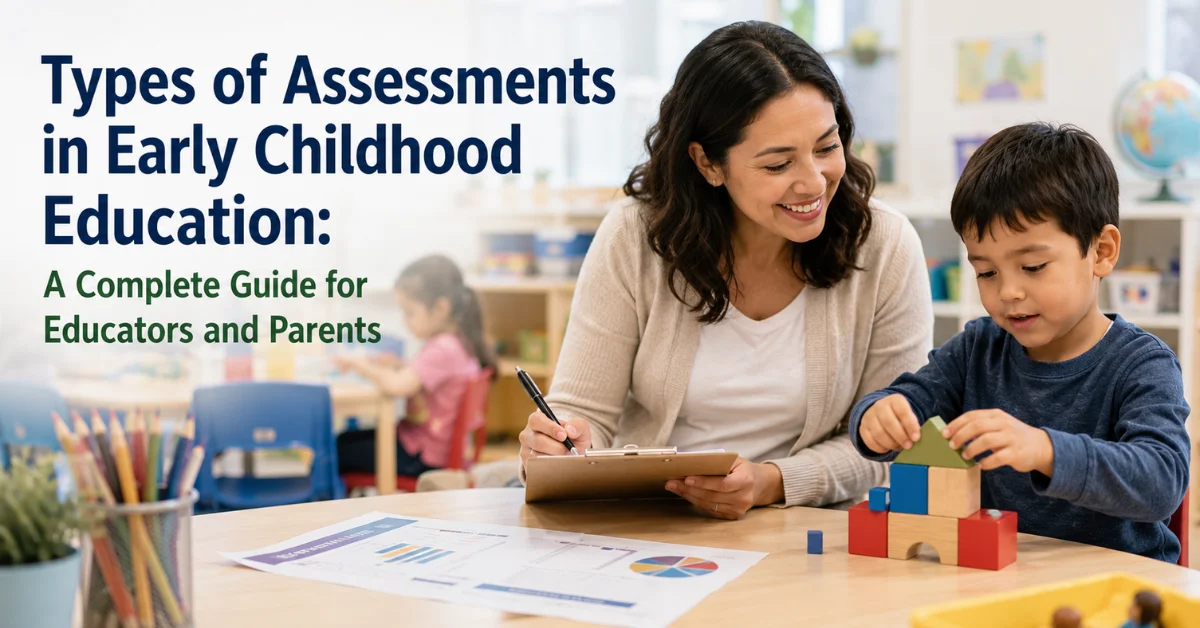
Assessment in early childhood settings is the continuous process of observing, documenting, and analyzing a child’s progress across key developmental domains including cognitive processing, speech and language acquisition, physical motor skills, and social-emotional maturity.
Unlike evaluation models used in elementary and secondary schools, early childhood assessment rarely involves formal test papers or timed quizzes. Forcing toddlers and preschoolers into artificial testing conditions often generates stress, yielding inaccurate results that fail to capture their true capabilities. Instead, meaningful evaluation occurs naturally during play, daily group routines, personal interactions, and hands-on exploration.
Effective early childhood evaluation enables educators to:
- Tailor Instructional Plans: Design classroom activities that align directly with each child’s current skill levels and emerging interests.
- Identify Early Interventions: Spot subtle signs of developmental delays or learning difficulties early, ensuring timely support.
- Enhance Family Communication: Provide parents with clear, objective evidence of their child’s growth over time.
- Evaluate Curriculum Impact: Determine whether instructional materials and classroom strategies are effectively supporting learning outcomes.
Teachers who want to deepen their professional knowledge in early learning settings can explore our detailed breakdown on professionalism in early childhood education to see how ethical practices shape classroom quality.
The Operational Framework: Formative vs. Summative Assessment
Virtually every assessment tool utilized in early childhood classrooms falls into one of two broader operational categories: Formative Assessment and Summative Assessment.
Formative Assessment
Formative assessment is an ongoing, real-time evaluation process that occurs during active learning rather than after it. It consists of the daily observations and informal notes that help an educator adjust instructional strategies immediately.
- Practical Example: A teacher observes during a math activity that several children are struggling to sort plastic blocks by color. The following morning, the teacher introduces a hands-on game sorting familiar classroom toys to reinforce the concept before introducing complex patterns.
- Core Characteristics: Informal, continuous, low-pressure for children, and designed specifically to guide short-term lesson planning.
Summative Assessment
Summative assessment occurs at pre-defined milestone intervals such as the conclusion of a unit, a semester, or a school year. It summarizes cumulative learning and milestone attainment over a specified period.
- Practical Example: At the end of the fall term, an educator compiles a progress report detailing a child’s development in letter recognition, counting accuracy, and peer collaboration compared to their baseline at enrollment.
- Core Characteristics: Periodic (quarterly or semi-annually), structured, and utilized primarily for long-term reporting to administrators and families.
Combining ongoing formative observations with periodic summative milestones gives educators a balanced, reliable framework for tracking child development.
7 Core Types of Assessments Used in Early Childhood Classrooms
Educators combine several distinct evaluation methods within their daily schedules to build a complete developmental profile for each child.
1. Observational Assessment
Observational assessment is the foundation of early childhood evaluation. Educators unobtrusively watch children during unstructured play, meal times, and group routines, recording actual behaviors as they occur naturally.
- Implementation Tools: Anecdotal logs, running records, and milestone checklists.
- Key Advantage: It is completely natural and does not disrupt play or induce performance anxiety.
2. Authentic Assessment
Authentic assessment measures skills during meaningful, real-world classroom activities rather than forced exercises. Evaluating a child’s counting ability while they distribute snack cups or watching them resolve a playground dispute provides real insight into functional skills.
For educators seeking to compare how structured learning environments execute these observational methods, reviewing our comparison of Kindercare vs other daycare centers offers helpful context on institutional standards.
3. Portfolio Assessment
A portfolio is a curated collection of a child’s work gathered over an extended period. It provides tangible evidence of developmental progression that standardized checklists cannot replicate.
- Portfolios Include: Name-writing samples, drawings, project photographs, self-portraits, and teacher observation notes.
- Modern Integration: Digital portfolio applications allow teachers to upload photo updates and audio recordings directly to parents in real time, fostering strong home-school alignment.
4. Developmental Screenings
Developmental screenings are brief, standardized checks designed to verify whether a child is reaching core milestones on schedule across physical, cognitive, and speech domains.
- Common Tools: The Ages and Stages Questionnaires (ASQ).
- Important Note: A screening is not a diagnostic tool. Its sole function is to identify whether a child requires a formal referral for comprehensive evaluation by specialized professionals.
5. Direct (Standardized) Assessment
Direct assessment uses structured, instructor-led tasks to measure specific competencies, such as asking a child to identify specific geometric shapes or point to recognized letters.
While direct assessment offers comparable benchmark data, early childhood experts recommend using it sparingly to prevent testing fatigue in young learners.
6. Play-Based and Game-Based Assessment
Play-based evaluation assesses cognitive and social development through structured games. Modern game-based tools use educational software or guided physical activities to track pattern recognition, vocabulary retention, and problem-solving skills seamlessly.
This approach allows children who experience anxiety during structured questioning to demonstrate their true abilities in an engaging environment.
7. Anecdotal Records
Anecdotal records are brief, objective narrative notes written by teachers to capture a specific event or interaction in the classroom.
- Example Note: “During block play, Liam attempted to build a tower using seven blocks. When it fell, he stated, ‘I need a wider base,’ reconstructed the structure, and successfully added eight blocks.”
These short observations provide qualitative insight into a child’s persistence, problem-solving reasoning, and emotional regulation.
To understand how educators apply similar observational standards in specialized learning environments, explore our detailed resource on the early childhood special education classroom.
Implementation Metrics Across Assessment Types
| Assessment Method | Typical Frequency | Primary Setting | Main Objective |
| Observational / Anecdotal | Daily or Weekly | Unstructured play & routines | Capturing immediate behavioral shifts |
| Portfolio Collection | Monthly compilation | Ongoing work samples | Documenting long-term skill progression |
| Developmental Screenings | 1–2 times per year | One-on-one screening | Flagging potential developmental delays |
| Summative Progress Reports | Quarterly / Semi-annually | Conference meetings | Summarizing cumulative milestone growth |
| Direct Assessment | Periodically | Structured teacher interaction | Benchmarking specific academic skills |
Adapting Assessments for Diverse Learners
Dual-Language Learners (DLLs)
Assessing children who speak a language other than English at home requires tailored strategies to avoid misidentifying language acquisition as a cognitive delay:
- Assess children in their native language whenever possible using qualified bilingual educators or interpreters.
- Evaluate total conceptual knowledge across both languages combined rather than testing English vocabulary exclusively.
Children with Special Needs
For children receiving specialized support through an Individualized Education Program (IEP):
- Conduct observations in familiar, comfortable classroom environments with familiar caregivers.
- Gather data from multiple sources including family input, teacher notes, and therapist reports to establish an accurate profile.
Frequently Asked Questions
1. What is the primary purpose of assessment in early childhood education?
The primary purpose is to identify each child’s developmental strengths, track milestone progress across cognitive and social domains, and adjust daily teaching strategies to support individual learning needs.
2. What is the most common assessment method used in preschools?
Observational assessment is the most common method because it allows teachers to record natural behavior and emerging skills during daily play without causing stress or interrupting classroom routines.
3. What is the difference between formative and summative assessment?
Formative assessment is an ongoing, informal process used daily to guide instructional choices, while summative assessment occurs at fixed intervals to measure cumulative milestone achievements over time.
4. Are formal standardized tests appropriate for preschoolers?
No. Formal standardized testing is generally discouraged for young children. Experts recommend authentic, observational, and play-based methods to evaluate learning naturally.
Summary
Effective early childhood assessment relies on a balanced, multi-faceted approach rather than a single testing tool, ensuring that daily classroom learning activities align seamlessly with fundamental physical education objectives and cognitive growth milestones.
When implemented properly, assessment ceases to be a formal testing obligation and becomes what it was always meant to be: a continuous, supportive process that honors each child’s individual growth journey.