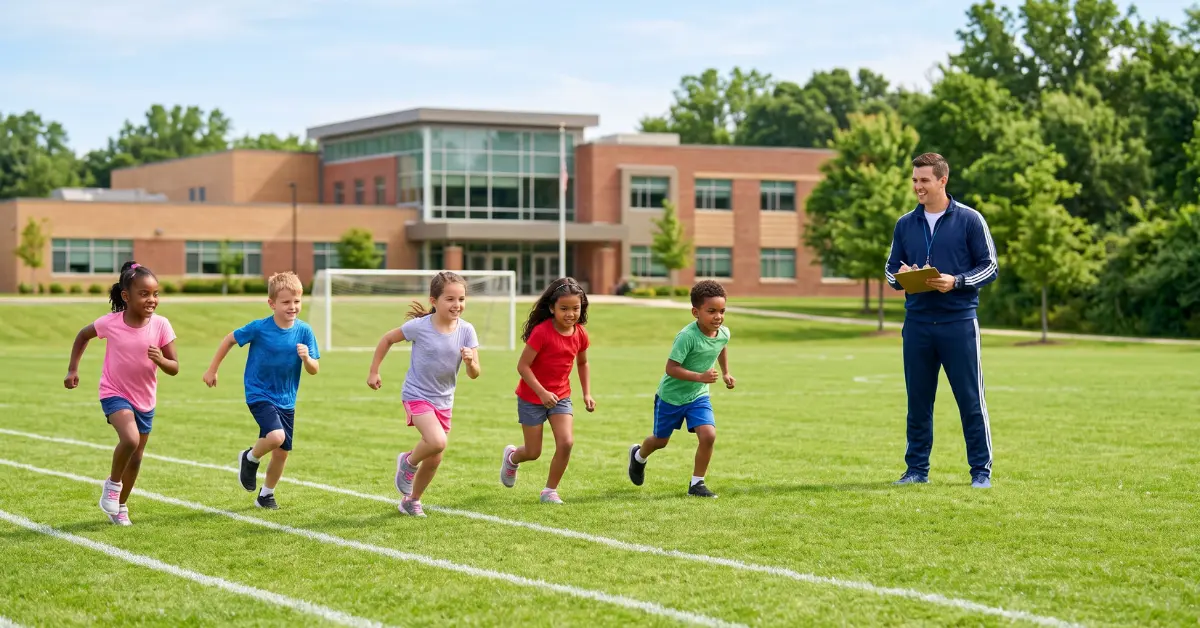
Physical education is not gym class. That distinction matters, and understanding it changes everything about how we set objectives, measure success, and defend PE’s place in the school day.
Gym class is activity time. Physical education is a discipline with defined learning objectives, national standards, measurable outcomes, and developmental progressions that span from pre-kindergarten through high school graduation. When physical education is designed and taught with clear objectives, it produces physically literate young people students who have the knowledge, skills, motivation, and confidence to be active for life.
This comprehensive guide covers the complete framework of physical education objectives including the four learning domains, the SHAPE America national standards, grade-specific goals, how objectives connect to academic performance, and practical implementation strategies to ensure every student builds long-term physical literacy and physical education objectives.
What Are Physical Education Objectives?
Physical education objectives are the specific, measurable outcomes that a PE program aims to achieve for students. They define what students should know, be able to do, and how they should feel about physical activity not just during the school years, but as a foundation for lifelong health and wellbeing.
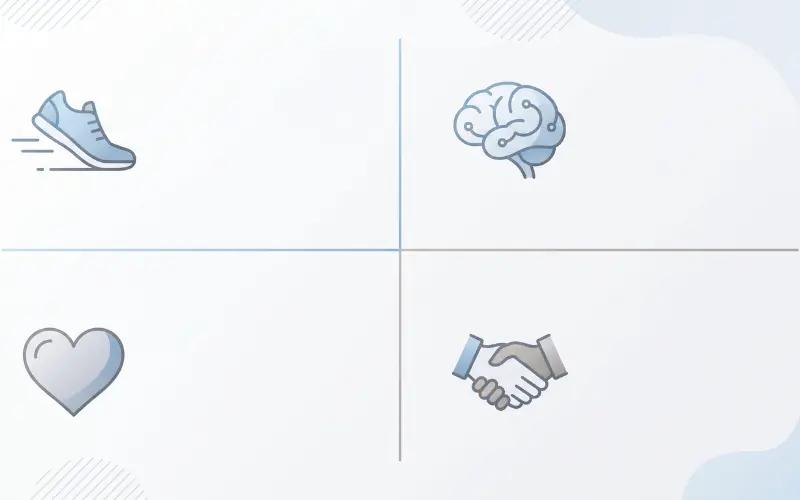
Well-designed physical education objectives address four distinct learning domains:
- Psychomotor domain: physical movement skills, motor patterns, and body control
- Cognitive domain: knowledge and understanding of movement, fitness, strategy, and health
- Affective domain: attitudes, feelings, values, and personal motivation around physical activity
- Social domain: interpersonal skills, cooperation, respect, communication, and sportsmanship
Most PE curriculum discussions focus exclusively on the psychomotor domain the physical skills students develop. This is understandable but incomplete. A student who can perform a flawless layup but hates competitive sports and never exercises outside of class has not met the full objectives of physical education. A comprehensive PE program addresses all four domains simultaneously.
The Four Objectives of Physical Education and Their Sub-Types
1. The Psychomotor Domain: Movement Skills and Physical Competence
The psychomotor domain is the foundation of physical education objectives. It covers the motor skills, movement patterns, and physical capacities that students develop through deliberate practice.
Psychomotor objectives include:
Fundamental movement skills (early childhood and elementary):
- Locomotor skills: running, jumping, skipping, galloping, hopping, leaping, and sliding
- Non-locomotor skills: balance, bending, stretching, twisting, and weight transfer
- Manipulative skills: throwing, catching, kicking, striking, dribbling, and rolling
Specialized movement skills (upper elementary and middle school):
- Sport-specific skills applied in game and activity contexts
- Combining fundamental skills in increasingly complex movement sequences
- Developing movement efficiency and control under varying conditions
Advanced movement application (high school):
- Refined sport and activity skills performed with consistency
- Tactical understanding applying skills within the strategic context of games and activities
- Personal fitness skills the ability to design and execute a personal fitness plan
The SHAPE America National Physical Education Standards identify developing a variety of motor skills (Standard 1) as the psychomotor foundation of quality PE. Psychomotor objectives are most effectively measured through authentic assessment performance tasks that demonstrate real movement competence rather than written tests.
2. The Cognitive Domain: Knowledge and Understanding
Physical education is an academic discipline with a genuine knowledge base. The cognitive domain covers what students know and understand about movement, fitness, strategy, the human body, and the role of physical activity in health.
Cognitive objectives in physical education include:
Movement concepts and principles:
- Understanding how the body moves (space, effort, relationships)
- Applying biomechanical principles to improve skill performance
- Recognizing movement patterns and analyzing their components
Fitness knowledge:
- Understanding the components of health-related fitness: cardiovascular endurance, muscular strength, muscular endurance, flexibility, and body composition
- Knowing how different types of exercise develop different fitness components
- Understanding principles of training: overload, progression, specificity, and reversibility
Rules, tactics, and strategies:
- Understanding the rules and scoring of sports and activities
- Recognizing tactical patterns in game play
- Making effective decisions in dynamic movement situations
Health literacy:
- Understanding the relationship between physical activity, nutrition, and health
- Knowing the physical and mental health benefits of regular exercise
- Understanding how to access health and fitness resources
The SHAPE America Standard 2 applies knowledge related to movement and fitness concepts — addresses the cognitive domain directly. Students who meet this standard can articulate why physical activity matters, how their body responds to exercise, and how to use that knowledge to make informed choices about their own health.
3. The Affective Domain: Attitudes, Values, and Motivation
The affective domain is perhaps the most important and least measured set of physical education objectives — and it is where most programs fall short.
You can teach a student to throw a ball accurately. You cannot force them to love throwing a ball. But you can design experiences that make physical activity feel accessible, enjoyable, meaningful, and personally relevant experiences that build the intrinsic motivation that sustains a lifetime of physical activity long after the bell rings for the last time.
Affective objectives in physical education include:
- Enjoyment and positive experiences: Creating genuine positive associations with movement the experience of mastery, the pleasure of physical exertion, the satisfaction of improving at something challenging
- Self-efficacy: Building students’ belief in their own physical competence the sense that they can move effectively, learn new skills, and participate successfully
- Personal values around health: Developing an internal understanding of why physical activity matters not compliance with an external requirement, but a personal sense of its value
- Intrinsic motivation: Shifting from extrinsic motivation (grades, teacher approval, avoiding embarrassment) to intrinsic motivation (personal challenge, enjoyment, health goals)
The SHAPE America Standard 4 develops personal skills, identifies personal benefits of movement, and chooses to engage in physical activity is the affective standard. Students who meet this standard do not merely tolerate PE. They actively choose to engage in physical activity because they understand its personal value and have built the habit and motivation to continue.
4. The Social Domain: Interpersonal Skills and Community
Physical education provides unique opportunities for social development that are difficult to replicate in any other academic setting. Team sports, cooperative games, partner activities, and group challenges all require communication, conflict resolution, leadership, followership, and respect for others.
Social objectives in physical education include:
- Cooperation and teamwork: Working effectively with others toward a shared goal including with teammates who have different skill levels, backgrounds, and perspectives
- Communication: Expressing ideas clearly in a physical context calling for the ball, encouraging teammates, giving and receiving feedback on movement
- Conflict resolution: Managing disagreements about rules, fair play, and team dynamics constructively
- Respect and inclusion: Treating all participants with dignity regardless of skill level, gender, body type, disability, or background
- Leadership: Taking initiative, organizing activities, supporting less skilled peers, and modeling positive behavior
The SHAPE America Standard 3 develops social skills through movement directly addresses this domain. Strong social objectives in PE extend far beyond sports they develop competencies that students carry into classrooms, workplaces, and communities for the rest of their lives.
The SHAPE America National Physical Education Standards
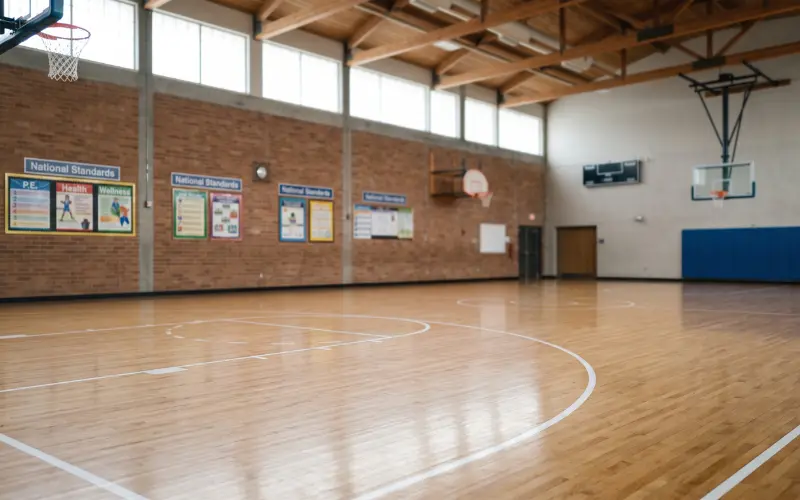
SHAPE America the Society of Health and Physical Educators is the largest organization of health and physical educators in the country, representing more than 200,000 professionals. Their National Physical Education Standards, revised in 2024 and published in the fourth edition, provide the authoritative national framework for PE objectives across pre-kindergarten through grade 12.
The four current National Physical Education Standards are:
Standard 1:
Develops a variety of motor skills. Addresses the psychomotor domain the physical skill foundation of PE.
Standard 2:
Applies knowledge related to movement and fitness concepts. Addresses the cognitive domain understanding the science and strategy of movement.
Standard 3:
Develops social skills through movement. Addresses the social domain interpersonal competence in physical activity contexts.
Standard 4:
Develops personal skills, identifies personal benefits of movement, and chooses to engage in physical activity. Addresses the affective domain motivation, values, and lifelong physical activity.
These standards span all four learning domains and collectively define what a physically literate student should know and be able to do as a result of quality physical education. The 2024 revision added explicit social domain standards alongside the original psychomotor, cognitive, and affective domains, recognizing that interpersonal skills deserve dedicated attention in PE curriculum design.
Physical Education Objectives by Grade Level!
Physical education objectives are not uniform across grades. Effective PE programs establish developmentally appropriate objectives for each grade span, building complexity and sophistication as students mature physically, cognitively, and socially.
Pre-K Through Grade 2: Building the Foundation
At this stage, the primary physical education objectives focus on:
Psychomotor:
- Mastering fundamental locomotor skills: run, jump, hop, gallop, skip, leap, and slide
- Developing body awareness and spatial orientation
- Beginning manipulative skills: rolling, catching, kicking, and striking with body parts
- Basic balance and weight transfer
Cognitive:
- Understanding basic movement vocabulary: fast/slow, high/low, forward/backward
- Recognizing body parts and their movement functions
- Beginning to connect exercise with feeling good
Affective:
- Experiencing physical activity as fun and positive
- Developing willingness to try new activities
- Beginning to understand personal effort
Social:
- Taking turns and sharing space
- Following movement directions
- Participating with peers in simple group activities
At this stage, physical education objectives prioritize breadth and positive experience over technical mastery. The goal is not perfect form — it is building confidence, exploring movement possibilities, and establishing the foundation that all future skill development depends on.
Grades 3 Through 5: Developing Competence
Upper elementary physical education objectives build on foundational movement to develop genuine competence in a range of activities:
Psychomotor:
- Combining locomotor and manipulative skills in activity contexts
- Developing mature patterns in key skills: overhand throw, catching, dribbling with hands and feet, striking with implements
- Beginning to apply skills in modified game situations
Cognitive:
- Understanding the components of health-related fitness
- Beginning to apply movement concepts to skill improvement
- Understanding basic rules and tactics in sport and activity contexts
Affective:
- Developing personal activity preferences
- Building self-efficacy in physical contexts
- Beginning to understand the connection between effort and improvement
Social:
- Working cooperatively in small groups
- Applying basic sportsmanship principles
- Giving and receiving simple feedback
Grades 6 Through 8: Refinement and Application
Middle school physical education objectives shift from developing skills to refining and applying them in increasingly realistic contexts:
Psychomotor:
- Consistent performance of specialized movement skills in activity and game contexts
- Applying skills tactically — reading the game, anticipating movement, making decisions
- Developing personal fitness skills — understanding how to improve one’s own fitness
Cognitive:
- Understanding training principles and how to apply them
- Analyzing movement for improvement
- Developing strategic understanding in sports and activities
Affective:
- Identifying personally meaningful physical activities
- Developing intrinsic motivation for participation
- Beginning to set personal fitness goals
Social:
- Demonstrating leadership in group activity contexts
- Resolving conflict independently and constructively
- Respecting and including peers of varying skill levels
Grades 9 Through 12: Independence and Lifelong Application
High school physical education objectives prepare students for a lifetime of physical activity beyond the structured school environment:
Psychomotor:
- Applying refined skills in full activity and game contexts
- Demonstrating the ability to independently execute a personal fitness program
Cognitive:
- Designing and evaluating a personal fitness plan
- Understanding the relationship between physical activity, nutrition, and long-term health
- Using health data (heart rate, fitness assessments) to inform personal training decisions
Affective:
- Demonstrating intrinsic motivation for physical activity
- Articulating personal reasons for choosing to be active
- Connecting physical activity to personal values and goals
Social:
- Demonstrating respectful, inclusive behavior in all physical activity contexts
- Taking leadership roles in group activities
- Adapting to diverse partners and activity settings
Physical Education Objectives and Academic Performance: The Evidence
One of the most important and most underused arguments for strong physical education objectives is the documented connection between physical activity and academic performance.
The evidence is clear:
- Regular physical activity during the school day is linked to higher concentration levels, more composed behavior, and improved academic performance
- Physical activity increases blood flow to the brain and promotes neuroplasticity the brain’s ability to form new connections
- Students who are more physically active show better performance in reading and mathematics
- Physical education reduces stress and anxiety, which directly improves students’ ability to focus and regulate their emotions in classroom settings
This connection means that cutting PE time to create more classroom instructional time is, paradoxically, likely to reduce academic performance rather than improve it. Strong physical education objectives are not in competition with academic objectives — they support them.
What Good Physical Education Objectives Look Like in Practice
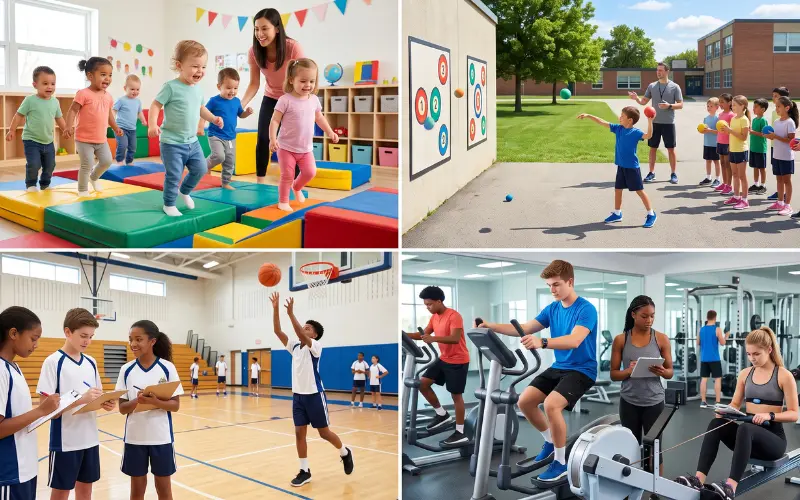
Knowing the framework is one thing. Writing and implementing effective physical education objectives is another. Here is what quality objective-setting looks like in a real PE program:
Specific and measurable:
“Students will demonstrate a mature overhand throw pattern, showing a step with the opposite foot, hip rotation, and follow-through, when throwing at a target 20 feet away” is a useful objective. “Students will learn to throw better” is not.
Developmentally appropriate:
Objectives for first graders should not look like objectives for seventh graders. Effective PE teachers understand the developmental progression of each skill and set objectives that challenge students at the right level without overwhelming them.
Addressing all four domains:
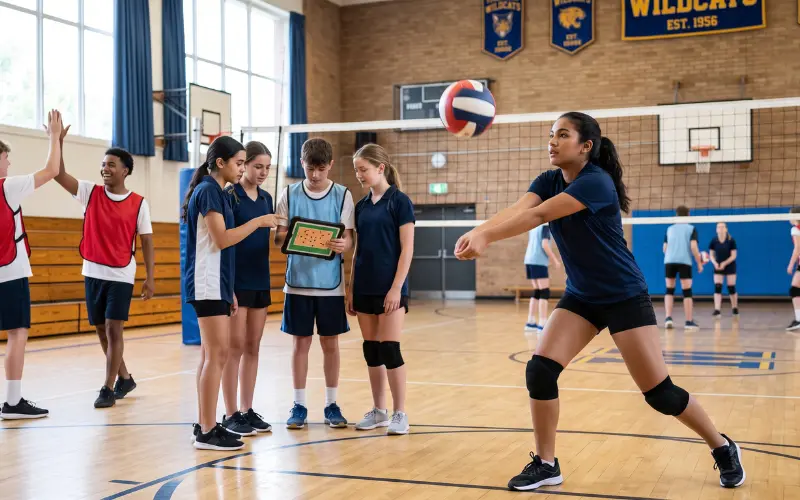
A single lesson can address all four domains simultaneously. A volleyball unit lesson might have psychomotor objectives (correct forearm pass technique), cognitive objectives (understanding when to use a forearm pass vs. an overhead pass), affective objectives (staying engaged and positive when a rally is lost), and social objectives (communicating with teammates before and during play).
Connected to assessment:
Objectives that are never assessed are wishes, not goals. Quality PE programs use authentic assessment — performance checklists, portfolio evidence, fitness assessments, peer observation, and self-assessment — to measure whether objectives are actually being met.
Real-World Classroom Scenarios: Applying PE Objectives in Practice
To move physical education objectives from paper into actual gymnasiums and schoolyards, teachers must translate high-level standards into daily classroom management. Here is how authentic objective-setting works across common school scenarios:
- Elementary School Circuit Training: Rather than telling kindergarteners to “exercise,” a practical psychomotor and cognitive objective looks like: “Students will rotate through four station zones practicing balancing, skipping, throwing, and resting while explaining to a partner which muscle group each station targets.” This builds movement competence alongside basic health literacy.
- Middle School Inclusive Game Play: When managing a diverse middle school class with varying athletic abilities, a social and affective objective ensures inclusion: “Students will modify cooperative game rules collaboratively to ensure every teammate touches the ball at least twice per possession, demonstrating positive communication and conflict resolution.”
- High School Fitness Planning: Instead of mandatory fitness testing that alienates unathletic students, high school objectives focus on personal autonomy: “Students will independently design and execute a 3-week individual conditioning log based on their personal heart-rate data and lifelong recreation goals, shifting from external compliance to intrinsic motivation.”
By grounding daily lesson plans in these specific operational scenarios, educators fulfill SHAPE America’s framework while giving students clear, achievable milestones for physical development.
Common Gaps in Physical Education Objectives
Even well-intentioned PE programs often miss these critical areas:
Affective objectives are written but never assessed
“Students will enjoy physical activity” appears on a lot of curriculum documents and is measured by almost nobody. Affective objectives require intentional assessment strategies student reflection journals, exit tickets about personal motivation, participation in non-graded activity choices.
Lifelong activity objectives are stated but not designed for
Most PE programs teach sports that require teams, facilities, equipment, and organized leagues activities that most adults cannot easily access after graduation. Strong programs also introduce lifetime activities: swimming, hiking, cycling, yoga, strength training, and recreational sports that students can genuinely continue for decades.
Inclusivity is an afterthought
Physical education objectives should apply to every student, not just the athletic ones. Objectives that assume a certain level of physical capability by design exclude students with disabilities, lower motor competence, or higher body weight the students who arguably need PE the most.
Cognitive objectives are tested, not applied
Students can often pass a fitness knowledge quiz while being entirely unable to apply that knowledge to their own health choices. Effective cognitive objectives bridge knowledge and behavior students not only know what cardiovascular endurance is but understand how to develop it in their own lives.
Frequently Asked Questions
What are the main objectives of physical education?
Physical education objectives address four learning domains: psychomotor (developing movement skills and physical competence), cognitive (building knowledge about movement, fitness, and health), affective (developing positive attitudes, values, and intrinsic motivation toward physical activity), and social (building interpersonal skills through movement). Together, these objectives develop physically literate students who have the knowledge, skills, and motivation to be active for life.
What are the SHAPE America National Physical Education Standards?
SHAPE America’s four national standards (revised 2024) define the objectives of quality PE: Standard 1 develops a variety of motor skills (psychomotor); Standard 2 applies knowledge related to movement and fitness concepts (cognitive); Standard 3 develops social skills through movement (social); Standard 4 develops personal skills, identifies personal benefits of movement, and chooses to engage in physical activity (affective). These standards apply across pre-K through grade 12.
What is the difference between PE goals and PE objectives?
Goals are broad directional statements “students will become physically literate.” Objectives are specific, measurable outcomes “students will demonstrate a mature skip pattern with a two-part rhythmic pattern and an alternating foot.” Good PE programs have both: goals provide direction, objectives provide the specific targets that let you know whether you are reaching that direction.
What is physical literacy and how does it relate to PE objectives?
Physical literacy is the overall outcome that quality physical education works toward. A physically literate person has the knowledge, skills, motivation, and confidence to value and take responsibility for being active throughout life. Physical education objectives across all four domains psychomotor, cognitive, affective, and social are the building blocks of physical literacy.
How do physical education objectives support academic performance?
Regular physical activity is linked to improved concentration, better emotional regulation, higher academic achievement in reading and mathematics, and reduced stress and anxiety. Physical education objectives that develop genuine physical activity habits in students have documented benefits for their performance across all academic areas.
What physical education objectives are appropriate for elementary students?
Elementary PE objectives focus on mastering fundamental locomotor skills (running, jumping, skipping, hopping), developing basic manipulative skills (throwing, catching, kicking), building body awareness and spatial orientation, and establishing positive, confidence-building experiences with movement. The affective and social objectives at this level emphasize fun, turn-taking, and willingness to try new activities.
How should physical education objectives be assessed?
Effective PE assessment uses authentic performance tasks rather than written tests alone. Assessment tools include performance checklists (observing specific skill criteria), fitness assessments (measuring cardiovascular endurance, flexibility, and strength), student reflection journals (measuring affective objectives), peer observation tasks (measuring social objectives), and portfolio evidence of learning over time.
What is the objective of physical education at the high school level?
High school physical education objectives shift toward independence and lifelong application. Students should be able to design and execute a personal fitness plan, apply refined skills in full activity contexts, demonstrate intrinsic motivation for physical activity, and show the knowledge and self-direction needed to remain active after the structured school PE program ends.
Q: What are the four main objectives of physical education and their sub-types?
The four core objectives are the psychomotor domain (sub-types include locomotor, non-locomotor, and manipulative skills), the cognitive domain (covering movement concepts, rules, and fitness knowledge), the affective domain (focusing on enjoyment, self-efficacy, and intrinsic motivation), and the social domain (emphasizing cooperation, communication, and respect).
Q: How do physical education objectives impact a student’s overall development?
Well-rounded PE objectives develop the whole person by building physical literacy, teaching lifelong health management habits, fostering positive social behavior, and supporting academic performance through enhanced concentration and reduced classroom stress.
Authoritative References & Research Base
To ensure alignment with national benchmarks and evidence-based educational practices, physical education frameworks draw upon major research and institutional guidelines:
- SHAPE America Standards: The Society of Health and Physical Educators (SHAPE America) outlines national benchmarks for K-12 physical literacy, emphasizing motor skills, fitness application, social development, and personal motivation in their comprehensive framework (SHAPE America National Standards).
- Academic Performance & Physical Activity: Research published by the Centers for Disease Control and Prevention (CDC) demonstrates a clear correlation between regular physical activity in schools, increased cognitive performance, and enhanced emotional regulation among students (CDC Health and Academics Research).
- Child Development & Motor Skills: Long-term studies in kinesiology and childhood development highlight that mastering fundamental motor skills during early education directly predicts lifelong physical activity adherence and lower health risks in adulthood.
Final Thoughts
Physical education objectives, when designed thoughtfully and implemented with genuine commitment, do something no other school subject does: they develop the whole person. The student who leaves a quality PE program has not just learned to play basketball or run a mile. They understand how their body works, they have tools to manage stress, they have social skills built through shared physical challenge, and most importantly they have the motivation and confidence to choose to be active for the rest of their lives.
That is a remarkable set of outcomes for any subject to claim. It is also a high standard to meet. Physical education professionals who take their objectives seriously who address all four learning domains, set measurable goals, assess honestly, and design for inclusion give their students something genuinely valuable and genuinely lasting.
The objectives matter. The planning matters. The teaching matters. And the students who experience quality physical education carry it with them far longer than any test score.