

If you have ever searched for Remote Jobs: Your Complete Guide to Working From Home, you are in the right place. The way people work has changed forever. What once seemed like a rare privilege — working from the comfort of your own home — has become one of the most sought-after career choices in the world today. Millions of people across every industry are ditching the daily commute, skipping the office politics, and building successful careers entirely on their own terms.
But here is the truth: finding and landing a great remote job is not as simple as typing “work from home” into a search bar. The remote job market is competitive, fast-moving, and filled with options that range from life-changing opportunities to outright scams. Without the right guidance, it is easy to waste weeks applying to the wrong roles, on the wrong platforms, with a resume that was never built for remote hiring.
That is exactly why this guide exists. Whether you are a complete beginner looking for your very first work-from-home role, a career changer exploring new industries, or an experienced professional ready to go fully remote — this guide walks you through everything. You will learn which industries are hiring right now, where to find legitimate remote jobs, how to write a resume that gets noticed, what remote interviews really look for, and the honest challenges of remote work that most job boards never bother to mention.
By the time you finish reading, you will have a clear, confident plan to find and land the remote job that fits your skills, your lifestyle, and your goals. Let’s get started.
What Are Remote Jobs?
Remote jobs are positions where you perform all — or most — of your work outside a traditional office. Instead of commuting to a building, you work from home, a coffee shop, a co-working space, or anywhere with a reliable internet connection.
There are three main types you’ll encounter:
- 100% fully remote — You never need to go into an office. You can live anywhere (sometimes within a specific country or time zone).
- Hybrid remote — You split your time between home and an office, usually a few days per week.
- Remote-first — The company is built around remote work as the default, but may have optional office locations.
Pro tip: Always check which type a job listing is advertising. Many listings use “remote” loosely and still expect you to live near a specific city. Look for terms like “US National,” “work from anywhere,” or “fully distributed” to confirm it’s truly location-independent.
Why Remote Jobs Are More Popular Than Ever
The remote work revolution didn’t slow down after 2020 — it accelerated. Here’s why more people and companies are embracing it:
- Workers report higher productivity at home when given the right tools and environment.
- Companies save significantly on office space, overhead, and sometimes salaries.
- The talent pool expands globally — employers can hire the best person for the job, not just the closest one.
- Employees save money, too — the average remote worker saves between $2,000 and $7,000 per year on commuting, work clothes, and lunches.
- Mental health benefits — studies consistently show remote workers report lower stress and better work-life balance when given autonomy over their schedule.
Top Industries Offering Remote Jobs Right Now
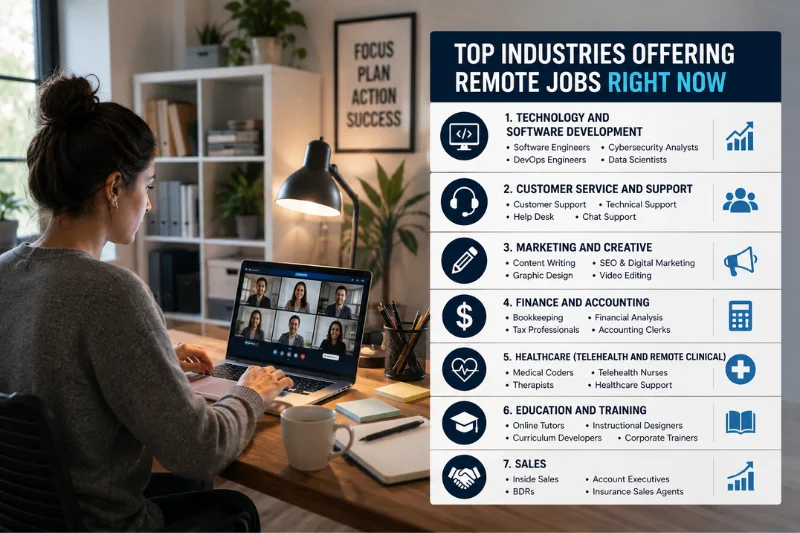
Not every field has gone remote equally. These industries lead the pack in 2026:
1. Technology and Software Development
Tech has always been the most remote-friendly industry. Roles in high demand include:
- Software engineers and full-stack developers
- DevOps and cloud infrastructure engineers
- Cybersecurity analysts
- AI/ML engineers and data scientists
- QA testers and technical support specialists
2. Customer Service and Support
Customer service is one of the largest sources of entry-level remote jobs. Companies like TTEC, Amazon, and dozens of startups hire thousands of remote agents each year for:
- Customer support representatives
- Technical support (Tier 1 and Tier 2)
- Chat and email support specialists
- Help desk coordinators
3. Marketing and Creative
Digital marketing translates naturally to remote work. Look for openings in:
- Content writing and copywriting
- SEO and digital marketing management
- Graphic design and UX/UI design
- Social media management
- Video editing and production
4. Finance and Accounting
More accounting and finance roles are going remote, especially:
- Accounts payable and receivable clerks
- Financial analysts
- Bookkeepers
- Actuarial analysts
- Tax professionals
5. Healthcare (Telehealth and Remote Clinical)
Remote healthcare is booming, particularly:
- Medical coders and billers
- Telehealth nurses and counselors
- Healthcare support assistants
- Mental health therapists (online platforms)
6. Education and Training
Online education has exploded, creating demand for:
- Online tutors and instructors
- Instructional designers
- Curriculum developers
- Corporate trainers and eLearning specialists
7. Sales
Remote sales roles are widely available across experience levels:
- Inside sales representatives
- Account executives
- Business development reps (BDRs)
- Insurance sales agents
Entry-Level Remote Jobs: Where to Start
One of the biggest gaps in most remote job guides is that they ignore beginners. If you have little or no experience, here are the most accessible entry points:
| Job Title | Typical Pay | Experience Required |
|---|---|---|
| Customer service rep | $14–$20/hr | None to minimal |
| Data entry specialist | $15–$22/hr | Basic computer skills |
| Virtual assistant | $15–$25/hr | Organizational skills |
| Social media assistant | $16–$24/hr | Personal social media use |
| Online tutor | $18–$40/hr | Subject knowledge |
| AI training generalist | $18–$25/hr | None required |
| Chat/email support | $14–$20/hr | Good written communication |
Real talk: Entry-level remote jobs are competitive. Employers receive far more applications than they would for on-site roles simply because geography isn’t a barrier. Your application needs to stand out — more on that below.
Where to Find Legitimate Remote Jobs
Skip the noise and go straight to sources that vet their listings:
Dedicated Remote Job Boards
- Remote.co — Curated listings across 20+ categories with a clear “100% remote” filter
- RemoteJobs.com — Large global database with salary data and email alerts
- Remote.com/jobs — AI-powered matching that sends relevant jobs to your profile (the most advanced platform currently available)
- We Work Remotely — Tech-heavy but high-quality listings
General Job Boards (With Remote Filters)
- Indeed — Largest volume of listings; use the “remote” location filter and search by your state or “US National”
- LinkedIn Jobs — Strong for mid-to-senior roles; follow companies you like and set job alerts
Company Career Pages
Some of the most reliable remote roles never appear on third-party boards. Check directly:
- Amazon Jobs — Remote filter available at amazon.jobs
- Capital One Careers — Remote listings at capitalonecareers.com
- Pearson Jobs — Education-sector remote roles at pearson.jobs
- TTEC — Large volume of WFH customer service roles at ttecjobs.com
Avoid These Red Flags
Not every “remote job” listing is legitimate. Watch out for:
- Roles that ask you to pay for training, equipment, or background checks upfront
- Listings with vague job descriptions and unusually high pay for entry-level tasks
- Companies with no verifiable online presence or reviews
- Requests for your bank account or Social Security number before an official offer
How to Land a Remote Job: Step-by-Step

Step 1 — Build a Remote-Ready Resume
Your resume needs to communicate that you can work independently and communicate digitally. Make sure it includes:
- Any previous remote or freelance experience (even informal work counts)
- Tools you’re proficient with: Zoom, Slack, Asana, Notion, Google Workspace, Microsoft Teams
- Clear, quantified achievements rather than vague duties (“Handled 80+ customer tickets daily with a 96% satisfaction rating” beats “Responsible for customer service”)
- A clean, ATS-friendly format — many companies use applicant tracking software before a human ever reads your resume
Step 2 — Write a Cover Letter That Addresses Remote Specifically
Most candidates send a generic cover letter. Stand out by directly addressing:
- How you manage your time and stay organized without supervision
- Your home office setup (briefly — it signals you’re ready to work)
- A past example of communicating clearly over written channels
Step 3 — Set Up Your Home Office Before You Apply
Companies want to know you’re set up to succeed. At minimum, you need:
- A reliable internet connection (25 Mbps download or faster)
- A quiet, dedicated workspace
- A working webcam and microphone for video calls
- A modern computer (most companies specify Windows or Mac requirements)
Step 4 — Prepare for Remote Interviews
Remote job interviews almost always happen over video. Prepare by:
- Testing your audio, video, and lighting at least 30 minutes before the call
- Sitting in front of a clean, neutral background or using a professional virtual background
- Making eye contact by looking at your camera lens, not the screen
- Having a backup plan (phone number for the interviewer) in case your internet drops
Step 5 — Follow Up Strategically
Send a thank-you email within 24 hours of your interview. Keep it short — three to four sentences that reaffirm your interest and reference one specific topic from the conversation. It takes two minutes and most candidates skip it entirely.
Skills That Make You a Better Remote Candidate
Regardless of your field, these skills consistently make remote workers more hireable and more successful:
- Written communication — You’ll rely on it constantly. Clear, concise written messages replace hallway conversations.
- Self-discipline and time management — No one is watching. You have to manage your own calendar and deadlines.
- Tech adaptability — Companies roll out new tools regularly. Being a fast learner matters.
- Proactive communication — Remote teams can’t see you’re stuck. Speaking up early when you hit a blocker is a valued skill.
- Problem-solving independence — Knowing when to research something yourself versus when to escalate keeps workflows smooth.
How Much Do Remote Jobs Pay?
Pay for remote jobs varies widely by industry and experience level, but remote work does not mean lower pay. In fact, many fully remote roles pay competitively with — or above — equivalent on-site positions.
General pay ranges by experience level:
- Entry level (0–2 years): $14–$35/hr depending on field
- Mid-level (3–6 years): $50,000–$100,000/year
- Senior/specialist (7+ years): $100,000–$200,000+/year in tech, finance, and product roles
Highest-paying remote job categories right now:
- Software engineering and AI/ML — $120,000–$200,000+
- Product management — $110,000–$180,000
- UX/UI design — $90,000–$150,000
- Data science and analytics — $90,000–$160,000
- Sales leadership — $100,000–$300,000+ (with commission)
- Digital marketing management — $75,000–$130,000
- Customer success management — $70,000–$120,000
What Competitors Don’t Tell You: The Real Challenges of Remote Work
Most remote job sites paint a rosy picture. Here’s what they leave out — and how to handle it.
Isolation is Real
Working from home can feel lonely, especially if you live alone or transition from a social office environment. Combat it by:
- Joining online communities in your field (Discord servers, LinkedIn groups, Reddit communities like r/remotework)
- Scheduling a virtual coffee or casual call with a coworker once a week
- Working from a library or co-working space occasionally to change scenery
“Always On” Culture is a Hidden Trap
Remote work can blur the line between work and personal time. Without a commute to signal the end of the workday, many remote workers end up working longer hours, not fewer. Set a firm end-of-day routine: close your laptop, silence work notifications, and physically leave your workspace.
Promotions Can Be Slower
Out-of-sight can mean out-of-mind when it comes to career advancement. Be intentional:
- Speak up in meetings and contribute ideas visibly
- Document your accomplishments in writing — don’t assume your manager tracks everything
- Ask for regular one-on-one check-ins to discuss your career goals
Tax and Legal Complications for International Remote Workers
If you work for a company in one country while living in another, tax implications can get complicated quickly. Consult a tax professional before accepting an international remote role. Some companies use employer-of-record (EOR) services like Remote.com to handle compliance — ask upfront how the company handles this.
Remote Jobs by Location: What to Know

United States
The US has the largest volume of remote job listings globally. States like North Carolina, Texas, Florida, and Colorado have growing remote workforces. Most US remote jobs require you to live in the US and sometimes within specific states due to payroll tax laws.
International and “Work From Anywhere” Roles
A growing number of companies — especially tech startups — hire globally. Look for listings that say “worldwide,” “anywhere,” or list multiple countries. Platforms like Remote.com specialize in connecting global job seekers with these roles.
Digital Nomad Considerations
If you plan to work remotely while traveling between countries, research digital nomad visas (available in Portugal, Spain, Germany, Costa Rica, and dozens of other countries). These give you legal working status without needing a local employer.
Quick Checklist: Are You Ready to Apply for Remote Jobs?
Use this before you hit “submit” on your next application:
- My resume highlights remote-friendly tools and independent work experience
- I have a reliable internet connection (25 Mbps+)
- I have a quiet, dedicated workspace at home
- My webcam and microphone work properly
- I’ve set up job alerts on at least two job boards
- I’ve researched the company to confirm it’s legitimate
- My cover letter mentions how I stay organized and communicate remotely
- I’m prepared to discuss my remote work setup in an interview
Frequently Asked Questions About Remote Jobs
1. What is a remote job?
A remote job is a position where you work outside a traditional office — usually from home, a co-working space, or anywhere with a reliable internet connection. You complete your tasks, attend meetings, and collaborate with your team entirely online, using tools like Zoom, Slack, and email.
2. Are remote jobs legitimate?
Yes — millions of legitimate remote jobs exist across every industry. The key is knowing where to look. Stick to verified job boards like Indeed, Remote.co, and LinkedIn, and always research the company directly on their official website and Glassdoor before applying. A legitimate employer will never ask you to pay for training, equipment, or background checks upfront.
3. What types of remote jobs are available for beginners with no experience?
Plenty of remote jobs welcome beginners. The most accessible entry-level roles include customer service representative, data entry specialist, virtual assistant, chat support agent, online tutor, and AI training generalist. Most of these require basic computer skills and strong written communication rather than formal experience or a degree.
4. How much do remote jobs pay?
Pay varies widely depending on your industry and experience level. Entry-level remote roles typically pay between $14 and $35 per hour. Mid-level positions range from $50,000 to $100,000 per year, while senior roles in tech, finance, and product management can exceed $150,000 annually. Remote work does not mean lower pay — many companies offer competitive salaries plus a home office stipend.
5. Do I need a degree to get a remote job?
Not always. Many remote jobs prioritize skills, certifications, and portfolio work over formal education. Fields like customer service, digital marketing, content writing, graphic design, and data entry regularly hire candidates without a degree. That said, roles in engineering, healthcare, finance, and law typically still require relevant qualifications.
6. What equipment do I need to work remotely?
At a minimum, you need a reliable computer, a stable internet connection of at least 25 Mbps, a working webcam, and a headset or clear microphone. Some employers provide equipment after you’re hired — always ask during the offer stage. A quiet, dedicated workspace also goes a long way in making a strong impression during video interviews and daily calls.
7. How do I find remote jobs that are truly 100% remote?
Use platforms that offer a strict “100% remote” filter, such as Remote.co and Remote.com. On general job boards like Indeed, search using “US National” or “work from anywhere” as the location. Read job descriptions carefully — watch for phrases like “must be located near [city]” or “occasional office visits required,” which signal it’s hybrid, not fully remote.
8. Can I work a remote job from another country?
It depends on the employer and the role. Some companies hire globally and use employer-of-record (EOR) services to manage international payroll and compliance. Others restrict hiring to specific countries or states due to tax laws. If you plan to work remotely while traveling abroad, look into digital nomad visas — countries like Portugal, Spain, and Costa Rica offer legal frameworks for this lifestyle.
9. How do I stand out when applying for remote jobs?
Tailor your resume to highlight remote-relevant tools (Slack, Zoom, Asana, Google Workspace) and any experience working independently. Write a cover letter that specifically addresses how you manage your time, stay organized without supervision, and communicate clearly in writing. Strong candidates also come prepared with a proper home office setup and test their tech before every video interview.
10. What are the biggest challenges of working remotely — and how do I handle them?
The three most common challenges are isolation, overworking, and slower career visibility. Combat isolation by joining online communities in your field and scheduling occasional virtual coffee chats with teammates. Prevent overworking by setting a firm end-of-day routine and silencing work notifications after hours. Stay visible for promotions by speaking up in meetings, documenting your achievements in writing, and requesting regular one-on-one check-ins with your manager.
Final Thoughts
Remote jobs have opened up a world of career opportunities that didn’t exist a decade ago. Whether you’re looking for flexibility, better pay, or simply the freedom to work from wherever you feel most productive, the remote job market has options for nearly every skill set and experience level.
The key is being intentional — applying strategically, preparing thoroughly, and understanding the real trade-offs of remote work alongside its very real benefits.
Start with one job board, set up your alerts, polish your resume with the tips in this guide, and take that first step. Your next career move might be closer than you think — and it doesn’t require a commute.