

If you’ve been searching for amazon remote jobs, you’ve probably run into the same problem most people do — job boards that list outdated postings, vague search results, or pages that tell you to “visit a fulfillment center near you.” That’s not what you’re looking for.
This guide cuts through the noise. Whether you want a customer service role you can do from your living room, a corporate position with a six-figure salary, or simply want to understand which amazon remote jobs are truly work-from-home and which require office attendance, you’ll find real, actionable answers here.
From entry-level customer service opportunities to high-paying AWS and corporate careers, this guide covers everything you need to know about finding, applying for, and succeeding in amazon remote jobs.
Are Amazon Remote Jobs Real? (Short Answer: Yes, But It Depends on the Role)
Amazon employs over 1.5 million people globally, and while the majority of those roles are warehouse and logistics positions that require physical presence, a meaningful portion of corporate, tech, and customer service roles are fully remote or hybrid.
Here’s the honest breakdown:
Truly remote: Customer service associate (virtual/WFH), software development engineer, certain AWS roles, account executives, HR and finance roles, legal, and various corporate positions.
Hybrid (remote + office): Most managerial and team lead roles, some product and marketing positions.
On-site only: Fulfillment center associates, delivery drivers, warehouse supervisors, and most hourly operations roles.
The confusion arises because Amazon has two separate hiring portals targeting different audiences — and most job seekers don’t know which one to use for remote work.
Amazon’s Two Hiring Portals — Which One to Use
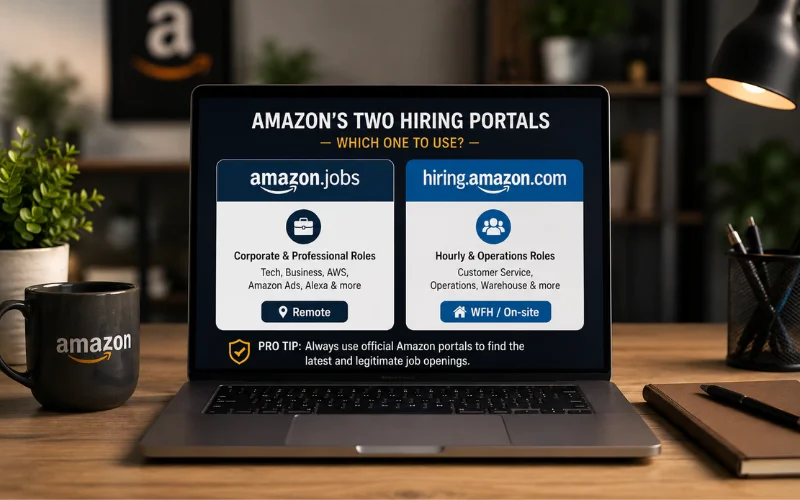
1. amazon.jobs — This is Amazon’s primary corporate job portal. It covers all salaried and professional roles across Amazon, AWS, Amazon Ads, Alexa, and more. If you’re looking for remote tech, business, or corporate positions, this is where you go. You can filter directly by “Remote” under Location.
2. hiring.amazon.com — This portal focuses exclusively on hourly, operations, and customer service roles. It’s the right place to find work-from-home customer service positions, but it also heavily promotes on-site warehouse jobs. Don’t get confused by the WFH filter — it only applies to select customer service roles.
Pro tip: Always go directly to these official portals rather than relying on third-party job boards. Listings on Indeed, LinkedIn, and similar sites are frequently outdated or scraped from Amazon’s own feed, which means you may be reading a posting that’s already been filled.
Types of Amazon Remote Jobs
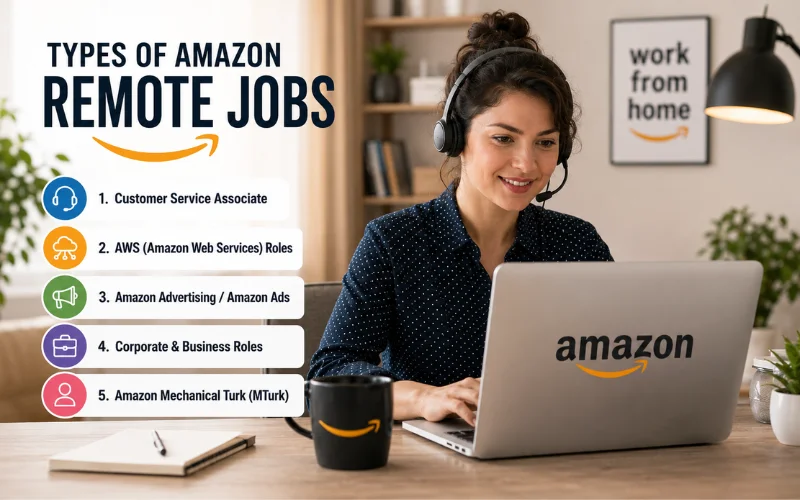
1. Customer Service Associate (Virtual/Work from Home)
This is the most accessible Amazon remote job for most people. As a virtual customer service associate, you handle customer contacts via phone, chat, and email — solving order issues, processing refunds, answering questions about products, and troubleshooting digital services like Kindle or Prime.
What to know:
- Pay typically ranges from $15–$18/hour depending on location, with some markets higher
- Amazon provides equipment (laptop and peripherals) in most cases — you don’t need to buy your own
- You must have a dedicated, quiet workspace and a reliable internet connection (generally 10 Mbps or higher download speed)
- Schedules vary and can include evenings and weekends — flexibility is required
- Most WFH customer service roles in the US are listed under Amazon’s “Virtual Locations” filter
- Seasonal openings (especially October through January) are significantly higher than the rest of the year
Skills needed: Strong written and verbal communication, patience, ability to navigate multiple systems simultaneously. No prior Amazon experience is required.
2. AWS (Amazon Web Services) Roles
AWS is Amazon’s cloud computing division, and it’s one of the most remote-friendly parts of the company. AWS has tens of thousands of employees, many of whom work fully remotely in roles like:
- Cloud Support Engineer
- Solutions Architect
- Technical Account Manager
- DevOps Engineer
- Security Engineer
- Product Manager (Technical)
These roles pay significantly more — $120,000 to $250,000+ for senior technical positions — and typically require relevant certifications or experience. AWS actively recruits globally, and many positions are “Virtual — United States” or “Remote — EMEA.”
Where to search: Go to amazon.jobs and filter by “Amazon Web Services” under Teams and “Remote” under Locations.
3. Amazon Advertising / Amazon Ads
Amazon Ads has been growing rapidly as a business unit, and many of its commercial and sales roles are remote. Account Executive positions, for example, are often listed as fully remote in the US and pay $89,000–$156,000 base salary plus RSUs and commissions.
These roles require prior B2B sales or digital advertising experience, and the interview process is rigorous (more on that below).
4. Corporate and Business Roles
Amazon hires remotely for a wide range of business functions including:
- Finance and Accounting
- Human Resources
- Legal and Compliance
- Marketing and Brand Management
- Operations and Supply Chain (analytics/strategy roles)
- Project and Program Management
The catch: Amazon has pushed for more in-office presence in its corporate workforce, with a return-to-office mandate affecting many US-based corporate employees. That said, many roles outside of Seattle, New York, and other hub cities remain de facto remote, and job postings will specify if a role is remote-eligible.
5. Amazon Mechanical Turk (MTurk) — Supplemental Income, Not a Full-Time Job
MTurk is Amazon’s crowdsourcing marketplace where independent workers complete small tasks (called HITs — Human Intelligence Tasks) for small payments. It’s legitimate and flexible, but it is not a full-time remote job. Most workers earn $2–$6/hour on average, making it suitable only as a minor income supplement.
Where to Find Amazon Remote Jobs: Step-by-Step
Step 1: Go to amazon.jobs
Visit amazon.jobs and click “Search jobs.”
Step 2: Set your filters
- Location: Type “Remote” or “Virtual” in the location field
- Job Category: Choose “Customer Service” for WFH hourly roles, or browse by department for corporate/tech
- Team: Filter by AWS, Amazon Ads, Finance, etc. based on your background
Step 3: Set up job alerts
Create a free account at amazon.jobs to receive email alerts when new remote positions matching your criteria are posted. This is essential because popular remote roles — especially customer service — fill quickly.
Step 4: Cross-check on hiring.amazon.com for hourly WFH roles
If you’re interested in customer service or hourly work, also check hiring.amazon.com and filter by “Work from Home” under Job Type.
Amazon’s Hiring Process for Remote Jobs

Understanding the process removes a lot of anxiety. Here’s what to expect:
1. Online Application
Submit through the official portal. For hourly roles, the application is short (15–20 minutes). For corporate and tech roles, you’ll typically submit a resume and answer a few screening questions.
2. Online Assessments
Most customer service applicants are asked to complete a WorkStyle assessment and a Virtual Job Tryout — a simulation of actual job tasks. These are not pass/fail in the traditional sense but help match you to roles. Take them seriously.
3. Phone or Video Interview
Corporate and tech roles involve one or more interviews via Amazon Chime (their internal video conferencing tool). For hourly remote roles, there may be a brief phone screen.
4. Amazon’s Leadership Principles Interview
This is critical for any non-hourly role. Amazon interviewers use behavioral questions heavily structured around Amazon’s 16 Leadership Principles (Customer Obsession, Ownership, Invent and Simplify, etc.). You must prepare using the STAR method (Situation, Task, Action, Result) with specific, detailed stories from your professional history.
For remote roles, they’ll also typically ask:
- How you manage your time and productivity independently
- How you handle technical issues (internet outages, equipment problems)
- How you stay connected with a distributed team
5. Background Check and Offer
Amazon runs background checks for all hires. For customer service WFH roles, they also verify that your home workspace meets their requirements.
What Amazon Pays for Remote Roles
| Role | Salary Range |
|---|---|
| Virtual Customer Service Associate | $15–$18/hour |
| Technical Customer Support (AWS) | $25–$35/hour |
| Cloud Support Engineer (AWS) | $90,000–$130,000/year |
| Solutions Architect (AWS) | $130,000–$200,000/year |
| Account Executive (Amazon Ads) | $89,000–$156,000/year + RSU |
| Software Development Engineer II | $155,000–$220,000/year + RSU |
| Senior Program Manager | $120,000–$175,000/year + RSU |
| HR Business Partner | $80,000–$130,000/year |
Amazon compensation also includes Restricted Stock Units (RSUs) for salaried roles, which vest over four years with a heavier allocation in years three and four. Total compensation for mid-to-senior tech roles frequently exceeds $250,000–$400,000 when stock is included.
Benefits for Amazon Remote Employees
Full-time Amazon remote employees receive the same benefits package as on-site workers:
- Medical, dental, and vision insurance (available from day one for hourly workers, after 90 days in some cases)
- 401(k) with Amazon matching
- Paid time off and paid holidays
- Parental leave (up to 20 weeks for birth parents in corporate roles)
- Employee discount on Amazon.com
- Life and disability insurance
- Mental health support through an Employee Assistance Program (EAP)
For WFH customer service associates, Amazon typically ships a work laptop and headset to your home before your start date. You are responsible for your own internet connection and ensuring your workspace meets their requirements.
The Reality of Working Remotely for Amazon

Before you apply, it helps to know what people who have actually worked these jobs experience day to day.
- Virtual customer service roles are structured, monitored, and metrics-driven. Expect regular quality checks, handle time targets, and schedule adherence tracking. Amazon’s WFH CS teams operate much like an office — just without the commute. Some people thrive in this environment; others find it isolating without the social element of a physical workplace.
- Corporate remote roles can feel more autonomous, but Amazon’s culture of written communication (they famously use six-page narrative memos instead of PowerPoint decks), data-driven decision-making, and high accountability doesn’t become easier just because you’re remote. In many ways, remote corporate work at Amazon requires more discipline and self-direction than an average company.
- AWS technical roles remote work is well-established and normalized. AWS is built on distributed teams, global collaboration, and async communication, which makes remote work feel natural.
Common Mistakes to Avoid When Applying
1. Applying through unofficial sites
Dozens of sites impersonate Amazon’s hiring page or aggregate outdated postings. If you’re not applying on amazon.jobs or hiring.amazon.com, verify the source carefully.
2. Not tailoring your application
Amazon’s applicant tracking system scores resumes for keyword relevance. Read the job description carefully and incorporate relevant terms and skills into your resume naturally.
3. Skipping Leadership Principles prep
This single mistake eliminates more candidates than anything else at the corporate level. Amazon interviewers are specifically trained to evaluate you against these principles. One good story per principle, ready to go, makes an enormous difference.
4. Not having your tech setup ready
For WFH customer service roles, Amazon may ask you to confirm your internet speed, browser compatibility, and workspace setup early in the process. Have this ready before you apply.
5. Applying only once
If you don’t get an offer, you can reapply after six months. Many people get hired on their second or third attempt after improving their interview skills.
Frequently Asked Questions amazon remote jobs
1. Are amazon remote jobs available for beginners?
Yes. Many entry-level customer service and support positions require little to no previous Amazon experience. Strong communication skills and a reliable internet connection are often the main requirements.
2. Where can I find legitimate amazon remote jobs?
The safest places are Amazon’s official career portals, including amazon.jobs for corporate roles and hiring.amazon.com for hourly and customer service opportunities.
3. Do amazon remote jobs provide equipment?
For many work-from-home customer service positions, Amazon provides a company laptop and necessary peripherals. Requirements can vary by role and location.
4. How much do amazon remote jobs pay?
Pay depends on the position. Entry-level customer service roles often pay hourly rates, while AWS, software engineering, and management positions can offer six-figure salaries plus stock compensation.
5. Can I work remotely for Amazon from outside the United States?
Yes. Amazon hires remote employees in several countries, including India, the UK, South Africa, and the Philippines. Availability depends on local hiring needs.
6. What skills are most important for amazon remote jobs?
Communication, problem-solving, time management, computer proficiency, and the ability to work independently are valuable across most remote roles.
7. Are amazon remote jobs fully remote or hybrid?
Both options exist. Some positions are permanently remote, while others require occasional office visits or follow a hybrid schedule.
8. How long does it take to get hired for amazon remote jobs?
Customer service roles may take one to three weeks, while corporate and technical positions often require multiple interviews and can take several weeks to complete.
9. Do amazon remote jobs offer benefits?
Full-time employees typically receive benefits such as health insurance, paid time off, retirement plans, parental leave, and employee discounts.
10. Is Amazon Mechanical Turk considered one of the amazon remote jobs?
Not really. MTurk is a freelance task platform rather than a traditional remote job, and most workers use it as supplemental income rather than full-time employment.
Final Thoughts
amazon remote jobs offer opportunities across customer service, technology, AWS, sales, finance, HR, and many other fields. Whether you’re searching for an entry-level work-from-home position or a high-paying remote corporate role, the key is to focus on Amazon’s official job portals, tailor your application to the role, and prepare thoroughly for the interview process.
With new amazon remote jobs posted regularly, setting up job alerts and checking openings consistently can significantly improve your chances of landing the right opportunity. If you have the required skills, a professional home workspace, and a well-prepared application, amazon remote jobs can provide excellent career growth, competitive compensation, and the flexibility of working from home.