
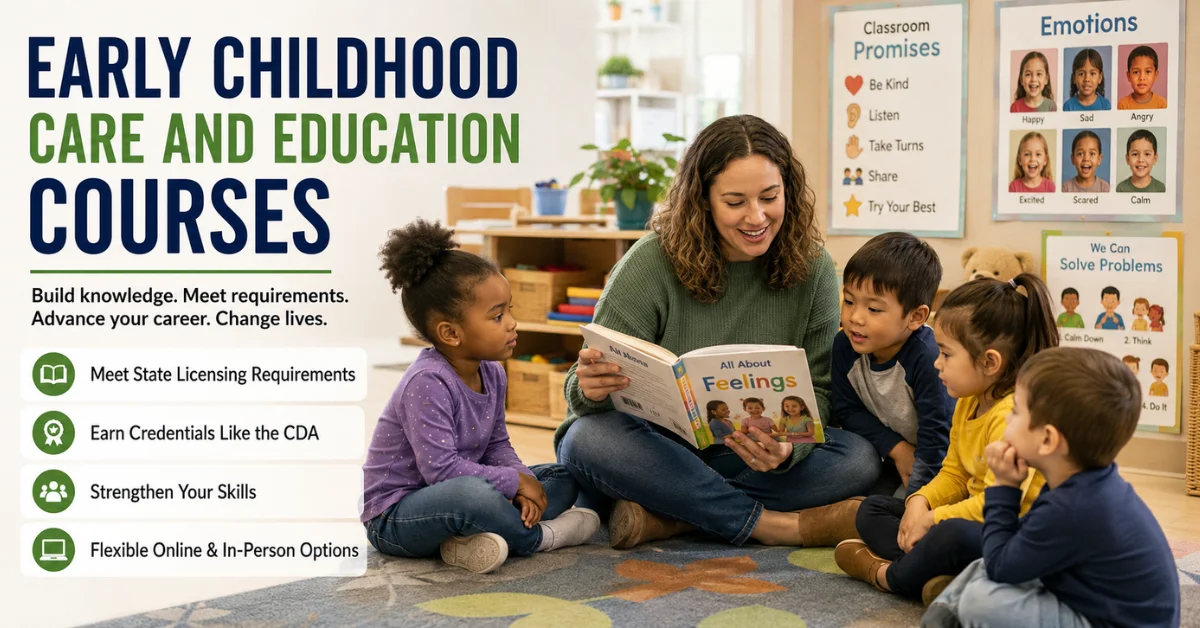
If you’re researching Early Childhood care and Education Courses, you’ve probably discovered that the field can be surprisingly confusing. Some courses satisfy state licensing requirements, some count toward professional credentials like the CDA, and others simply provide valuable professional development without meeting formal requirements. Understanding the difference is essential before investing your time and money.
Whether you’re a preschool teacher completing annual training hours, a family childcare provider working toward a credential, or a center director building a staff development plan, this guide explains how Early Childhood care and Education Courses work, which credentials matter most, how licensing requirements vary by state, and how to choose training that supports your long-term career goals. Through this comprehensive overview of Early Childhood care and Education Courses, you’ll learn how to select training that meets current requirements while supporting your future career advancement.
What “Early Childhood Care and Education Courses” Actually Covers
Early childhood education (ECE) is a broad field, and the training landscape reflects that. Early Childhood care and Education Courses generally refer to structured professional learning designed for educators and caregivers working with children from birth through age eight, including infant/toddler care, preschool, pre-K, kindergarten, and family childcare settings.
These courses typically serve three main purposes:
1. State licensing compliance
Training required to maintain childcare licenses or registrations, usually through state-approved providers.
2. Credential preparation
Early Childhood care and Education Courses that support credentials such as the CDA, FCCPC, or an associate/bachelor’s degree in early childhood education.
3. Professional development
Specialized training that helps educators strengthen skills in areas such as trauma-informed care, autism inclusion, dual language learning, and leadership.
Understanding which type of Early Childhood care and Education Courses you need before enrolling can save both time and money while helping you reach your professional goals.
The Major Types of ECE Courses Available

Online Self-Paced Courses
The most popular format for working educators. You log in when you have time — during nap time, on weekends, after the kids go home — and work through modules at your own speed. Most platforms allow you to start and stop freely, saving your progress.
These work best for: annual CEU requirements, topic-specific professional development, and CDA training hours.
What to verify before enrolling:
- Is the provider approved in your state?
- Does the course award CEUs (Continuing Education Units) or just a certificate of completion? These are not the same thing.
- Will the certificate upload to your state’s professional development registry?
Instructor-Led Online (Zoom/Virtual Classroom)
Live training sessions conducted via video conference. These offer real-time interaction with an instructor and peers, which matters for topics that benefit from discussion — like behavior guidance, family communication, or reflective supervision.
Some states give different weight to live training vs. self-paced modules, so check your state’s specifics.
In-Person / On-Site Training
Workshops, seminars, and on-site training delivered at childcare centers or community venues. First Aid/CPR certification almost always requires an in-person component. Some states also require at least a portion of annual training hours to be completed in person.
College Courses (Credit-Bearing)
Courses taken through a community college or university that count toward an associate or bachelor’s degree in ECE. These are longer, more rigorous, and more expensive — but they’re the pathway to higher pay, director qualifications, and public school teaching positions. They also satisfy CDA training requirements.
Free Online Courses with Certificates
A growing number of free courses are available through government agencies, nonprofits, and training platforms. These range from one-hour introductions to five-hour deep dives on topics like trauma-informed care or child development milestones. Some award CEUs; others award certificates only.
We cover the best free options in detail further below.
Understanding CEUs vs. Clock Hours vs. Credit Hours
This is where most educators get confused, and it matters.
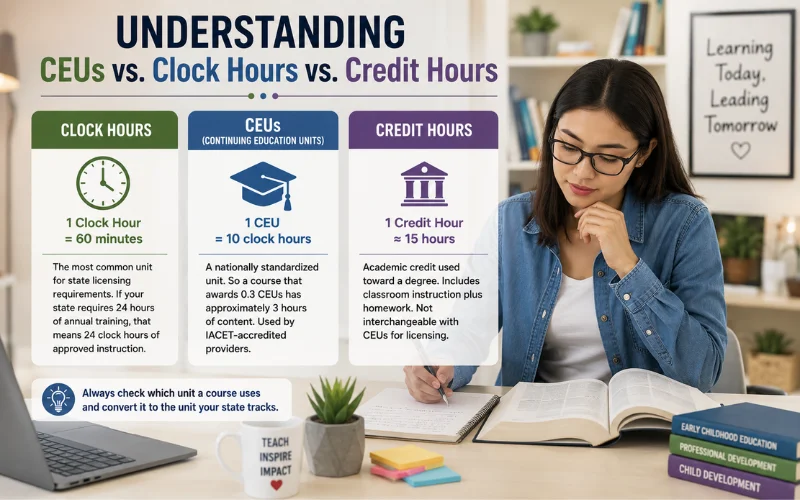
- Clock hours (also called contact hours or training hours): One clock hour = 60 minutes of instruction. This is the most common unit for state licensing requirements. If your state requires 24 hours of annual training, that means 24 clock hours of approved instruction.
- CEUs (Continuing Education Units): A nationally standardized unit. One CEU = 10 clock hours of instruction. So a course that awards 0.3 CEUs has approximately 3 hours of content. This is the standard used by IACET-accredited providers, which is a mark of quality to look for.
- College credit hours: Academic credit used toward a degree. One college credit hour typically represents about 15 hours of classroom instruction plus homework. These are not interchangeable with CEUs for licensing purposes, though your state may count degree coursework toward training requirements.
When you see a course listing, always note which unit it uses and convert to the unit your state tracks.
Core Subject Areas in Early Childhood Education Training
Quality ECE training covers eight recognized content areas. These are aligned with what the Council for Professional Recognition uses for CDA credentialing, and most states organize their training requirements around similar domains:
1. Planning a safe, healthy learning environment
child-proofing, outdoor safety, nutrition, allergy management, illness policies, and emergency preparedness.
2. Advancing children’s physical and intellectual development
age-appropriate activities, learning through play, STEM for early learners, and supporting cognitive development.
3. Supporting children’s social and emotional development
attachment theory in practice, emotion coaching, building self-regulation skills, and preventing challenging behaviors before they start.
4. Building productive relationships with families
communication strategies, family engagement, culturally responsive practices, and working with families experiencing stress.
5. Managing an effective program operation
record-keeping, staff supervision, licensing compliance, budgeting basics for directors, and program quality improvement.
6. Maintaining a commitment to professionalism
ethics in early childhood education, advocacy, professional boundaries, and career development.
7. Observing and recording children’s behavior
documentation, portfolio development, using observations to plan curriculum, and communicating progress to families.
8. Understanding principles of child development and learning
developmentally appropriate practice (DAP), theories from Piaget, Vygotsky, and Erikson applied to real classroom situations.
Most states require training hours to be distributed across multiple content areas rather than concentrated in one — another reason to plan your training year intentionally rather than grabbing whatever’s available.
CDA Credential Training: What It Is and How to Get It
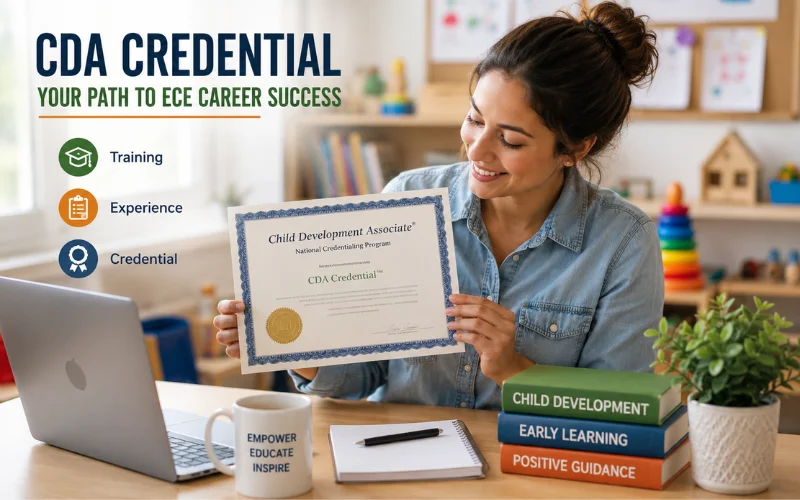
The Child Development Associate (CDA) credential is the most widely recognized entry-level credential in early childhood education. It’s issued by the Council for Professional Recognition and is accepted in all 50 states as evidence of professional competency.
Who Should Pursue a CDA?
- Anyone working in a Head Start or Early Head Start program (federally required for lead teachers)
- Educators who want to advance from assistant to lead teacher
- Family childcare providers looking to improve their business viability
- Anyone who needs a credential to meet state-specific quality rating system (QRIS) requirements
CDA Requirements at a Glance
- Minimum age: 18 years old
- High school diploma or equivalent (GED)
- 120 hours of formal childcare education covering all eight CDA subject areas (at least 10 hours per area)
- 480 hours of professional experience working with children in the relevant age group within the past 5 years
- A completed professional portfolio
- A Family Questionnaire with completed responses from the families you serve
- A formal Verification Visit by a CDA Professional Development Specialist
- Passing the CDA Exam (multiple choice, 65 questions)
The 120 training hours are the part most educators focus on — and where most online ECE courses play a role. You can mix and match courses from multiple approved providers to reach the 120-hour total, as long as all subject areas are adequately covered.
CDA Specialization Tracks
The CDA comes in four types based on the setting you work in:
- Preschool CDA — for those working with children ages 3–5 in center-based settings
- Infant-Toddler CDA — for those working with children birth to age 3
- Family Child Care CDA — for home-based childcare providers
- Home Visitor CDA — for professionals who visit families in their homes
You must choose the track that matches your current work setting. The training content and portfolio requirements are slightly different for each.
CDA Renewal
CDA credentials must be renewed every three years. Renewal requires 45 clock hours of professional development (with at least 25 hours in a formal ECE setting), a renewal application, and an updated family questionnaire. You do not need to retake the exam.
Important: The renewal process must be initiated before your credential expires. If it lapses, you may need to go through initial credentialing again, which is significantly more time and money.
State Licensing Requirements: Why They Vary So Much
One of the most challenging aspects of Early Childhood care and Education Courses is that training requirements vary significantly from state to state. There is no national standard for the number of training hours required, the topics that must be covered, or the providers approved to deliver training.
In general:
- Annual training requirements can range from as little as 6–12 hours in some states to 30+ hours for certain childcare roles.
- Most states require training in health and safety and child abuse recognition, while other mandatory topics vary by state.
- Approval rules for Early Childhood care and Education Courses also differ. Some states maintain official lists of approved providers, while others accept courses from accredited organizations such as IACET.
Because requirements vary so widely, it’s important to verify that your Early Childhood care and Education Courses meet your state’s licensing and registry requirements before enrolling.
How to Find Your State’s Specific Requirements
The single most reliable source is your state’s childcare licensing agency. Common names include Department of Children and Families, Office of Child Care, Department of Health and Human Services, or similar. Search “[your state] childcare licensing training requirements” and go directly to the official .gov site.
Many states also have a professional development registry — an online system where you create a profile, log your training, and track your hours. Examples include:
- Ohio Professional Registry (OPR)
- Florida’s TRAINING Transcript System (via the Florida Children’s Forum)
- California’s Early Educator Central (CARES Plus registry)
- Illinois Gateways to Opportunity Registry
- Texas Child Care Training registry (Texas Rising Star)
If your state has a registry, register early. Many training providers will upload your certificates directly once you give them your registry ID number.
How to Choose the Right ECE Training Provider
Not all training platforms are equal. Here’s what to look at before enrolling anywhere:
Accreditation
Look for providers accredited by IACET (International Accreditors for Continuing Education and Training). IACET accreditation means the provider meets rigorous standards for course development, instruction, and assessment. It’s the gold standard in the continuing education space.
CDA Council Partnership
If you’re pursuing a CDA, look for providers listed as partners of the Council for Professional Recognition. This doesn’t guarantee quality but does confirm the training will count toward credentialing.
State approval
Verify directly with the provider that their courses are approved in your state before purchasing. Good providers will have a state-by-state page on their website showing approval status. If they can’t tell you clearly, move on.
Course content quality
A well-designed course will have clear learning objectives, interactive elements (not just reading and a quiz), references to current research, and practical application to real classroom situations.
Support access
Especially important for CDA candidates, who often need help navigating the portfolio and credentialing process. Some providers offer education coaches; others offer unlimited email support. Know what you’re getting.
Certificate delivery
How quickly will you receive your certificate? Can the provider upload it directly to your state registry? Can you access it again if you lose it?
Best Free Early Childhood Education Courses (With Certificates)
Several high-quality free courses are worth knowing about, whether you’re building toward your annual hours or exploring a new topic:
Trauma-Informed Care and the Pyramid Model (ProSolutions Training)
5 hours, 0.50 CEUs. Covers how adverse childhood experiences affect behavior and learning, and how to support affected children within the pyramid model framework. Genuinely useful content, not just compliance box-checking.
Recognizing and Reporting Child Abuse (ProSolutions Training)
2 hours, 0.20 CEUs. Every state requires training in this area. This course covers signs of physical, emotional, and sexual abuse, legal reporting obligations, and how to document concerns appropriately.
Watch Me! Celebrating Milestones and Sharing Concerns (CDC)
approximately 1 hour, 0.1 CEUs (requires 80% on post-test). Developed by the Centers for Disease Control, this teaches developmental milestone monitoring and how to have supportive conversations with families when concerns arise.
Pediatric First Aid (First Aid for Free)
self-guided, free certificate. Covers infant and child CPR, choking response, and common pediatric medical emergencies. Note: most states require hands-on First Aid/CPR certification from an approved provider in addition to online modules — this doesn’t replace that, but it’s excellent supplemental knowledge.
Obesity Prevention: One Step at a Time (Bright Futures)
1 hour, 1 CE hour (state-dependent). Three modules covering physical activity requirements, movement promotion, and family engagement around healthy habits.
Playing Outdoors (Care Courses)
1 hour, 0.1 CEUs. A practical look at outdoor play environments, safety considerations, and the developmental benefits of time outside across all weather conditions.
Working with Students with Special Educational Needs (Alison/Global Text Project)
approximately 3 hours, free PDF certificate. Covers common disabilities in early childhood settings, differentiated support strategies, and the role of educators in the IEP process.
Important note on free courses and state licensing: Free certificates don’t automatically count toward your state’s annual training requirement. Always verify with your state licensing agency that a specific free course counts before relying on it. Some states accept free courses from approved providers; others require paid or registry-verified training.
Building Your Annual Training Plan: A Practical Approach
Most educators approach professional development reactively — they grab whatever’s available when a deadline looms. A more strategic approach saves money, reduces stress, and builds genuinely useful knowledge.
Here’s how to plan your training year intentionally:
Step 1: Know your number
Find out exactly how many training hours your state requires and in which content areas. Write it down.
Step 2: Audit what you already have
Log in to your state registry and review your current transcript. You may have hours from previous years that don’t expire, depending on your state’s rules.
Step 3: Identify mandatory topics first
Fill your state-required topic areas (typically health/safety, child abuse recognition) before choosing electives. These are non-negotiable and sometimes have to come from specific approved providers.
Step 4: Choose development areas that serve your current challenges
If you have a child with significant behavioral challenges in your class, prioritize training in positive guidance or social-emotional development. If you have a high percentage of dual-language learners, prioritize language acquisition and culturally responsive practice. Connect training to your actual work.
Step 5: Space it out
Trying to complete 24 hours of training in the last two weeks before your license renewal is miserable and ineffective. Two to three hours of training per month is much more manageable and actually leads to learning.
Step 6: Keep your certificates
Save every certificate digitally in a dedicated folder — email, cloud storage, or both. Upload to your registry immediately upon completion. If a provider takes time to upload, follow up within two weeks.
ECE Courses for Center Directors
Running a childcare center requires a different set of skills than working directly with children, and the training landscape reflects that — though less comprehensively than it should. Many Early Childhood care and Education Courses are specifically designed to help directors build the leadership, compliance, and operational skills needed to run a successful program.
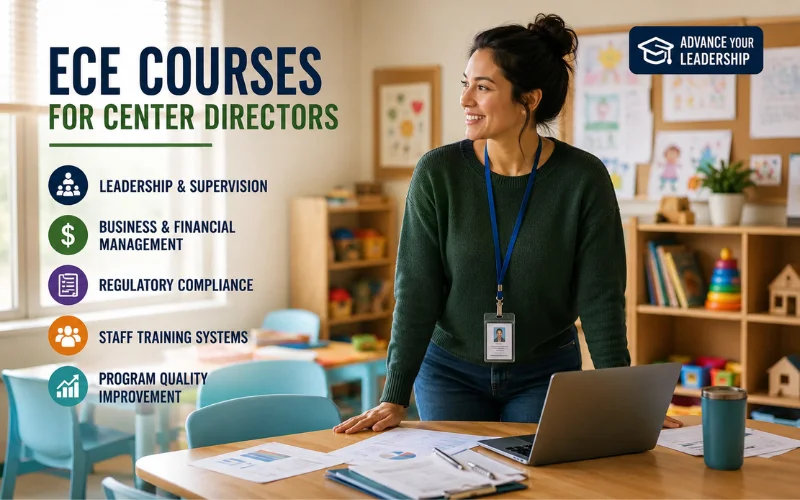
Directors typically need training in:
- Leadership and supervision — coaching staff rather than evaluating them, having difficult conversations, building a team culture, and reducing turnover (a persistent crisis in the ECE field).
- Business and financial management — understanding your program’s cost per child, setting tuition rates that are both competitive and sustainable, managing payroll and benefits, and navigating subsidy reimbursement systems like CCAP (Child Care Assistance Program).
- Regulatory compliance — staying current on licensing regulations, conducting internal compliance checks before formal inspections, understanding your state’s quality rating system (QRIS) and how it affects your subsidy rates.
- Staff training systems — designing onboarding for new hires, tracking staff training hours, managing substitute coverage for training days, and building a culture where professional development is valued rather than resented.
- Program quality improvement — using tools like the Classroom Assessment Scoring System (CLASS) or Environment Rating Scales (ERS) to identify and address quality gaps.
Many advanced Early Childhood care and Education Courses for directors focus on these leadership and management competencies, helping administrators improve program quality while maintaining compliance with state regulations.
Directors in many states must meet specific education and experience requirements to be licensed. Check your state’s requirements — some require a degree, some a CDA or director credential, and some a specified number of years of teaching experience. Choosing the right Early Childhood care and Education Courses can help satisfy these requirements while preparing you for long-term leadership roles in the field.
Frequently Asked Questionsearly childhood care and education courses
1. What are Early Childhood care and Education Courses?
Early Childhood care and Education Courses are professional training programs designed for educators and caregivers working with children from birth through age eight. These courses cover child development, health and safety, curriculum planning, family engagement, behavior guidance, and professional development.
2. Do Early Childhood care and Education Courses count toward state licensing requirements?
Many Early Childhood care and Education Courses do, but not all. Whether a course counts depends on your state’s childcare licensing agency and approved training providers. Always verify approval before enrolling.
3. Can I complete Early Childhood care and Education Courses online?
Yes. Many educators complete Early Childhood care and Education Courses through self-paced online programs, virtual instructor-led classes, and hybrid formats. Online training is often accepted for licensing and credential requirements, though some states impose limitations.
4. How many training hours do I need for a CDA credential?
The CDA requires 120 hours of formal education covering all eight CDA subject areas, along with work experience, a professional portfolio, and a successful verification visit and exam. Many Early Childhood care and Education Courses are designed specifically to help candidates meet these requirements.
5. Are free Early Childhood care and Education Courses worth taking?
Yes, especially for professional development. However, free Early Childhood care and Education Courses do not automatically meet state licensing requirements. Always confirm whether the training is approved in your state.
6. What’s the difference between CEUs and clock hours?
A clock hour equals 60 minutes of instruction. A CEU (Continuing Education Unit) equals 10 clock hours. Understanding the difference is important when selecting Early Childhood care and Education Courses that meet your state’s requirements.
7. Can I use courses from multiple providers for my CDA?
Yes. The Council for Professional Recognition allows candidates to combine coursework from multiple approved providers as long as all required subject areas are covered and documented properly. Many professionals complete their Early Childhood care and Education Courses through multiple training platforms.
8. How long does it take to complete Early Childhood care and Education Courses for a CDA?
Most candidates complete the required Early Childhood care and Education Courses and credentialing process within six to twelve months, depending on their schedule and existing work experience.
9. Are college ECE courses better than professional development courses?
Not necessarily. College courses are ideal for earning a degree and advancing into leadership positions, while professional development-focused Early Childhood care and Education Courses are often more practical for meeting licensing requirements and improving classroom skills.
10. How can I choose the best Early Childhood care and Education Courses?
Look for state approval, IACET accreditation, strong course content, positive reviews, CDA alignment if needed, and reliable certificate or registry reporting. The best Early Childhood care and Education Courses are those that support both your current requirements and your long-term career goals.
Final Thoughts
Choosing the right Early Childhood Care and Education Courses is about more than simply checking off annual training requirements. Every course you complete contributes to your professional knowledge, classroom effectiveness, and long-term career opportunities.
The most successful educators approach training strategically. Instead of waiting until renewal deadlines approach, they select Early Childhood Care and Education Courses that strengthen areas where they want to grow, support the children and families they currently serve, and prepare them for future roles such as lead teacher, director, coach, or consultant.
Whether your goal is earning a CDA, meeting state licensing requirements, completing continuing education hours, or building a pathway toward an ECE degree, investing in high-quality Early Childhood Care and Education Courses today can create better opportunities, higher earning potential, and a stronger impact on children’s lives for years to come.