
If you’ve been reciting the Quran for years or have completed your memorization, you may be wondering whether you’re ready to start an ijazah course online. This guide explains everything you need to know about choosing the right ijazah course online, what the learning process looks like, and how long an ijazah course online typically takes.
You’ll also learn how to identify a genuine certification with a verified Sanad and avoid programs that simply hand out certificates without proper assessment. By the end, you’ll know exactly how to choose the best ijazah course online with confidence.
What Is an Ijazah in the Quran?
The word Ijazah (إجازة) comes from the Arabic root meaning “permission” or “authorization.” In the context of Quranic studies, it is a formal certification granted by a qualified Sheikh to a student who has demonstrated mastery in either reciting or memorizing the Quran — according to the precise rules of Tajweed — without error.
But an Ijazah is more than a certificate. It is an unbroken chain of transmission, known as a Sanad (سند), that connects you, the student, directly back through your teacher, through his teacher, and through every generation of scholars — all the way to the Prophet Muhammad ﷺ himself.
This chain is what makes the Ijazah unique in all of Islamic scholarship. It is the living proof that the Quran you recite today is the same Quran that was revealed over 1,400 years ago — preserved not just in writing, but in the mouths and memories of human beings, teacher to student, in an uninterrupted line.
The Prophet ﷺ said:
“The best of you are those who learn the Quran and teach it.” — [Sahih Bukhari, 5027]
Holding an Ijazah means you have been formally authorized to continue that chain.
The Two Types of Online Ijazah Courses

Before enrolling in any program, you need to know which type of Ijazah you are pursuing. They require different preparation and follow different assessment methods.
1. Ijazah in Quran Recitation (Riwayah / Tajweed)
This is granted to a student who can recite the entire Quran aloud, from memory or from the Mushaf, with complete mastery of Tajweed — covering every rule of pronunciation, elongation (Madd), stopping (Waqf), and articulation point (Makhraj).
Within this type, there are further levels based on the narration (Riwayah) being studied:
- Hafs ‘an ‘Asim — the most widely used recitation in the Muslim world, standard in most online programs
- Warsh ‘an Nafi’ — common in North and West Africa
- Qalun ‘an Nafi’ — used in parts of Libya and Tunisia
- Shu’bah ‘an ‘Asim, Al-Duri ‘an Abi Amr, and others within the Seven Qira’at (القراءات السبع)
Most students begin with Hafs. If your goal is to teach Quran in most parts of the world, Hafs is the standard you need.
2. Ijazah in Quran Memorization (Hifz)
This is granted to a student who has memorized the entire Quran (all 30 Juz) and can recite it fluently by heart, without referring to the text, while maintaining correct Tajweed throughout. The Sheikh listens to the full recitation — often over multiple sessions — and only grants the Ijazah when satisfied that no errors remain.
Which one should you pursue?
If you have already completed Hifz, you may be eligible for both simultaneously. If you haven’t memorized the full Quran, the Recitation Ijazah is the more accessible path — though it still requires strong Tajweed and the ability to recite the entire Quran in sequence.
Am I Ready for an Ijazah Course? (Honest Prerequisites)
This is the question most online academies avoid. They want your enrollment, so they soften the requirements. Here is the honest answer.
To begin an Ijazah program online, you should already have:
Foundational requirements:
- Completion of a Noorani Qaida or equivalent foundational Arabic reading course
- Solid, working knowledge of Tajweed rules — not just theory, but applied correctly in recitation
- The ability to recite fluently without long pauses to work out letters
- Familiarity with the Waqf (pause) and Ibtida’ (resumption) rules
For Hifz Ijazah specifically:
- Full memorization of all 30 Juz
- Ability to recite from any point in the Quran without needing a starting prompt from the beginning of a Surah
The honest checkpoint: If you are still working on Tajweed rules or have gaps in your memorization, an Ijazah course is not the right next step yet. A preparatory Tajweed course or memorization review program should come first. A reputable academy will assess you before enrollment — and if they don’t, treat that as a warning sign.
What Does an Online Ijazah Course Actually Look Like?
This is where most competitor websites go completely silent. They promise “one-on-one sessions with certified scholars” and “flexible scheduling” — but what does that mean in practice? Here’s what the experience genuinely involves.
The Enrollment Assessment
Before classes begin, a qualified teacher will conduct a full assessment of your current recitation level. You’ll typically recite several pages or Juz from different parts of the Quran. This is not a formality. The results determine:
- Whether you are ready to start immediately
- Which narration (Riwayah) you’ll pursue
- What specific areas need correction before the final Ijazah examination
The Weekly Sessions
Sessions are typically 30–60 minutes, one-on-one with your assigned Sheikh or teacher, conducted via Zoom, Skype, or a dedicated learning management system. In each session:
- You recite a pre-agreed section of the Quran (usually 1–5 pages, depending on your level)
- The teacher listens in real time, interrupts to correct errors, and explains the rule being violated
- Corrections are noted — some programs maintain a written log of recurring mistakes
- The teacher may re-demonstrate the correct pronunciation audibly for you to imitate
- The session ends with a brief review and the assignment for the next class
The Ongoing Correction Process
Ijazah is not like a standard course where you study a syllabus and sit an exam at the end. It is an ongoing, cumulative process. Every session is effectively part of the examination. The teacher tracks your errors over time, and the Ijazah is only granted once the teacher is personally satisfied that your recitation meets the standard — consistently, not just on a good day.
The Final Examination
When your teacher determines you are ready, a formal listening session is conducted — often in the presence of a second witness or recorded for documentation. You recite passages chosen by the teacher, sometimes randomly selected, to confirm that your mastery is complete and not restricted to memorized sequences.
Receiving the Certificate
Upon successful completion, you receive:
- A written Ijazah certificate, typically in Arabic, signed by your Sheikh
- The full Sanad (chain of transmission) connecting your name to the Prophet ﷺ through your teacher’s lineage
- In many programs, a digital version and a physical copy posted to you
The Sanad is an essential part of the certificate. If a program grants you a certificate without providing a documented Sanad — be cautious.
How Long Does an Online Ijazah Course Take?
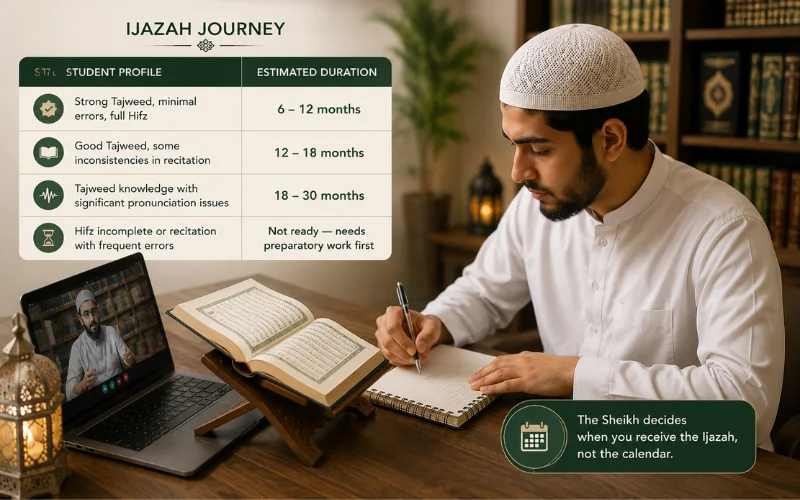
The honest answer most academies avoid: it varies significantly, and anyone who gives you a fixed timeline without knowing your level is not being truthful.
Here is a realistic breakdown:
| Student Profile | Estimated Duration |
|---|---|
| Strong Tajweed, minimal errors, full Hifz | 6 – 12 months |
| Good Tajweed, some inconsistencies in recitation | 12 – 18 months |
| Tajweed knowledge with significant pronunciation issues | 18 – 30 months |
| Hifz incomplete or recitation with frequent errors | Not ready — needs preparatory work first |
The frequency of sessions also matters. Students attending 3–5 sessions per week progress significantly faster than those attending 1–2 per week.
One important reality to set expectations honestly: the Sheikh decides when you receive the Ijazah, not the calendar. No program can guarantee a completion date, and you should be skeptical of any that do.
What to Look for in an Online Ijazah Program
With dozens of academies now offering online Ijazah, the differences in quality are enormous. Here is a checklist of what genuinely matters.
Verified Teacher Credentials
Your teacher must themselves hold an Ijazah — and ideally, they should be willing to share their own Sanad or the name of the Sheikh who granted them authorization. If you cannot verify this, you cannot verify the authenticity of the Ijazah you receive.
A Documented Sanad Chain
A legitimate Ijazah certificate includes a full Sanad — the traceable chain of names connecting your teacher back to the Prophet ﷺ. Ask to see a sample certificate or Sanad before enrolling.
Entry Assessment
As discussed, a serious program will not enroll anyone who applies. They will assess your recitation level first. This protects both you and the integrity of the program.
One-on-One Sessions (Non-Negotiable)
Ijazah cannot be granted through group classes. The teacher must listen to you recite, correct your specific errors, and be personally satisfied with your recitation before granting authorization. Any program offering Ijazah in group classes should be questioned.
No Fixed End-Date Promises
Reputable programs cannot promise you’ll have your Ijazah in 3 months or 6 months. They can estimate based on your level, but the Ijazah is granted only when you are genuinely ready.
Transparency About Correction and Assessment
You should understand, from the start, how errors are tracked, what standard you need to meet, and what the re-examination process looks like if you make errors during the final assessment.
Red Flags to Avoid
- Programs that enroll anyone regardless of existing level
- Certificates granted without a documented Sanad
- Group Ijazah “courses” with fixed end dates
- No information about who the teachers are or what their own credentials are
- Unusually low prices that don’t reflect the genuine one-on-one time required
The Sanad: Why It Matters More Than the Certificate
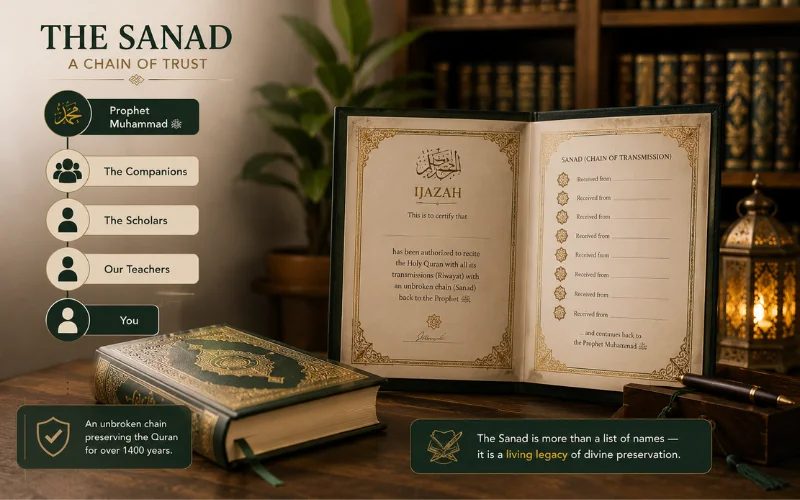
Many students focus on the certificate — a framed document to hang on the wall. The true value of Ijazah lies in the Sanad.
The preservation of the Quran through connected human transmission is one of the most remarkable features of Islamic civilization. Unlike any other book in history, the Quran has been transmitted through an unbroken oral chain that scholars have maintained with extraordinary rigor since the time of the Prophet ﷺ.
When your Sanad is documented, it typically reads something like:
“[Your name] received Ijazah from [Sheikh’s name], who received it from [his Sheikh’s name], who received it from [his Sheikh’s name]…” — continuing for anywhere from 20 to 40+ generations, back to the companions who learned directly from the Prophet ﷺ.
This is not symbolic. It is a living, verified lineage. And it is what gives your Ijazah — and the authority to teach — its meaning.
Before enrolling in any program, ask: “Can you show me my teacher’s Sanad?” The answer will tell you everything you need to know.
What Can You Do With an Ijazah?
Once you hold an Ijazah, you are formally authorized to:
Teach the Quran
at mosques, Islamic centers, schools, and online platforms. Many institutions specifically require Ijazah as a credential before employing Quran teachers.
Grant Ijazah to others
subject to your own ongoing mastery and, in most scholarly traditions, only after you yourself have reached the level of an established teacher. Your students become part of your Sanad chain.
Recite in formal settings
such as Tarawih prayers, Quran competitions, or as an Imam, where a documented Ijazah carries significant weight in many communities.
Continue to higher levels
Ijazah in Hafs is often the beginning. Many scholars go on to obtain Ijazah in additional Riwayat, then in the Seven Qira’at (Shatibiyyah), then in the Ten Qira’at (Tayyibat al-Nashr). Each level deepens your knowledge and extends your teaching authority.
Frequently Asked Questions (FAQs)
1. What is an ijazah course online?
An ijazah course online is a one-on-one Quran certification program where a qualified Sheikh listens to your recitation, corrects your Tajweed, and grants an authentic Ijazah with a documented Sanad once you successfully complete the ijazah course online requirements.
2. Can I earn a valid Ijazah through an ijazah course online?
Yes. An ijazah course online is widely accepted when it is taught by a qualified teacher who holds an authentic Ijazah and personally evaluates your recitation through live online sessions before granting certification.
3. Do I need to memorize the entire Quran before joining an ijazah course online?
Not necessarily. If your ijazah course online focuses on Quran Recitation (Tajweed), you may recite from the Mushaf. Full memorization is required only for students enrolling in an ijazah course online for Hifz (Quran Memorization).
4. How long does it take to complete an ijazah course online?
The completion time for an ijazah course online depends on your Tajweed skills and memorization level. Most students finish an ijazah course online within 6 to 24 months, while beginners usually need additional preparation first.
5. What are the requirements to join an ijazah course online?
Most reputable ijazah course online programs require fluent Quran reading, strong Tajweed skills, knowledge of Waqf and Ibtida’ rules, and a placement assessment before enrollment. Students pursuing Hifz through an ijazah course online should have memorized all 30 Juz.
6. How can I verify whether an ijazah course online is authentic?
Choose an ijazah course online that offers one-on-one classes, qualified teachers with verified Ijazah credentials, a documented Sanad, an entry assessment, and transparent evaluation standards. Avoid any ijazah course online that guarantees certification within a fixed timeframe.
7. What is included after completing an ijazah course online?
A genuine ijazah course online provides an official Ijazah certificate containing your Sheikh’s authorization, your name, the type of Ijazah awarded, official signatures, and the complete Sanad (chain of transmission) connecting back to Prophet Muhammad ﷺ.
8. Can children enroll in an ijazah course online?
Yes. There is no minimum age requirement for an ijazah course online. As long as a child demonstrates the required level of Quran memorization or recitation with proper Tajweed, they may successfully complete an ijazah course online and receive an authentic Ijazah.
9. What can I do after completing an ijazah course online?
After completing an ijazah course online, you may teach the Quran, work as a qualified Quran instructor, lead Quran recitation in Islamic centers or mosques, and continue advanced Qira’at studies under qualified scholars.
10. How much does an ijazah course online usually cost?
The cost of an ijazah course online varies depending on the academy and teacher qualifications. Most ijazah course online programs charge between $15 and $40 per one-on-one session, while the total cost depends on how long you take to complete the ijazah course online.
Final Thought
The Ijazah is one of the most serious credentials in Islamic scholarship. It is not a reward for effort or a recognition of years studied — it is a certification of demonstrated mastery, granted only when a qualified teacher is personally satisfied that you have met the standard.
That is what makes it meaningful, and what makes the choice of program so important. Choose a program where the teachers are verifiably qualified, the Sanad is documented, and the academy is honest with you about what you need to do — and how long it may take — to genuinely earn it.
The students who approach Ijazah with that seriousness are the ones who leave with something that goes far beyond a certificate: a connection to the Prophet ﷺ through an unbroken line of human transmission, and the trust of a community to carry that chain forward.