

If you’re considering an online locksmith course, you’re probably trying to answer a simple question: can you actually learn a hands-on trade through online training, or is it just another certificate that looks good on paper but doesn’t translate into real work? That’s a fair concern because locksmithing is a practical profession built around mechanical knowledge, problem-solving, and hands-on skill. Unlike many office-based careers, success in locksmithing depends on your ability to diagnose lock issues, work with keys and cylinders, and help customers solve urgent security problems.
The challenge is that the internet is full of conflicting information. One online locksmith course promises you’ll be job-ready in a matter of weeks. Another claims you’ll be able to launch your own business immediately after graduation. Some advertise “certification” without explaining whether that certification is recognized by employers, licensing agencies, or professional organizations. For someone new to the industry, separating marketing claims from reality can be difficult.
The truth is that a quality online locksmith course can provide a strong foundation in locksmithing principles, lock mechanisms, key systems, rekeying procedures, safe servicing, and even modern electronic security technologies. However, no course exists in isolation. Your long-term success depends on understanding how training, licensing requirements, certifications, practical experience, and business development all fit together.
That’s why this guide goes beyond simply reviewing what an online locksmith course teaches. You’ll learn what skills you can realistically expect to gain, how to evaluate training providers, what additional costs to budget for, whether hands-on experience is necessary, and how professional credentials fit into the larger picture. By the end, you’ll have a much clearer understanding of whether an online locksmith course is the right investment for your career goals and what steps should come next after completing your training.
What an Online Locksmith Course Actually Teaches
Strip away the marketing copy, and most reputable online locksmith courses cover a fairly consistent core curriculum. If a course is missing several of these, that’s worth noticing.
Key fundamentals
- Identifying key types and blanks by shape, bow, and cut
- Cutting keys by hand and by code
- Duplicating standard and cylinder keys using a key machine
Lock mechanisms
- Pin tumbler locks (the most common residential lock type)
- Wafer tumbler, disc tumbler, and lever tumbler locks
- Warded locks and combination/pushbutton locks
- High-security cylinders
Core locksmith skills
- Rekeying a lock to work with a new key
- Master keying systems (one key opens many locks, each lock also has its own unique key)
- Non-destructive entry: picking, raking, bumping, and impressioning
- Reading and troubleshooting locks that are jammed, worn, or damaged
Specialty areas
- Safe and vault servicing, dial manipulation, and drilling
- Automotive locksmithing, including transponder keys and key programming
- Electronic access control, CCTV basics, and alarm/detection systems (increasingly bundled into courses as “home security technician” training)
- Setting up a locksmith business, pricing jobs, and liability insurance
- State-specific licensing and legal considerations
A genuinely useful course teaches all of this in a sequence that builds — you’re not jumping into master keying before you understand basic pin tumbler mechanics. If a course’s syllabus reads like a random list of topics with no clear progression, that’s a sign the curriculum wasn’t built by someone who has actually trained locksmiths.
The Three Things People Confuse: Training, Licensing, and Certification
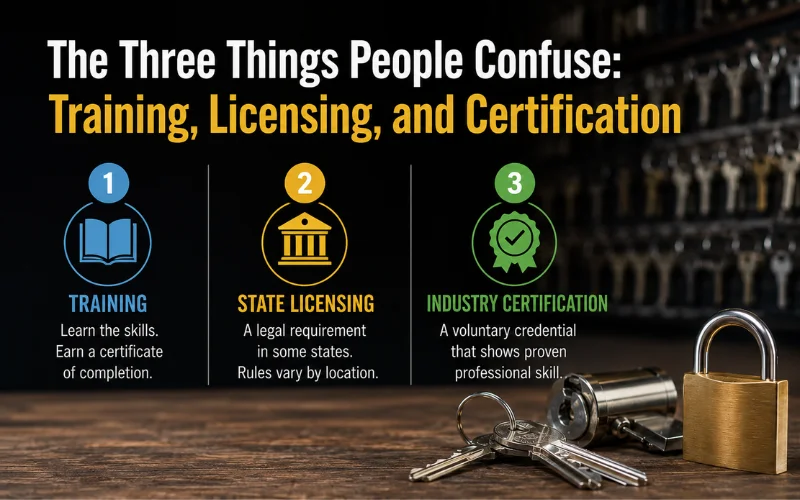
This is the part almost no course-provider page explains clearly, and it’s the single most important thing to understand before you enroll in anything.
1. Training (the course itself)
This is education. You learn the trade. At the end, you typically receive a certificate of completion or a “career diploma” from the school. This proves you studied the material — it does not, on its own, prove to a customer, employer, or state regulator that you’re licensed or certified to work.
2. State licensing (a legal requirement, where it exists)
Whether you need a license to work as a locksmith depends entirely on the state you’re in, and the rules vary more than most people expect. Some states regulate locksmiths directly — for example, California requires registration through its Bureau of Security and Investigative Services, Texas requires a license through its Private Security Board, Louisiana ties licensing to the State Fire Marshal’s office, and Illinois requires registration through its Department of Financial and Professional Regulation. Other states have no statewide locksmith licensing requirement at all, though cities or counties may still require a local business license or permit. Because this changes and varies so much by location, the only reliable way to know your requirement is to check directly with your state’s licensing or professional regulation board before you assume a course will cover it.
3. Industry certification (a credential, separate from both of the above)
In the U.S., the recognized professional certification body for locksmiths is ALOA (the Associated Locksmiths of America), through its Proficiency Registration Program. This is an exam-based credential with tiers — Certified Registered Locksmith (CRL), Certified Professional Locksmith (CPL), and Certified Master Locksmith (CML) — plus specialty tracks for automotive, safes, institutional work, and forensic investigation. In a handful of states, a specific ALOA exam is actually required for licensing (Louisiana and Alabama both require the Certified Licensed Locksmith exam, for instance). In most states, ALOA certification isn’t legally required, but it functions as a widely recognized signal of skill that customers and employers in the industry actually know to look for.
Here’s why this matters so much: a $700–$1,200 online course can teach you real, usable skills without getting you any closer to a state license or an ALOA certification — and a course that doesn’t say this clearly is, intentionally or not, leaving out the most important context a prospective student needs. Before you enroll anywhere, ask directly: “Does this course satisfy my state’s licensing requirement, and is it recognized toward ALOA certification?” A trustworthy provider will give you a direct answer (often “no, but here’s how the two relate”), not a vague non-answer.
How to Evaluate a Course Before You Pay
Use this as a working checklist when comparing options.
| What to check | Why it matters |
|---|---|
| Accreditation status | Accredited programs (commonly through DEAC in the U.S.) meet recognized educational standards. Non-accredited doesn’t automatically mean bad, but you should know which you’re getting. |
| Hands-on component | Locksmithing is a physical trade. A course that’s 100% video with no practice locks, tools, or hands-on exercises will leave a real skills gap. |
| What’s included in the price | Some courses bundle a key machine, practice locks, and a starter tool kit. Others sell the curriculum only and expect you to buy tools separately — often a $200–$500 additional cost people don’t budget for. |
| Instructor access | Self-paced video is common, but live instructor support (even just email or a scheduled call) matters a lot when you hit a confusing lesson. |
| Realistic completion time | Be skeptical of “finish in 2 weeks” claims for a trade this hands-on. Most thorough programs reasonably take 3–6 months of consistent effort. |
| Refund or trial period | A short money-back window (10–14 days is common) lets you evaluate the actual course quality before you’re locked in. |
| What credential you actually receive | “Certificate of completion,” “career diploma,” and “certification” are not interchangeable terms — confirm which one you’re getting and what it’s recognized for. |
| State licensing guidance | Does the course explain your state’s specific requirements, or just point you to “check with your local board” as a disclaimer? |
Is an Online-Only Course Enough, or Do You Need Hands-On Apprenticeship Too?
This is worth answering honestly, because the locksmith trade has historically been learned a different way than most: word-of-mouth, working alongside an experienced locksmith, picking up the feel for things that’s hard to convey through video alone — how a pin tumbler actually responds under tension, what a worn cylinder sounds like, how to talk to a panicked customer locked out of their house at midnight.
An online course can teach you the theory and the step-by-step mechanics extremely well, and a course that includes real tools and practice locks closes a meaningful part of that gap. But most working locksmiths and several training providers will tell you the same thing: pairing your course with some real hands-on time — shadowing a working locksmith, an apprenticeship, or even practicing extensively on your own salvaged locks — makes a measurable difference in how job-ready you actually are. If a program promises you’ll be fully prepared for skilled work with zero physical practice, treat that claim skeptically.
What It Actually Costs (Beyond the Course Price)
The course tuition is rarely the whole bill. Budget for these as well:
- A basic tool kit, if not included: roughly $150–$500 depending on quality and how much you need (pick sets, tension tools, plug followers, key gauges).
- A key machine, if you plan to cut keys commercially: entry-level manual machines start around $200–$400; better semi-automatic machines run considerably higher.
- State licensing fees, where applicable: these vary widely, often in the $50–$300 range plus possible background check fees.
- ALOA exam fees, if you pursue certification: individual PRP exams typically run in the range of $50–$100 each, and the full path to higher certification levels involves multiple exams.
- Liability insurance, once you’re working: a real, recurring cost most course pages don’t mention at all, despite it being essential for protecting yourself and your customers.
Seeing the full picture before you commit helps you compare a $750 course with no tools included against a $1,100 course that bundles a key machine and a full tool set — the second one may actually be the better value once you account for what you’d otherwise buy separately.
Career Outlook and What to Realistically Expect
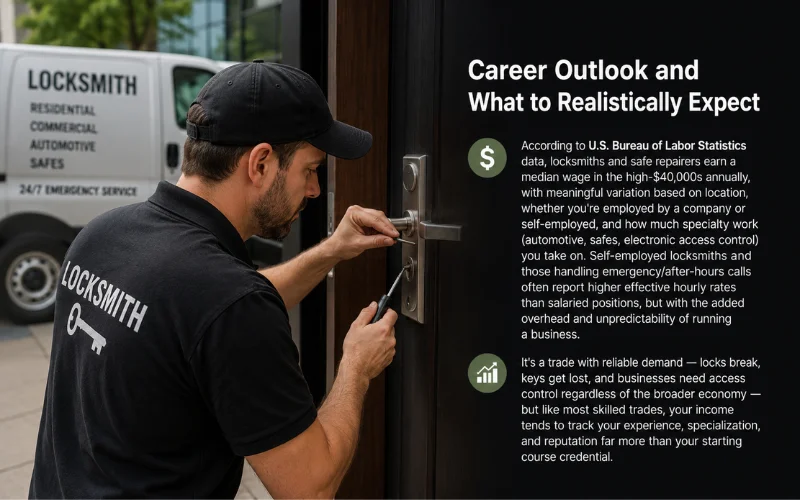
According to U.S. Bureau of Labor Statistics data, locksmiths and safe repairers earn a median wage in the high-$40,000s annually, with meaningful variation based on location, whether you’re employed by a company or self-employed, and how much specialty work (automotive, safes, electronic access control) you take on. Self-employed locksmiths and those handling emergency/after-hours calls often report higher effective hourly rates than salaried positions, but with the added overhead and unpredictability of running a business.
It’s a trade with reliable demand — locks break, keys get lost, and businesses need access control regardless of the broader economy — but like most skilled trades, your income tends to track your experience, specialization, and reputation far more than your starting course credential.
Red Flags to Watch For
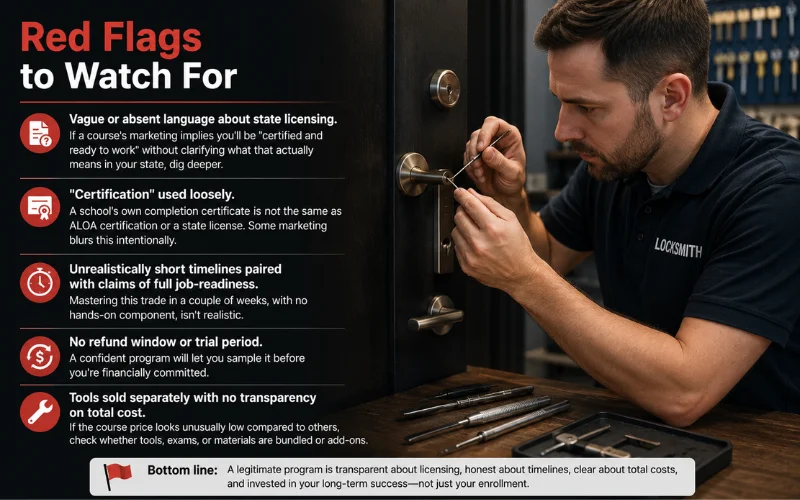
A few patterns worth being cautious about when comparing courses:
- Vague or absent language about state licensing. If a course’s marketing implies you’ll be “certified and ready to work” without clarifying what that actually means in your state, dig deeper.
- “Certification” used loosely. A school’s own completion certificate is not the same as ALOA certification or a state license. Some marketing blurs this intentionally.
- Unrealistically short timelines paired with claims of full job-readiness. Mastering this trade in a couple of weeks, with no hands-on component, isn’t realistic.
- No refund window or trial period. A confident program will let you sample it before you’re financially committed.
- Tools sold separately with no transparency on total cost. If the course price looks unusually low compared to others, check whether tools, exams, or materials are bundled or add-ons.
Frequently Asked Questions
1. Is an online locksmith course worth it?
Yes, a reputable online locksmith course can provide valuable technical knowledge and foundational skills. However, most students benefit from combining online learning with hands-on practice to become fully job-ready.
2. Can I become a locksmith entirely through an online locksmith course?
An online locksmith course can teach the theory and techniques of locksmithing, but many professionals recommend additional practical experience through independent practice, apprenticeships, or entry-level work.
3. How long does an online locksmith course take to complete?
Most online locksmith course programs can be completed in 2 to 6 months, depending on the curriculum and the amount of time you dedicate each week.
4. Does an online locksmith course provide a locksmith license?
No. Completing an online locksmith course generally results in a certificate of completion or diploma, not a state-issued locksmith license.
5. What skills will I learn in an online locksmith course?
A quality online locksmith course typically covers key cutting, lock mechanisms, rekeying, lock picking fundamentals, master key systems, security hardware, and business basics.
6. How much does an online locksmith course cost?
The average online locksmith course costs between $500 and $1,500, although pricing varies based on course depth, included tools, instructor support, and accreditation.
7. Do employers recognize an online locksmith course?
Many employers recognize training from a reputable online locksmith course, especially when it is paired with practical experience and demonstrated skills.
8. Do I need special tools while taking an online locksmith course?
Some online locksmith course providers include practice locks and tools, while others require students to purchase equipment separately.
9. Can an online locksmith course help me start my own locksmith business?
Yes. Many online locksmith course programs include lessons on pricing, customer service, business operations, and legal considerations for self-employed locksmiths.
10. What should I look for before enrolling in an online locksmith course?
Before choosing an online locksmith course, review the curriculum, accreditation status, instructor support, hands-on training opportunities, refund policy, and state licensing guidance.
Final Thoughts
A quality online locksmith course can give you a strong foundation in locksmithing skills, from key cutting and rekeying to understanding modern security systems. However, completing an online locksmith course is only one part of becoming a successful locksmith. Real-world practice, knowledge of your local licensing requirements, and continued skill development are equally important.
Before enrolling in any online locksmith course, make sure you understand exactly what the program includes, what credential you’ll receive, and whether you’ll need additional training, tools, or certifications afterward. Choosing the right online locksmith course can save you money, set realistic expectations, and help you start your locksmith career with confidence.