
If you have been searching for the best Online Bartender Course: Get Certified From Home, you have landed in exactly the right place. The bartending industry is booming, and the good news is that you no longer need to spend weeks in a classroom or thousands of dollars at a physical school to break into it. Today, a high-quality online bartender course gives you the skills, the knowledge, and the certification you need — all from the comfort of your own home, on your own schedule, at a fraction of the traditional cost.
But here is what most people do not realize: the online bartending world is crowded with options, and not all of them are worth your time or money. Some courses hand you a certificate after a few hours of basic recipe reading and call it done. Others offer deep, structured training that genuinely prepares you for the fast pace of a real bar environment. Knowing the difference before you enroll can save you both money and frustration.
That is exactly why this guide exists. Whether you are a complete beginner who has never stepped behind a bar in your life, someone looking to earn a legally recognized alcohol service certification, or an experienced server ready to move up to bartending — this guide walks you through everything. You will learn what a quality online bartender course actually covers, which certifications matter in your state, how much bartenders really earn by venue type and city, how to practice real bartending skills at home without a physical bar, and what to expect on your very first shift behind the bar.
Everything competitors skip, this guide covers. By the time you finish reading, you will know exactly which online bartender course fits your goals, what steps to take after you certify, and how to walk into your first bartending job with real confidence. Let’s get started.
What Is an Online Bartender Course?
An online bartender course is a self-paced training program you complete entirely from home using video lessons, written materials, and interactive exercises. You learn the same foundational skills taught in physical bartending schools — drink recipes, bar setup, glassware, cocktail techniques, responsible alcohol service, and customer interaction — all through your computer, tablet, or phone.
Some courses take as little as a few hours to complete. Others offer 10 to 30+ hours of structured content with exams and a nationally recognized certificate at the end.
The bottom line: An online course teaches you the knowledge. You build the physical speed and muscle memory through practice at home — which is completely achievable with the right setup. More on that below.
Who Should Take an Online Bartender Course?
Online bartending training is the right fit if you:
- Want to start bartending but can’t afford the time or cost of a full in-person program
- Have a busy schedule and need to learn at your own pace
- Already work in hospitality and want to sharpen your cocktail and service knowledge
- Are moving to a new state and need a recognized alcohol service certification
- Want to host better parties or break into event bartending on the side
- Are exploring the bartending career path before committing to a longer program
Even if you plan to eventually attend an in-person school, completing an online course first gives you a real advantage — you walk in knowing terminology, drink families, and bar basics, which means you learn the physical techniques faster.
What You’ll Learn in a Quality Online Bartender Course
A well-structured online bartender course covers far more than just drink recipes. Here’s what to expect from a thorough program:
Bartending Foundations
- Bar setup, layout, and workflow
- Essential bartending tools: shakers, strainers, jiggers, muddlers, bar spoons
- Glassware types and which drinks belong in which glass
- Garnishes: citrus twists, olives, cherries, salted rims, and more
- How to read and complete a customer order efficiently
Spirits and Liquor Knowledge
- The six base spirits: vodka, gin, rum, tequila, whiskey, and brandy
- Understanding proof, ABV, and how alcohol content affects cocktails
- Beer and wine basics every bartender needs to know
- Popular mixers, syrups, bitters, and liqueurs
- Premium vs. well vs. call vs. top-shelf brands
Cocktail Recipes and Techniques
- Classic cocktails: Old Fashioned, Martini, Manhattan, Negroni, Mojito, Margarita
- Shooters and shots
- Blended and frozen drinks
- Non-alcoholic mocktails (increasingly requested by modern guests)
- Free pouring vs. measured pouring — and when to use each
- Shaking, stirring, layering, and building drinks in the glass
Responsible Alcohol Service
- How to check IDs correctly and spot fake identification
- Signs of intoxication and how to handle them
- How to cut off a customer safely and professionally
- Dram shop liability — what it means and why it matters for your career
- State and local alcohol laws
Customer Service and Bar Etiquette
- How to manage multiple customers at once during a rush
- Upselling techniques that feel natural, not pushy
- How to handle difficult situations behind the bar
- Tipping culture and how to maximize your earnings
Online vs. In-Person Bartending School: The Honest Comparison
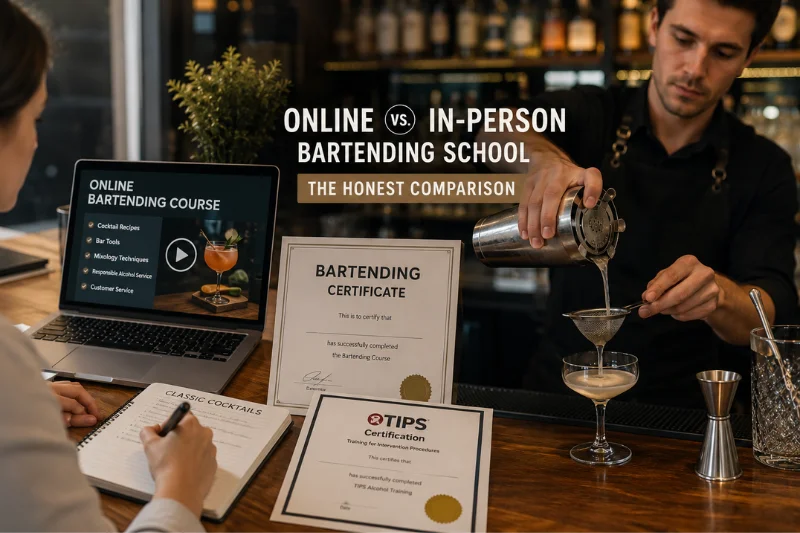
Most bartending schools only promote their own model. Here’s the unbiased truth.
| Factor | Online Course | In-Person School |
|---|---|---|
| Cost | $0–$300 | $200–$700+ |
| Time to complete | Days to weeks (self-paced) | 1–4 weeks (set schedule) |
| Physical practice | Self-directed at home | Supervised behind a real bar |
| Certification | Yes (varies by program) | Yes (usually TIPS or state-approved) |
| Job placement help | Some programs offer it | Most offer it |
| Best for | Beginners, budget-conscious, busy schedules | Those who want supervised hands-on speed training |
| Recognition by employers | Widely accepted | Widely accepted |
The honest verdict: Neither is automatically better. Online courses work extremely well for learning knowledge and theory. In-person schools add supervised speed training and immediate instructor feedback. Many successful bartenders started with an online course and supplemented it with real bar experience by working as a barback or working at events.
Bartending Certifications That Actually Matter
This is one of the most important things competitors rarely explain clearly. There are two types of certifications you will encounter:
1. Bartending Course Completion Certificates
These come from the school itself — ABC Bartending School, Local Bartending School, European Bartender School, and similar programs. They show employers you completed formal training. Most hospitality employers accept and respect these certificates.
2. Alcohol Service Certifications (The Legal Ones)
These are issued or recognized by state alcohol control boards and are often legally required to serve alcohol. The main ones are:
- TIPS (Training for Intervention ProcedureS) — The most widely recognized nationwide. Accepted in 50 states and teaches responsible alcohol service. Valid for 3 years.
- ServSafe Alcohol — Offered by the National Restaurant Association and recognized across most states.
- TABC Certification — Required specifically in Texas for anyone who sells or serves alcohol.
- RBS (Responsible Beverage Service) Certification — Required in California since 2022 for all alcohol servers.
- State-specific programs — Many states have their own approved providers. Always check your state’s Alcohol Beverage Control (ABC) board website for the current requirement.
Pro tip: Always get your state’s legally required alcohol service certification in addition to your bartending course certificate. The bartending certificate shows your skills. The alcohol service certification keeps you legally protected on the job.
Minimum Age to Bartend by State — The Guide Nobody Else Gives You
Age requirements to serve alcohol vary significantly across the US. Here is a complete state-by-state reference:
- Age 18 to bartend: Connecticut, Florida, Georgia, Hawaii, Illinois*, Iowa, Louisiana, Maine, Massachusetts, Michigan, Minnesota, Montana, New Hampshire, New Jersey, New York, Pennsylvania, Rhode Island, Tennessee, Texas, Vermont, Wisconsin
- Age 19 to bartend: Arizona, Idaho, Nebraska
- Age 20 to bartend: Kentucky
- Age 21 to bartend: Alabama, Alaska, Arkansas, California, Delaware, DC, Indiana, Kansas, Maryland, Mississippi, Missouri, Nevada, New Mexico, North Carolina, North Dakota, Ohio, Oklahoma, Oregon, South Carolina, South Dakota, Utah, Virginia, Washington, Wyoming
*Illinois requires age 18 but local ordinances may vary.
Important: Even in states where 18-year-olds can bartend, you must be 21 to taste or consume alcohol on the job. Always verify current requirements directly with your state’s liquor control authority, as laws can change.
How Much Do Bartenders Actually Earn?
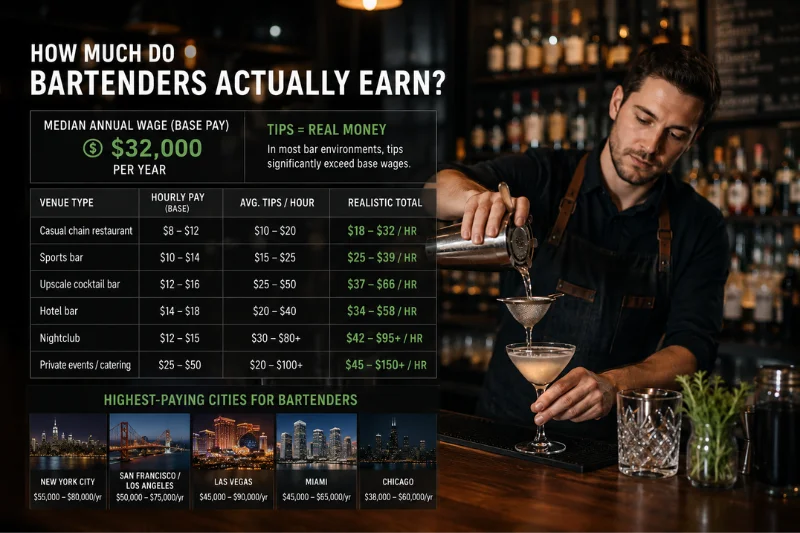
Most online courses skip this entirely. Here is the real breakdown so you know exactly what you are getting into.
Base Salary
According to the Bureau of Labor Statistics, the median annual wage for bartenders in the US is around $32,000 per year in base pay alone.
Tips — Where the Real Money Is
Tips are where bartending income gets exciting. In most bar environments, tips significantly exceed base wages. Here is what to realistically expect:
| Venue Type | Hourly Pay (Base) | Avg. Tips/Hour | Realistic Total |
|---|---|---|---|
| Casual chain restaurant | $8–$12 | $10–$20 | $18–$32/hr |
| Sports bar | $10–$14 | $15–$25 | $25–$39/hr |
| Upscale cocktail bar | $12–$16 | $25–$50 | $37–$66/hr |
| Hotel bar | $14–$18 | $20–$40 | $34–$58/hr |
| Nightclub | $12–$15 | $30–$80+ | $42–$95+/hr |
| Private events/catering | $25–$50 | $20–$100+ | $45–$150+/hr |
Highest-Paying Cities for Bartenders
- New York City — average $55,000–$80,000/year with tips
- San Francisco/Los Angeles — $50,000–$75,000/year
- Las Vegas — $45,000–$90,000/year (casino and resort bars)
- Miami — $40,000–$65,000/year
- Chicago — $38,000–$60,000/year
The Complete Bartending Career Path
This is something none of your competitors map out clearly. Bartending is not just a job — it is a career with genuine progression.
Barback (Starting Out)
Before bartending, many people start as a barback: stocking ice, washing glasses, cutting garnishes, and supporting bartenders during service. It pays less but gives you priceless real-world experience in a live bar environment. Most barbacks move to bartending within 3 to 12 months.
Bartender
Your first bartending role. You own a section of the bar, build your speed, and develop your customer relationships. Expect the first few months to feel fast and intense — that is normal. Your tips grow as your regulars do.
Head Bartender / Bar Lead
You take on scheduling, ordering, training new staff, and maintaining bar standards. This role adds management responsibility to your technical skills. Pay typically increases by 15 to 30%.
Bar Manager
You run the entire bar operation: inventory, supplier relationships, cost control, staff hiring, and event coordination. Annual salaries in this role range from $45,000 to $75,000+ depending on the venue.
Beverage Director
You oversee multiple bars or an entire restaurant group’s beverage program. You develop cocktail menus, negotiate with distributors, and shape the brand’s drink identity. Salaries range from $70,000 to $120,000+.
Bar Owner or Consultant
Many experienced bartenders eventually open their own bar, work as independent cocktail consultants, or compete in national and international mixology competitions. The sky is genuinely the limit.
How to Practice Bartending at Home (The Guide Nobody Gives You)
One of the biggest questions about online bartender courses is: “How do I practice without a real bar?” The answer is simpler than you think.
Your Home Bar Starter Kit
You do not need a full professional setup. Start with these essentials:
Tools (under $50 total to start):
- Boston shaker set (two-piece tin shaker)
- Hawthorne strainer
- Jigger (1 oz / 2 oz)
- Bar spoon
- Muddler
- Channel knife or Y-peeler (for citrus garnishes)
- Speed pourers (for free pour practice)
Glassware to have on hand:
- Highball glasses
- Rocks / Old Fashioned glasses
- Coupe or Martini glasses
- Wine glasses
- Pint glasses
Liquors to practice with (buy one of each):
- Vodka, gin, white rum, tequila, bourbon, and triple sec cover 80% of classic cocktails
Mixers and extras:
- Simple syrup (make your own: equal parts sugar and water, heated)
- Citrus: lemons, limes, oranges
- Soda water, tonic water, cola, ginger beer
- Bitters (Angostura is the essential starting point)
What to Practice at Home
- Free pouring — Use a speed pourer and a measuring cup. Practice pouring exactly 1 oz and 1.5 oz without looking at the cup until you can do it consistently.
- Timing — Use your phone’s stopwatch. Aim to build and serve a simple cocktail in under 60 seconds.
- Memorization — Use flashcard apps like Anki to drill drink recipes until they are automatic.
- Shaking technique — Shake hard for 10 to 15 seconds. Your tins should be ice-cold and your hands slightly numb when you stop. That is the correct dilution point.
- Stirring — Practice stirring a Manhattan or Negroni smoothly for 30 seconds without splashing or clanging.
What to Expect on Day One Behind the Bar
This is something every bartending school skips entirely — and it is what new bartenders actually search for. Here is the honest reality of your first real bar shift.
It will feel overwhelming
The noise, the pace, the number of simultaneous orders — nothing in a course fully prepares you for the physical reality of a busy Saturday night. That is normal. Every experienced bartender has been there.
The bar layout will be unfamiliar
Even if you know exactly where things should go, every bar is different. Spend time before your shift walking the bar, learning where every bottle, tool, and glass lives. Speed comes from muscle memory, and muscle memory requires your specific bar’s layout.
Your first customers will test you
Some will be patient. Some will not. Focus on eye contact, a quick acknowledgment (“I’ll be right with you”), and never appearing panicked even when you are.
Tips will be inconsistent at first
Your best tips come from regulars and from customers who sense you are confident and engaged. It builds over time.
Ask questions freely
No experienced bartender expects a new hire to know everything. Asking shows professionalism, not weakness. Use quiet moments to ask colleagues about the bar’s most popular orders and any house-made syrups or specialty drinks on the menu.
How to Choose the Right Online Bartender Course
With so many options available, here is what to look for:
Must-Haves
- Clear curriculum with lesson breakdowns listed before you pay
- A certificate upon completion (and clarification of whether it is nationally recognized)
- Responsible alcohol service content included
- Mobile-friendly access so you can study anywhere
- Customer reviews or verified testimonials
Nice to Have
- Video-based lessons rather than text-only content
- Downloadable study materials or recipe guides
- An exam to solidify what you learned
- Job placement assistance after graduation
- A money-back guarantee (30 days is the standard)
Red Flags to Watch For
- No refund policy at all
- No instructor credentials listed
- Courses that claim to certify you for a specific state without any actual state board approval
- Prices that seem too good to be true with zero curriculum details
- Sites that look unverified or have no reviews anywhere online
Top Online Bartender Courses Worth Considering
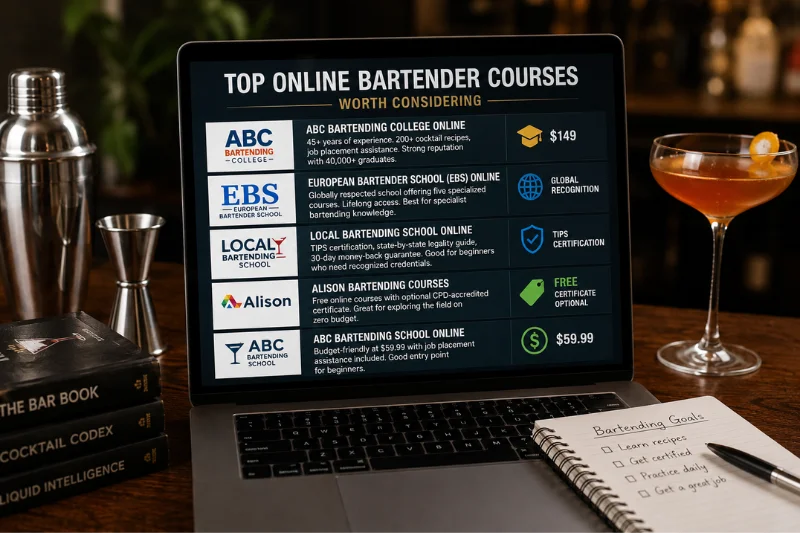
Here is an honest overview of the most well-known options:
ABC Bartending College Online
One of the largest US bartending school networks with 45 years of experience. Their online course starts at $149 and includes 200+ cocktail recipes and job placement assistance. Strong reputation with 40,000+ graduates.
European Bartender School (EBS) Online
The most globally respected bartending school, offering five specialized online courses through DrinksWorld.com. Courses range from beginner essentials to Tiki cocktails, Craft Flair, and advanced mixology. Lifelong access. Best for those who want specialist bartending knowledge.
Local Bartending School Online
Strong US/Canada focus with TIPS certification options, a state-by-state legality guide, and a 30-day money-back guarantee. Good for beginners who need legally recognized credentials.
Alison Bartending Courses
Free online bartending courses with the option to purchase a CPD-accredited certificate. Great for exploring the field on zero budget. Less depth than dedicated bartending schools.
ABC Bartending School Online
Budget-friendly at $59.99 with job placement assistance included. Good entry point for beginners. Best for those who want a quick, affordable certification.
Frequently Asked Questions About Online Bartender Courses
1. What is an online bartender course?
An online bartender course is a self-paced training program that teaches you everything you need to know about bartending — from cocktail recipes and bar setup to responsible alcohol service and customer interaction — all from the comfort of your home. You complete the lessons on your phone, tablet, or computer and earn a certificate when you finish.
2. Is an online bartender course recognized by employers?
Yes — most employers, especially for entry-level bartending roles, accept certificates from reputable online bartender courses. What matters most to bar managers and hiring teams is that you understand drink recipes, bar etiquette, and responsible alcohol service. Pairing your online bartending certificate with a state-approved alcohol service certification like TIPS makes your application even stronger.
3. How long does it take to complete an online bartender course?
Most online bartender courses take between 10 and 30 hours of study time, which you spread across your own schedule. Some students finish in a weekend by studying intensively. Others take two to four weeks while balancing work or school. Because online courses are self-paced, you move as fast or as slow as you need to.
4. How much does an online bartender course cost?
Online bartender courses range from completely free — platforms like Alison offer no-cost bartending content — to around $300 for advanced programs from schools like the European Bartender School. Popular mid-range options include ABC Bartending School Online at $59.99 and ABC Bartending College Online starting at $149. Always check what is included: certificate, job placement assistance, and money-back guarantee add real value.
5. Do I need any experience to enroll in an online bartender course?
No experience is required. Online bartender courses are specifically designed for complete beginners. You start with the basics — bar tools, glassware, and foundational drink recipes — and build your knowledge step by step. If you already have some bartending experience, an online course can sharpen your cocktail knowledge and help you earn a recognized certificate.
6. Can I really learn bartending skills online without a real bar?
You can absolutely learn all the knowledge and theory online. The physical skills — free pouring accuracy, shaking speed, and managing a busy rush — develop through practice at home and real bar experience. Set up a basic home bar kit with a Boston shaker, jigger, strainer, and bar spoon, and practice your techniques in your kitchen. Many successful bartenders started exactly this way.
7. What certifications will I receive after completing an online bartender course?
You typically receive two things: a course completion certificate from the bartending school, and the option to earn a legally recognized alcohol service certification such as TIPS, ServSafe Alcohol, or your state’s required program. The school certificate demonstrates your training. The alcohol service certification — which is legally required in many states including California and Texas — is what keeps you protected on the job. Always pursue both.
8. Is an online bartender course valid in my state?
The online bartending course itself is generally accepted nationwide since it is a training certificate rather than a government license. However, the alcohol service certification you need depends entirely on your state. California requires RBS certification, Texas requires TABC, and many other states require TIPS or a state-approved equivalent. Always check your state’s Alcohol Beverage Control board website to confirm current requirements before you start working.
9. How much can I earn after completing an online bartender course?
Bartender earnings vary widely depending on where you work. Base pay typically ranges from $8 to $18 per hour, but tips are where the real income is. Bartenders at upscale cocktail bars earn $37 to $66 per hour including tips. Nightclub bartenders can clear $42 to $95 per hour on a busy night. Private event bartenders often earn $45 to $150+ per hour. In cities like New York, Las Vegas, and San Francisco, top bartenders earn $55,000 to $90,000 per year or more.
10. What is the best online bartender course for beginners?
The best course depends on your goals and budget. If you want to start for free, Alison’s bartending courses are a solid introduction. If you want an affordable all-in-one option with job placement assistance, ABC Bartending School Online at $59.99 is a strong choice. For the most internationally respected certificate, the European Bartender School’s Essentials of Bartending course is the gold standard. If you need a US-specific alcohol service certification alongside your training, Local Bartending School’s TIPS-certified program is the most practical option for working legally in most states.
Final Thoughts
An online bartender course is one of the most affordable, flexible, and genuinely effective ways to launch a bartending career — or level up the one you are already building. The key is pairing the knowledge you gain online with real practice, the right certifications for your state, and a willingness to get into an actual bar environment as quickly as possible.
You do not need to spend thousands of dollars or take weeks off work to start bartending. You need the right knowledge, a home practice setup, a legal certification, and the confidence to walk behind a bar and take your first order.
That journey starts today.