
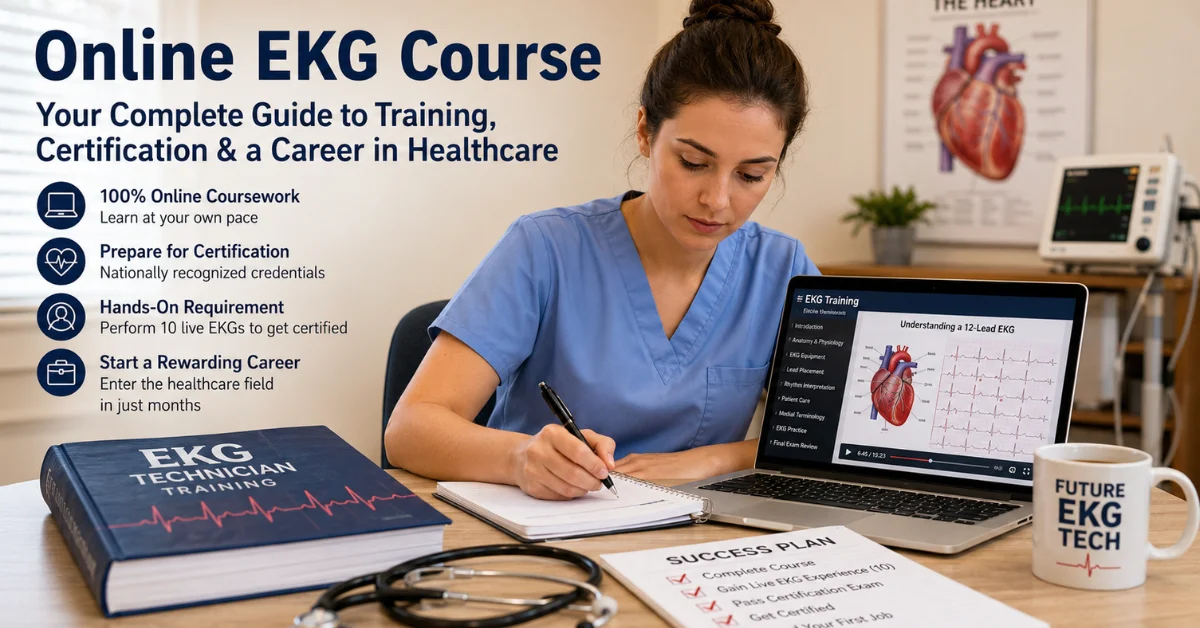
If you’re researching an online EKG course, here’s the direct answer up front: yes, you can complete 100% of the coursework online, and yes, you can prepare for a real, nationally recognized certification that way. But there’s a catch almost every program glosses over in the fine print—to actually become certified, you’ll still need to perform EKGs on real patients before your credential is officially issued. No matter how a school markets itself, that hands-on clinical requirement can’t be replaced by online lessons alone.
That’s why it’s important to understand exactly how the certification process works before you enroll. Many students assume finishing an online EKG course automatically makes them job-ready, only to discover later that they still need documented live EKG experience. Knowing this in advance can save you time, money, and unnecessary frustration.
This guide breaks down everything you need to know—from what you’ll actually learn in an online EKG course, how long training usually takes, and what different programs cost, to the certifications employers recognize most, the live-EKG requirement, salary expectations, and practical tips for choosing a program that truly prepares you for your first healthcare job. Whether you’re changing careers or looking for an entry point into the medical field, this guide will help you make an informed decision with confidence.
What an EKG Technician Actually Does
Before you spend money on a course, it helps to know what the job looks like day to day, because “EKG technician” means slightly different things depending on the setting.
In most hospitals, clinics, and physician’s offices, an EKG technician:
- Preps patients and explains the procedure before attaching electrodes
- Operates the EKG machine to capture a 12-lead tracing
- Recognizes when a reading looks abnormal enough to flag immediately for a physician
- Preps patients for Holter monitoring (a portable 24–48 hour EKG)
- Assists with stress tests
- Documents results in the electronic medical record and routes them to the ordering provider
A smaller, related role — sometimes called an EKG monitor technician or telemetry technician — works from a central monitoring station watching multiple patients’ heart rhythms simultaneously and alerting nursing staff to dangerous changes. The training overlaps heavily, but the day-to-day work is different (active patient contact vs. screen monitoring), so check which one a course is actually preparing you for. Some program pages use the titles interchangeably, which can be misleading if you’re hoping for hands-on patient work.
What’s Actually Covered in an Online EKG Course
Course length varies (more on that below), but a legitimate program — regardless of price — should cover the same core ground:
- Cardiac anatomy and physiology: how the heart’s electrical conduction system works, since you can’t read a rhythm strip without understanding what’s generating it
- Medical terminology: word roots and shorthand used in cardiology and the broader medical chart
- EKG equipment operation and maintenance: lead placement, troubleshooting artifacts, infection control between patients
- Rhythm interpretation: normal sinus rhythm, sinus brady/tachycardia, atrial and junctional arrhythmias, ventricular arrhythmias, heart blocks, and pacemaker rhythms
- Patient safety and communication: positioning, informed consent basics, recognizing an emergency
- Healthcare ethics and HIPAA: legal boundaries around patient privacy and documentation
- Vital signs and basic clinical software: many programs now fold in EMR/EHR navigation since that’s part of the real job
If a course skips rhythm interpretation and jumps straight to “exam prep,” it’s a shortcut course, not a training program — useful only if you already have clinical experience and just need a refresher before testing.
The Part Most Online EKG Certification Programs Don’t Explain Clearly: The 10 Live EKGs
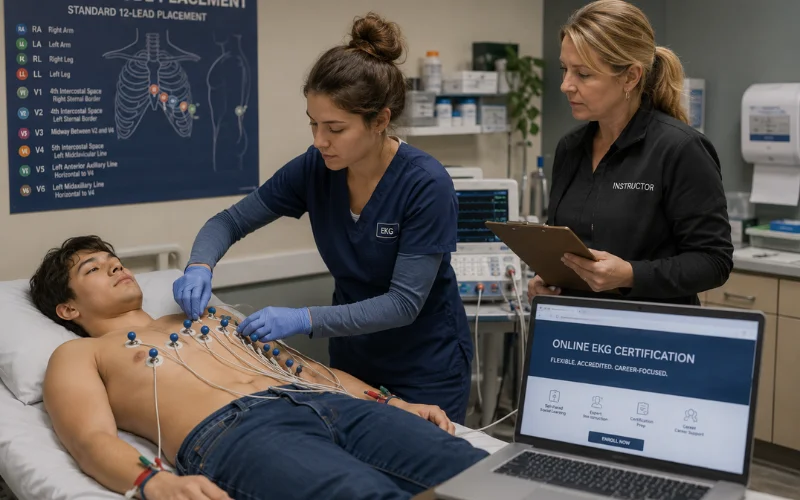
If you’re researching an Online EKG Certification program, this is the one requirement you absolutely need to understand before enrolling. Many students assume that completing an online course is all that’s required to become certified, but that’s not the full picture. This topic deserves its own section because very few course providers explain it clearly, and overlooking it can lead to confusion later in the certification process.
To sit for the Certified EKG Technician (CET) exam through the National Healthcareer Association (NHA)—the most widely recognized EKG certification in the United States—you must provide documented proof that you’ve successfully performed 10 EKGs on live individuals. This requirement comes directly from the NHA, not from any individual school, and it applies whether you complete your Online EKG Certification course, attend classes in person, or choose a hybrid learning format.
Here’s where many students get confused: when schools advertise a 100% Online EKG Certification program, they’re usually referring to the educational coursework only. The lectures, quizzes, assignments, and study materials are completed online, often at your own pace. However, the clinical requirement is separate. Regardless of how you complete your coursework, you’ll still need to gain real, hands-on experience by performing EKGs on live patients before you can fully satisfy the certification requirements.
Fortunately, the NHA offers an alternative called the Pre-Externship Route. This pathway allows students enrolled in an Online EKG Certification program to take the CET exam before completing the required 10 live EKGs. After passing the exam, you’ll have up to 90 days to perform the EKGs under appropriate supervision and submit documentation to the NHA. While this option gives online learners more flexibility, it doesn’t remove the requirement—it simply changes the order in which you complete it.
Before enrolling in any Online EKG Certification course, make sure you ask the provider these important questions:
- Do you have partnerships with clinics, hospitals, or urgent care centers where students can complete the required 10 live EKGs?
- If I need to arrange my own clinical experience, do you provide a clinical placement guide, outreach templates, or a list of facilities that commonly accept students?
- Are there any deadlines I should be aware of, including the NHA’s 90-day completion window after passing the CET exam?
If you already work in a healthcare-related position—such as a medical assistant, CNA, EMT, patient care technician, or even at the front desk of an urgent care clinic—your current employer may be the easiest place to complete your required live EKGs. If not, consider contacting community health clinics, urgent care centers, outpatient cardiology offices, hospitals, or EMS agencies. Many facilities are willing to supervise students, especially if you reach out to the clinical education coordinator or the person responsible for student training rather than the general reception desk.
Understanding this requirement in advance will help you choose the right Online EKG Certification program and avoid unexpected delays on your path toward becoming a certified EKG technician.sometimes allow supervised student practice; it’s worth calling ahead and asking specifically for whoever supervises student EKG hours rather than going through a general front desk.
Self-Paced vs. Scheduled: How Online EKG Courses Are Structured
Most online EKG courses fall into one of two formats:
Self-paced, open enrollment
You start anytime, move through lessons on your own schedule, and typically have anywhere from a few months to a full year of access. This is the most common model and works well if you’re studying around a job or family schedule. The tradeoff is that without external deadlines, it’s easy to let a course stall — set your own milestones if you go this route.
Cohort or instructor-paced
Less common for EKG specifically, but some programs run set start dates with weekly modules and live or moderated discussion access. This suits people who do better with structure and peer accountability.
Typical completion time runs 3 to 6 months for someone studying part-time, though access periods (the window before your enrollment expires) often extend to 9 or even 12 months to accommodate life getting in the way. Course hour totals vary widely between providers — anywhere from roughly 50 hours for a lean program to 150+ hours for one bundled with a full medical terminology course. More hours isn’t automatically better; it usually just means more foundational content (like a full medical terminology unit) is bundled in rather than assumed.
Which Certification Should You Actually Get?
Not all EKG certifications carry the same weight with employers, and this is where a lot of cheaper courses quietly cut corners by training toward a lesser-known credential.
| Certifying body | Credential | Recognition | Typical exam cost |
|---|---|---|---|
| National Healthcareer Association (NHA) | Certified EKG Technician (CET) | Most widely recognized nationally; commonly named directly in job postings | ~$200 (often included as a voucher in program tuition) |
| National Center for Competency Testing (NCCT) | NCET | Recognized regionally and by many hospital systems, especially where bundled with other allied health certs | ~$150–$200 |
| National Workforce Career Association (NWCA) | CEKG | Less widely recognized; accepted by some employers, unfamiliar to others | ~$140 |
| Smaller/proprietary bodies (varies by school) | Varies | Recognition is inconsistent and employer-dependent | Varies |
Practical advice: if you don’t yet know which hospital system or clinic group you want to work for, default to NHA’s CET. It’s the credential most consistently named in job postings and the one HR screeners are trained to recognize on sight. If a course is significantly cheaper than competitors, check which certifying body it’s actually preparing you for — that’s frequently where the savings come from. It’s not necessarily a bad choice (NCCT, for example, is legitimate and accredited), but you should choose it knowingly, not discover it after you’ve already paid.
Before committing to any program, it’s worth a five-minute search of job postings in your area for “EKG technician” to see which certification employers actually list as preferred or required.
What Should an Online EKG Course Actually Cost?
The cost of an online EKG course varies much more than most people expect. Programs that appear similar at first glance can differ by thousands of dollars, so it’s important to understand exactly what you’re paying for before enrolling.
Under $150 — Exam Prep Courses
These low-cost options are usually designed for students who already have some clinical knowledge and simply need help preparing for a certification exam. They often require you to purchase textbooks separately and pay the certification exam fee yourself (typically another $150–$200). Once you include those extra expenses, the total cost is often closer to $300–$400.
$900–$1,600 — Complete Training Programs
This is the price range where most comprehensive online EKG course providers fall. These programs typically include the full curriculum, study materials, instructor support, and an exam voucher. Some also bundle additional benefits such as a stethoscope or blood pressure kit, career coaching, resume assistance, or job placement support.
$2,000–$2,700 — University-Affiliated Programs
Some continuing education programs offered through universities are actually delivered by third-party providers such as ed2go or Cengage. In many cases, the curriculum and instructors are nearly identical across multiple universities, with the biggest differences being branding, course access length, and optional extras like medical terminology classes. While these programs can be worthwhile, you may find the same underlying online EKG course available elsewhere at a lower cost.
Compare the Total Cost, Not Just the Tuition
When evaluating any online EKG course, look beyond the advertised price. Calculate the total expense by including tuition, certification exam fees, textbooks, lab materials, and any extension fees if you need more time to complete the course. A program with a higher upfront price may actually offer better value if it includes everything you’ll need to earn your certification.
How to Choose the Right Online EKG Course: A Checklist
Run any program you’re considering through these questions before paying:
- Is the school accredited, and by whom? (Look for recognized accreditors like DEAC — accreditation matters for legitimacy and, in some cases, financial aid eligibility, even though most EKG certificate programs are non-credit and don’t qualify for federal aid.)
- Which certification does it prepare you for, and is the exam voucher included or separate?
- Is the live-EKG requirement addressed with real support (a clinical experience guide, partner sites, an externship coordinator) or just disclaimed?
- What’s the refund or money-back policy if the course isn’t a fit?
- How do you reach an instructor if you’re stuck on a concept — email, phone, live chat, or nothing at all?
- How long do you have access to the material, and what happens if you need more time?
- What do independent reviews say? Check Trustpilot, Google reviews, and the Better Business Bureau rather than only testimonials on the school’s own site.
- What’s the total real cost, including exam fees and materials, not just the advertised tuition?
If a program can’t give you a straight answer on the live-EKG requirement and certification path within one phone call or chat message, treat that as a signal — it usually means support after you’ve paid will be similarly vague.
Career Outlook and Salary
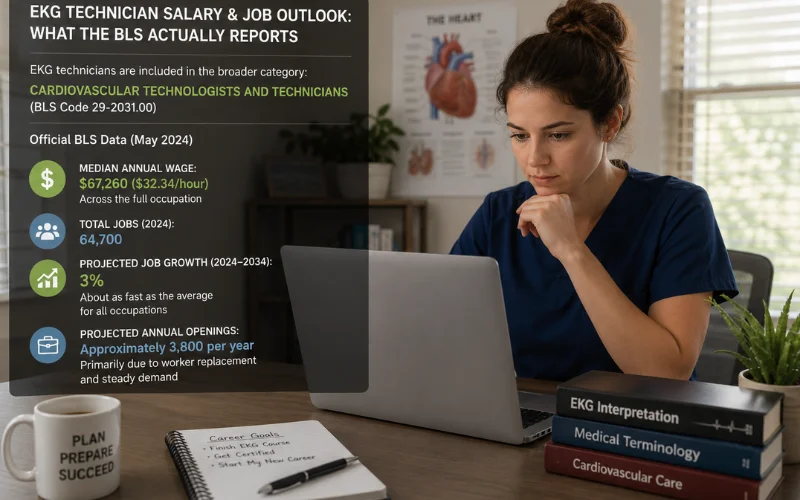
Here’s something worth knowing that most online EKG course providers don’t mention: the Bureau of Labor Statistics (BLS) doesn’t track “EKG Technician” as its own job code. Instead, EKG technicians are included within the broader category of Cardiovascular Technologists and Technicians (BLS code 29-2031.00), which also covers higher-paid specialists such as invasive cardiology and echocardiography technologists. Because of that, the salary figures you’ll often see advertised represent the entire occupation rather than entry-level EKG technicians alone.
According to the latest official BLS data (May 2024):
- Median annual wage: $67,260 ($32.34/hour) across the full occupation
- Total jobs (2024): 64,700
- Projected job growth (2024–2034): 3%, which is about as fast as the average for all occupations
- Projected annual openings: Approximately 3,800 per year, primarily due to worker replacement and steady demand
If you’re planning to enroll in an online EKG course, it’s important to understand that your starting salary will likely be lower than the overall category median. Pay depends on several factors, including your location, employer, healthcare experience, and workplace setting. Large hospitals and medical centers generally offer higher wages than small physician offices, while metropolitan areas with higher living costs often pay above the national average. Before choosing a program, check local job postings to see what employers in your area are actually offering.
You’ll also notice that some online EKG course websites advertise much higher job-growth figures. In many cases, those numbers come from outdated BLS projections or third-party salary websites rather than the latest official government data. While the profession remains stable and continues to offer consistent hiring opportunities, it’s always best to rely on current BLS statistics and local job listings when evaluating your career prospects.an the current official BLS projection, which is 3%. It’s still a stable, in-demand field — just worth knowing where a stat actually comes from before it factors into your decision.
From Enrollment to Your First Job: What the Path Actually Looks Like
- Confirm your eligibility. You’ll generally need a high school diploma or GED (or to be on track to earn one within 12 months, depending on the certifying body).
- Enroll and complete coursework. Budget 3–6 months of part-time study for most self-paced programs.
- Line up your live EKGs. Start this conversation with your program — or with a current/former healthcare employer — early, ideally before you finish coursework, not after.
- Sit for your certification exam. Decide in advance whether you’re using the standard route (live EKGs completed first) or the pre-externship route (exam first, EKGs within 90 days).
- Apply with your certificate of completion and, once issued, your certification. Some employers will hire with proof of program completion and a pending exam date; most prefer or require the active certification.
- Consider a CPR/BLS certification alongside your EKG credential. It’s not always mentioned by course providers, but many hospitals and clinics require current Basic Life Support certification for any clinical-facing role, EKG techs included. It’s inexpensive and worth having ready before you start job hunting.
Frequently Asked Questions online ekg course
1. Can I complete an online EKG course entirely from home?
You can complete all the coursework online, but you’ll still need to perform live EKGs on real patients to qualify for certification through organizations like the NHA.
2. How long does an online EKG course take to finish?
Most students complete an online EKG course in about 3–6 months while studying part-time. Some self-paced programs allow up to 12 months of access.
3. Do I need any previous healthcare experience?
No. Most online EKG programs are designed for beginners, although having experience as a CNA, EMT, or medical assistant can make the learning process easier.
4. Which EKG certification is best for getting hired?
The National Healthcareer Association’s Certified EKG Technician (CET) credential is the most widely recognized certification by hospitals and healthcare employers across the U.S.
5. How much does an online EKG course cost?
Costs range from under $100 for exam-prep courses to over $2,000 for comprehensive university-affiliated programs. Always compare the total cost, including exam fees and study materials.
6. Is the certification exam included in the tuition?
It depends on the provider. Some schools include an exam voucher in the tuition, while others require you to pay the certification exam fee separately.
7. Can I get a job immediately after completing the course?
Many employers require certification before hiring, although some may hire graduates who have completed training and have a scheduled certification exam date.
8. Is an online EKG course worth it?
For people looking to enter healthcare quickly, an online EKG course can be a practical and flexible option, especially when it prepares you for a nationally recognized certification.
9. What skills will I learn during the course?
You’ll study cardiac anatomy, rhythm interpretation, lead placement, patient preparation, infection control, medical terminology, healthcare ethics, and electronic medical records.
10. Do I need CPR or Basic Life Support (BLS) certification?
While not always required to complete the course, many employers expect EKG technicians to hold a current CPR or Basic Life Support (BLS) certification before starting work.
Final Thoughts
Choosing the right online EKG course is about more than finding the lowest price. Look for a program that prepares you for a recognized certification, clearly explains the live EKG requirement, and provides support throughout the certification process. By understanding the complete pathway—from coursework and hands-on practice to certification and employment—you’ll avoid common surprises and be better prepared for your first role as an EKG technician. Taking the time to compare programs now can save both money and frustration later while putting you on the fastest path toward a rewarding healthcare career.