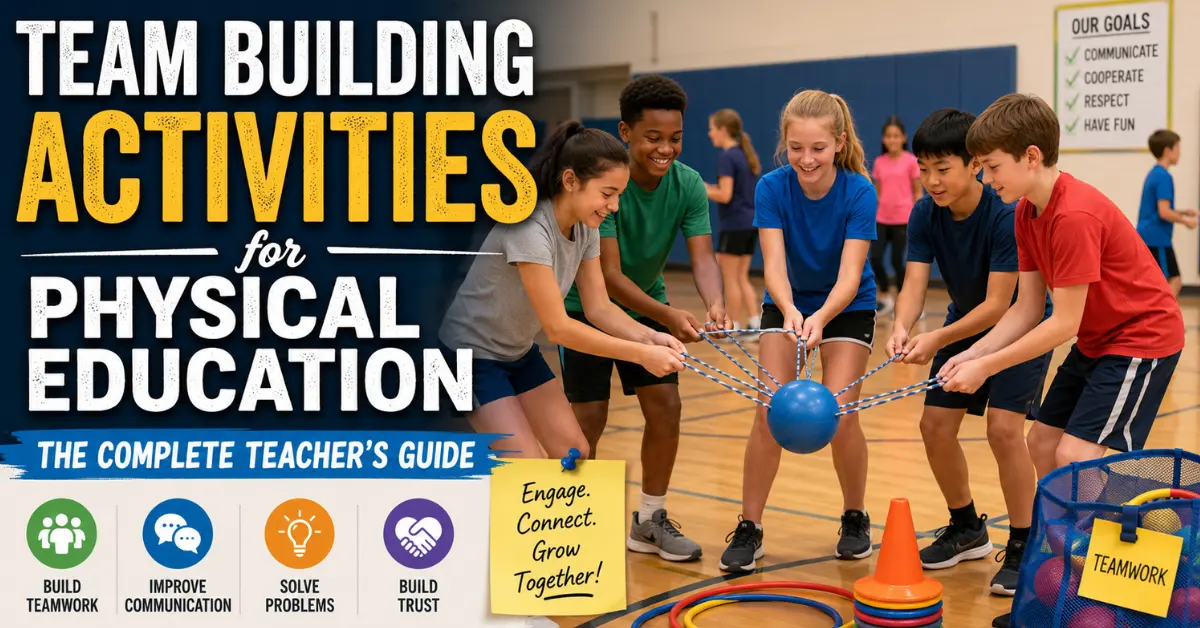
If you need team building activities for physical education that actually work in a 30-minute class, here are eight tested options sorted by grade level, group size, and equipment, so you can grab one in the next two minutes and walk into the gym ready.
| Activity | Best Grade | Group Size | Time | Equipment | Skill Focus |
|---|---|---|---|---|---|
| Human Knot | 3-8 | 6-10 | 8-10 min | None | Problem-solving |
| Stepping Stones (River Crossing) | K-6 | 4-6 | 15 min | Poly spots or mats | Cooperation |
| Hula Hoop Pass | K-5 | 6-12 | 8 min | 1 hoop per group | Communication |
| Minefield | 4-8 | Pairs | 12 min | Cones, blindfolds | Trust |
| Group Juggling | 2-8 | 6-15 | 10 min | Soft balls | Focus, teamwork |
| Parachute Pop-Up | K-4 | Whole class | 10 min | Parachute, balls | Coordination |
| All Aboard | 3-8 | 5-8 | 15 min | Tarp or mat | Strategy |
| Lap Sit Circle | 5-12 | 8-20 | 5 min | None | Trust, balance |
Pick the activity that fits your space and class size, then jump to the setup instructions, grade-by-grade variations, and the troubleshooting section below for handling reluctant or dominant students.
Why Team Building Activities for Physical Education Matter
Team building activities in physical education do more than fill five minutes before the “real” lesson starts. SHAPE America’s National Standards for K-12 Physical Education list “exhibits responsible personal and social behavior” as Standard 4, and cooperative games are one of the few PE formats that hit that standard directly, on purpose, every time they’re played.
Cooperative games and team building challenges give students a chance to practice leadership and empathy while working toward clear physical education objectives that extend far beyond simple physical fitness.
Beyond classroom management, team building activities for physical education build skills that travel well past the gym walls: verbal communication, conflict resolution, spatial problem-solving, and, especially for younger kids, the realization that winning together feels better than winning alone.
How to Run Team Building Activities for Physical Education (Step-by-Step)
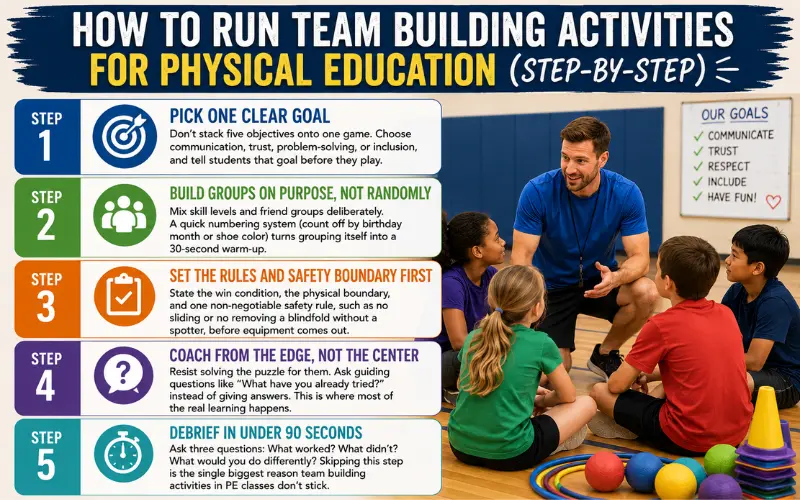
Step 1: Pick one clear goal
Don’t stack five objectives onto one game. Choose communication, trust, problem-solving, or inclusion, and tell students that goal before they play.
Step 2: Build groups on purpose, not randomly
Mix skill levels and friend groups deliberately. A quick numbering system (count off by birthday month or shoe color) turns grouping itself into a 30-second warm-up.
Step 3: Set the rules and safety boundary first
State the win condition, the physical boundary, and one non-negotiable safety rule, such as no sliding or no removing a blindfold without a spotter, before equipment comes out.
Step 4: Coach from the edge, not the center
Resist solving the puzzle for them. Ask guiding questions like “What have you already tried?” instead of giving answers. This is where most of the real learning happens.
Step 5: Debrief in under 90 seconds
Ask three questions: What worked? What didn’t? What would you do differently? Skipping this step is the single biggest reason team building activities in PE classes don’t stick.
Step-by-Step Instructions for the Best Team Building Activities for PE
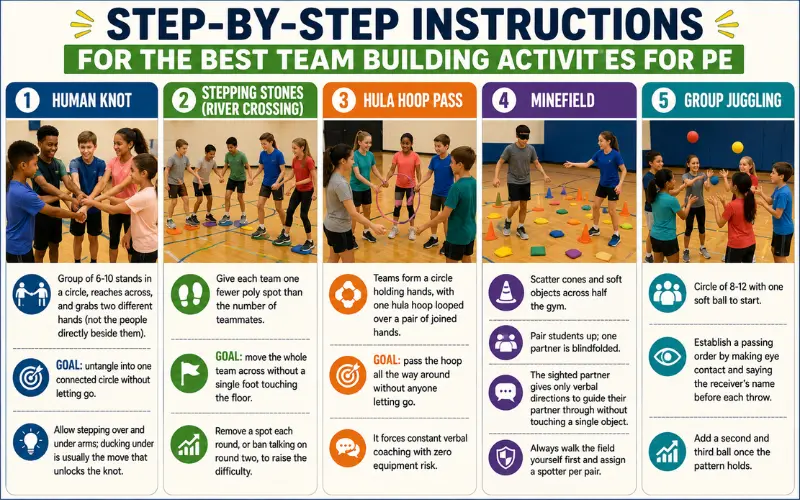
Human Knot
Group of 6-10 stands in a circle, reaches across, and grabs two different hands (not the people directly beside them). Goal: untangle into one connected circle without letting go. Allow stepping over and under arms; ducking under is usually the move that unlocks the knot.
Stepping Stones (River Crossing)
Give each team one fewer poly spot than the number of teammates. Mark a start and finish line 15-20 feet apart as the “river.” Goal: move the whole team across without a single foot touching the floor. Remove a spot each round, or ban talking on round two, to raise the difficulty.
Hula Hoop Pass
Teams form a circle holding hands, with one hula hoop looped over a pair of joined hands. Goal: pass the hoop all the way around without anyone letting go. It forces constant verbal coaching with zero equipment risk.
Minefield
Scatter cones and soft objects across half the gym. Pair students up; one partner is blindfolded. The sighted partner gives only verbal directions to guide their partner through without touching a single object. Always walk the field yourself first and assign a spotter per pair.
Group Juggling
Circle of 8-12 with one soft ball to start. Establish a passing order by making eye contact and saying the receiver’s name before each throw. Add a second and third ball once the pattern holds.
Team Building Activities for PE by Grade Level
- K-2: Keep rules to one sentence and skip blindfolds entirely. Parachute Pop-Up and Stepping Stones with extra spots work best, because young students need to see success fast.
- Grades 3-5: The sweet spot for Human Knot, Hula Hoop Pass, and full-length Stepping Stones with a silent round. Students can now handle multi-step rules and short debriefs.
- Middle School (6-8): Add Minefield, double-ball Group Juggling, and “All Aboard,” where teams fold a tarp in half and try to fit the whole group on it. Middle schoolers respond well to a light competitive layer on top of the cooperative goal.
- High School (9-12): Lean into low-prop, high-thinking challenges: Lap Sit Circle, silent height or birthday line-ups, and leadership-rotation versions of any game above, where a different student calls the strategy each round.
No-Equipment Team Building Activities for Physical Education
Out of gear, outdoors with nothing but a field, or covering someone else’s class? These need zero equipment: Human Knot, Lap Sit Circle, silent Birthday Line-Up, and Group Juggling with an imaginary ball, mimed and named aloud. They’re also the fastest team building activities to set up between periods, which makes them perfect as a five-minute opener rather than a full lesson.
Troubleshooting Common Problems With Team Building Activities for Physical Education
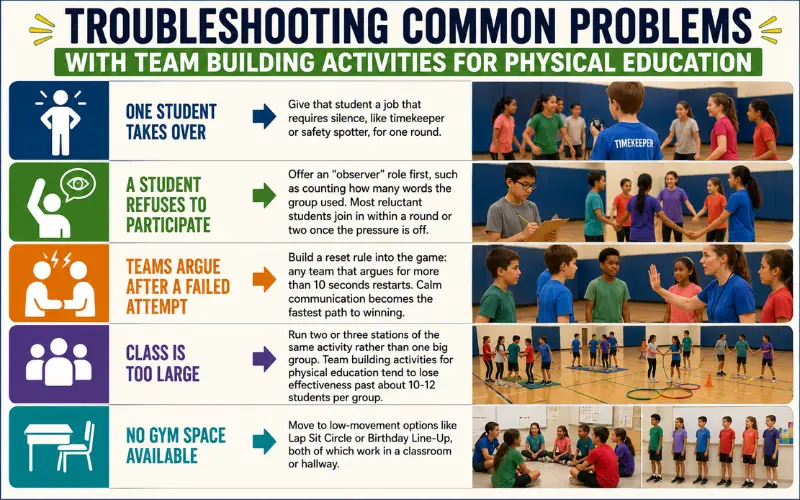
One student takes over
Give that student a job that requires silence, like timekeeper or safety spotter, for one round.
A student refuses to participate
Offer an “observer” role first, such as counting how many words the group used. Most reluctant students join in within a round or two once the pressure is off.
Teams argue after a failed attempt
Build a reset rule into the game: any team that argues for more than 10 seconds restarts. Calm communication becomes the fastest path to winning.
Class is too large
Run two or three stations of the same activity rather than one big group. Team building activities for physical education tend to lose effectiveness past about 10-12 students per group.
No gym space available
Move to low-movement options like Lap Sit Circle or Birthday Line-Up, both of which work in a classroom or hallway.
FAQ: Team Building Activities for Physical Education
What are the best team building activities for physical education?
Human Knot, Stepping Stones, Hula Hoop Pass, Minefield, and Group Juggling consistently work across grade levels because they need little equipment and finish in under 15 minutes.
How long should a PE team building activity last?
Aim for 8-15 minutes, including a 60-90 second debrief. Beyond that, engagement drops, especially below grade 5.
Can team building activities replace a regular PE lesson?
Occasionally. They work well as a full lesson at the start of a semester, after a break, or following a conflict in class. Most weeks, a 10-minute opener is enough.
Do team building activities need special equipment?
No. Several activities above use nothing but open space, which makes them usable in a classroom, hallway, or outdoor field.
What is the purpose of team building activities in physical education?
The purpose is to teach communication, trust, and problem-solving through movement, while meeting SHAPE America Standard 4 for responsible personal and social behavior in a way a worksheet or lecture can’t.
How do you assess team building activities in PE class?
Use a quick observation checklist during the debrief: did the student communicate, include teammates, and handle frustration well? Most teachers score this as part of a participation or social-skills rubric, not a pass/fail grade.
What’s the difference between team building activities and regular team sports in PE?
Team sports reward individual skill and competition between teams. Team building activities for physical education remove the competitive element (or make it secondary) so the entire group succeeds or fails together, which is what drives the cooperative skill-building.
How many team building activities should a PE teacher use per semester?
Most teachers rotate through 6-10 activities per semester, reusing favorites every few weeks with a harder variation. Repetition with rising difficulty builds more skill than introducing a brand-new game every single class.
Final Thoughts
The right team building activities for physical education aren’t the ones with the fanciest setup—they’re the ones you run consistently, with a clear goal and a meaningful debrief at the end. Start with one of the team building activities for physical education featured in this guide, then gradually introduce new challenges as students become more comfortable working together. When implemented regularly, team building activities for physical education help strengthen communication, cooperation, problem-solving, and trust among students. Over the course of a semester, team building activities for physical education stop being a “filler day” activity and become one of the most effective tools for creating a positive, supportive, and collaborative learning environment.