
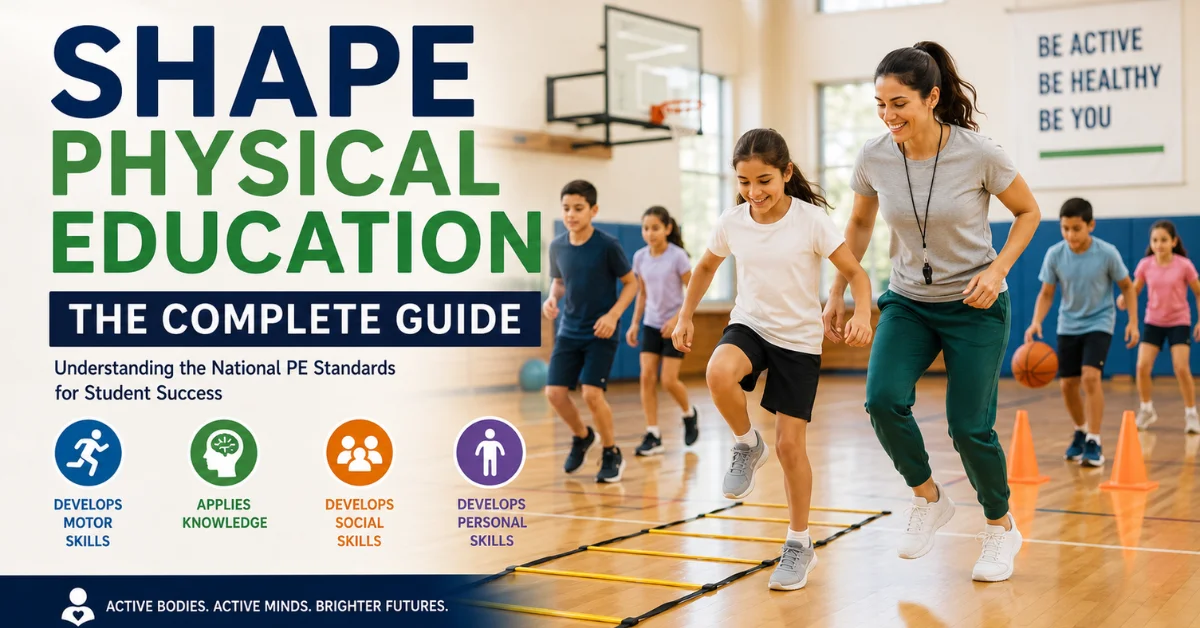
If you’ve been searching for SHAPE physical education, you’re likely trying to understand what these standards actually mean and why they matter in today’s schools. SHAPE physical education serves as the national framework for quality physical education in the United States, helping educators develop students’ motor skills, movement knowledge, social development, and lifelong physical activity habits.
The latest update introduced significant changes to SHAPE physical education, replacing the previous five-standard framework with a more streamlined four-standard model focused on physical literacy, student choice, and lifelong engagement in movement. Whether you’re a teacher, parent, administrator, or student, understanding SHAPE physical education provides valuable insight into what effective physical education should look like in modern schools.
What SHAPE America Actually Is
SHAPE America started in 1885 in Brooklyn, New York, under physical educator Edward Hitchcock. Over nearly 140 years, it went through several name changes — most recently as the American Alliance for Health, Physical Education, Recreation and Dance (AAHPERD) — before rebranding as SHAPE America in 2014. Today it’s headquartered near Baltimore, Maryland, and represents more than 200,000 health and physical education professionals across all 50 states through a network of state affiliate organizations.
The organization’s job isn’t to run schools or write laws. It’s a professional association, which means its standards are voluntary — no federal law requires a school to adopt them. But here’s why they carry weight anyway: most state departments of education build their own PE frameworks directly off the SHAPE America standards, teacher certification programs are evaluated against them, and textbook publishers, curriculum companies, and PE software platforms all design their products to align with them. In practice, even if a standard isn’t legally mandated, it’s the closest thing physical education has to a national curriculum.
The Four National Physical Education Standards
After a three-year revision process involving public comment, focus groups, and a research team at the University of Illinois at Urbana-Champaign, SHAPE America released a substantially revised set of standards. Instead of five standards, there are now four, organized around four learning domains: psychomotor (physical skill), cognitive (knowledge), affective (personal/emotional), and social (interpersonal) — the social domain being newly elevated to its own category.
Here’s what each standard means in plain language, with what it actually looks like at different grade levels.
Standard 1: Develops a Variety of Motor Skills
This is the physical “doing” standard — running, jumping, throwing, catching, balancing, striking, dribbling. The key word is variety. A student shouldn’t just master kickball; they should build a broad movement vocabulary they can apply across sports, dance, fitness activities, and recreation for the rest of their life.
- PreK–2: Non-locomotor and locomotor basics — hopping, skipping, transferring weight, simple ball bounces.
- Grades 3–5: Combining skills in practice tasks, like dribbling while moving or striking with a long-handled implement.
- Grades 6–8: Sport-specific technique inside small-sided games, plus dance sequences and outdoor activity skills.
- Grades 9–12: Activity-specific competence in lifetime sports — pickleball, weight training, hiking, swimming — the kinds of activities students might actually keep doing after graduation.
Standard 2: Applies Knowledge Related to Movement and Fitness Concepts
This is the “thinking” standard. It covers tactics and strategy (when to pass vs. shoot, how to create space on offense) and fitness literacy (understanding the FITT principle — Frequency, Intensity, Time, Type — heart rate, warm-ups, and the difference between health-related and skill-related fitness components).
By high school, this standard expects students to design their own training plan, evaluate perceived exertion, and explain how fitness habits formed now affect their health as adults. That’s a meaningfully higher bar than “know how to do a sit-up.”
Standard 3: Develops Social Skills Through Movement
This standard didn’t exist as its own category — it used to be folded into “personal and social behavior.” Now it stands alone, covering communication, leadership, conflict resolution, empathy, and cultural awareness, all practiced through physical activity settings.
Practically, this is where teamwork, sportsmanship, accepting feedback, and respecting differing abilities and backgrounds live. It also explicitly includes recognizing the cultural origins of games, sports, and dance — a notable addition that earlier versions of the standards touched on only lightly.
Standard 4: Develops Personal Skills, Identifies Personal Benefits of Movement, and Chooses to Engage in Physical Activity
This is the standard most directly tied to whether a student becomes a physically active adult — and it’s arguably the most student-centered standard SHAPE America has ever written. It covers goal-setting, self-reflection, emotional regulation during activity, and — critically — choice. Older students are expected to select activities based on their own interests rather than simply complete whatever the teacher assigns.
If you only remember one thing about the revision, make it this: the standards now treat the student as the owner of their own physical literacy journey, not a passive recipient of instruction.
What Changed From the 2013 Standards (and Why It Matters)
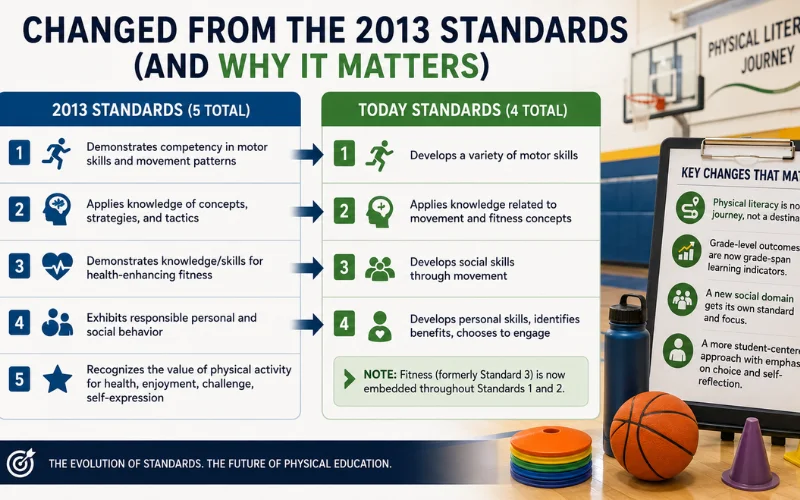
Most content you’ll find online — including pages from school districts and PE technology vendors — is still quoting the 2013 standards. If your school, blog, or curriculum references “five SHAPE standards,” it’s describing a framework that’s been retired. Here’s a direct comparison:
| 2013 Standards (5 total) | Today Standards (4 total) |
|---|---|
| 1. Demonstrates competency in motor skills and movement patterns | 1. Develops a variety of motor skills |
| 2. Applies knowledge of concepts, strategies, and tactics | 2. Applies knowledge related to movement and fitness concepts |
| 3. Demonstrates knowledge/skills for health-enhancing fitness | (folded into Standards 1 and 2 — fitness is now embedded throughout rather than standalone) |
| 4. Exhibits responsible personal and social behavior | 3. Develops social skills through movement |
| 5. Recognizes the value of physical activity for health, enjoyment, challenge, self-expression | 4. Develops personal skills, identifies benefits, chooses to engage |
Beyond the standard count, four structural changes matter just as much:
- “Physical literacy” became “physical literacy journey.” The 2013 language implied physical literacy was a fixed destination a student could “achieve.” The new framing treats it as an ongoing, individualized process — which changes how teachers are expected to assess it.
- Grade-level outcomes became grade-span learning indicators. Instead of rigid, age-locked benchmarks, the new standards group expectations across PreK–2, 3–5, 6–8, and 9–12, with sample learning progressions showing how a skill develops over time. This acknowledges that motor development depends more on practice opportunity than on a student’s exact age or grade.
- A new social domain. Previously bundled with personal behavior, social skill development now gets its own standard and its own dedicated attention in curriculum design.
- A more student-centered approach overall, most visible in Standard 4’s emphasis on choice, autonomy, and self-reflection.
If you’re a curriculum writer, instructional coach, or PE software provider still publishing materials based on the 2013 framework, this is worth fixing — both for accuracy and because Google increasingly rewards content that reflects the current, correct version of a topic.
Why These Standards Actually Matter (Beyond Compliance)
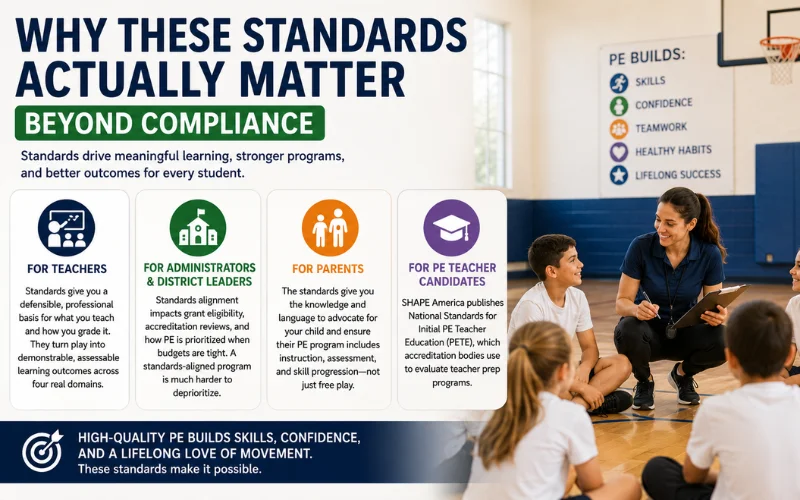
It’s easy to treat “standards” as bureaucratic paperwork. They’re not, and here’s the practical case for each audience.
For teachers
the standards give you a defensible, professional basis for what you teach and how you grade it. When an administrator questions why class time is “just playing games,” the standards are your answer — they translate play into demonstrable, assessable learning outcomes across four real domains, not just physical exertion.
For school administrators and district leaders
standards alignment affects grant eligibility (including federal PEP grants), accreditation reviews, and how PE is weighted against academic subjects when budgets get cut. A PE program that can show clear standards alignment is much harder to deprioritize than one that can’t.
For parents
understanding the standards gives you language to advocate for your child. If your school’s PE program is mostly free play with no instruction, no assessment, and no skill progression, you now know what a standards-aligned program should actually include — and you have specific, professional terminology to raise with a teacher or principal rather than a vague complaint about “not enough gym class.”
For PE teacher candidates
SHAPE America also publishes separate National Standards for Initial Physical Education Teacher Education (PETE), which accreditation bodies use to evaluate teacher prep programs. If you’re studying to become a PE teacher, expect your coursework to be evaluated against both the K-12 standards and the PETE standards.
Turning Standards Into Real Lesson Plans
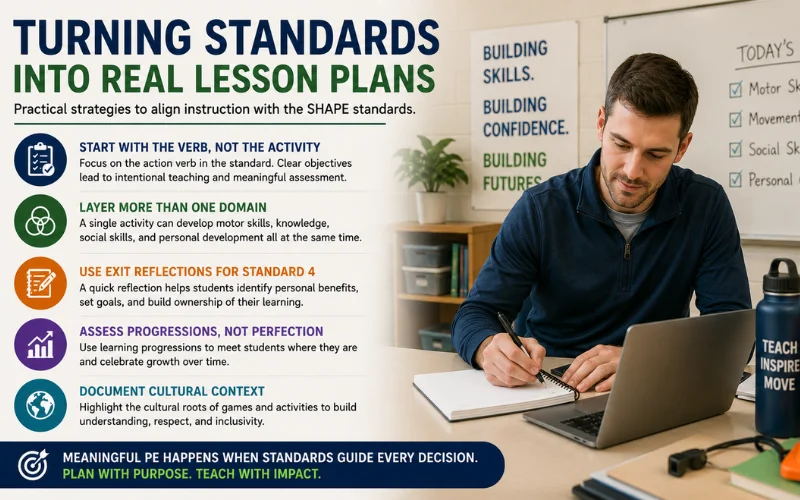
Knowing the standards exist is one thing. Building a week of instruction around them is another. Here’s a practical way to think about alignment without rewriting your entire curriculum from scratch.
Start with the verb, not the activity
Each grade-span indicator uses an action verb — demonstrates, applies, identifies, explains, sets, reflects. Before planning an activity, ask which verb you’re actually targeting. “Students will play kickball” isn’t a standard-aligned objective. “Students will demonstrate a proper underhand throwing technique in a small-sided game” is — and it tells you exactly what to watch for and assess.
Layer more than one domain into a single activity
A well-designed tag game can hit psychomotor (locomotor movement), cognitive (spatial strategy), social (fair play, including others), and affective (choosing effort level) simultaneously. You don’t need four separate activities to cover four standards in one class period.
Use exit reflections for Standard 4
A 90-second written or verbal reflection at the end of class — “What did you do well today, and what activity would you choose to repeat outside of school?” — is a low-effort, high-value way to hit the self-reflection and personal-interest components that the standards emphasize heavily.
Assess progressions, not perfection
Because indicators are now grade-span rather than grade-level, a 4th grader who’s still working on a 3rd-grade skill indicator isn’t automatically “behind.” The learning progressions exist precisely to let teachers meet students where they are.
Document cultural context where it fits naturally
Standard 3 now explicitly includes recognizing the cultural roots of games and movement traditions. A short, genuine note on where a game like capoeira-inspired movement, lacrosse, or jump rope traditions originated adds real instructional depth without derailing the lesson.
Common Myths About SHAPE Physical Education
Myth: SHAPE PE standards are a federal requirement
False. They’re a voluntary professional framework. States and districts choose how much to adopt, adapt, or ignore. That said, most state PE frameworks borrow heavily from them, so in practice they shape instruction almost everywhere.
Myth: “SHAPE” stands for something related to body shape or fitness testing
No — SHAPE is an acronym for Society of Health and Physical Educators. It’s the name of the organization, not a description of a fitness program or body-composition goal.
Myth: Meeting the standards means students have to pass a fitness test
Not necessarily. The standards cover skill development, knowledge, social behavior, and personal engagement — fitness testing is just one possible assessment tool among many, and SHAPE America’s own guidance discourages using fitness test scores punitively or as a grade.
Myth: The standards are the same as a curriculum
They’re not. Standards describe the destination — what a student should know and be able to do. A curriculum is the actual sequenced plan (units, lessons, assessments) a district or teacher builds to get there. Two schools can both be “standards-aligned” and look completely different in daily practice.
Frequently Asked Questions
1. What is SHAPE physical education?
SHAPE physical education refers to the National Physical Education Standards developed by SHAPE America (Society of Health and Physical Educators). These standards outline what students should know and be able to do in physical education from PreK through Grade 12.
2. What does SHAPE stand for in SHAPE physical education?
In SHAPE physical education, SHAPE stands for the Society of Health and Physical Educators, a national professional organization dedicated to advancing health and physical education.
3. How many standards are included in SHAPE physical education?
The latest version of SHAPE physical education, released in, includes four National Physical Education Standards. Older versions featured five standards.
4. Is SHAPE physical education required by law?
No. SHAPE physical education standards are voluntary. However, many state education departments use them as the foundation for their own physical education standards and curriculum frameworks.
5. What changed in the SHAPE physical education update?
The SHAPE physical education revision reduced the standards from five to four, introduced a dedicated social skills standard, emphasized student choice, and adopted grade-span learning indicators instead of rigid grade-level outcomes.
6. Why is SHAPE physical education important?
SHAPE physical education helps ensure that students develop motor skills, movement knowledge, social competence, personal responsibility, and lifelong physical activity habits rather than simply participating in recreational games.
7. Who uses SHAPE physical education standards?
Teachers, school districts, curriculum developers, teacher preparation programs, and state education agencies commonly use SHAPE physical education standards to guide instruction and assessment.
8. Does SHAPE physical education focus only on fitness?
No. While fitness is important, SHAPE physical education also emphasizes motor skill development, movement concepts, social skills, emotional growth, and lifelong engagement in physical activity.
9. How does SHAPE physical education benefit students?
SHAPE physical education supports physical health, cognitive development, teamwork, leadership, self-confidence, problem-solving, and long-term wellness through structured learning experiences.
10. Where can I find the official SHAPE physical education standards?
The official SHAPE physical education standards can be found on SHAPE America’s website, where educators and schools can access the latest standards, guidance documents, and implementation resources.
Final Thoughts
SHAPE physical education is much more than a set of recommendations for gym class. It represents a comprehensive framework designed to help students develop physical competence, movement knowledge, social skills, and a lifelong appreciation for physical activity. The revision modernized SHAPE physical education by emphasizing student-centered learning, social development, and the concept of a lifelong physical literacy journey.
For teachers, SHAPE physical education provides a roadmap for creating meaningful, standards-aligned lessons. For parents, it offers a clear understanding of what quality physical education should include. And for students, it creates opportunities to build healthy habits, confidence, and skills that can last a lifetime. As schools continue to prioritize whole-child development, SHAPE physical education remains one of the most influential frameworks guiding physical education programs across the country.