
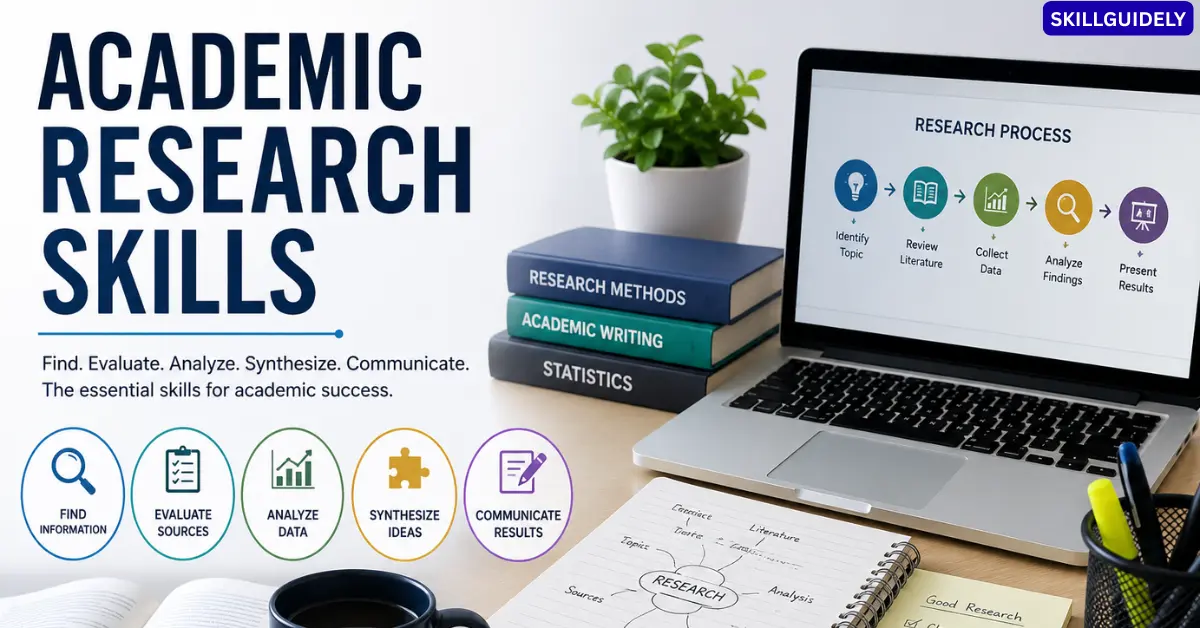
Academic success is not just about reading textbooks or memorizing notes. The real difference between average and top-performing students comes down to one powerful ability: academic research skills.
These skills help you find accurate information, understand complex topics, and turn raw data into meaningful knowledge. In simple terms, academic research skills teach you how to think smarter, not harder.
In this guide, you will learn what academic research skills are, why they matter, and how to develop them using practical methods that go beyond typical textbook explanations.
You are suggested for this course
Academic Skills: Complete Guide to Learn, Improve & Succeed
What Are Academic Research Skills?
Academic research skills are the abilities used to find, evaluate, organize, and use information for study or academic writing.
They help students answer questions like:
- Why is this topic important?
- Which sources are trustworthy?
- How can I explain this clearly in my assignment?
Instead of just collecting information, academic research skills help you understand and apply it effectively in essays, reports, and projects.
Why Academic Research Skills Matter Today
Strong academic research skills are essential in modern education because information is everywhere, but not all of it is reliable.
Students with strong research skills can:
- Understand subjects deeply instead of memorizing blindly
- Write better essays and assignments
- Avoid plagiarism and misinformation
- Improve critical thinking and decision-making
- Perform better in exams and projects
In simple terms, good research skills turn confusion into clarity.
Core Academic Research Skills You Need
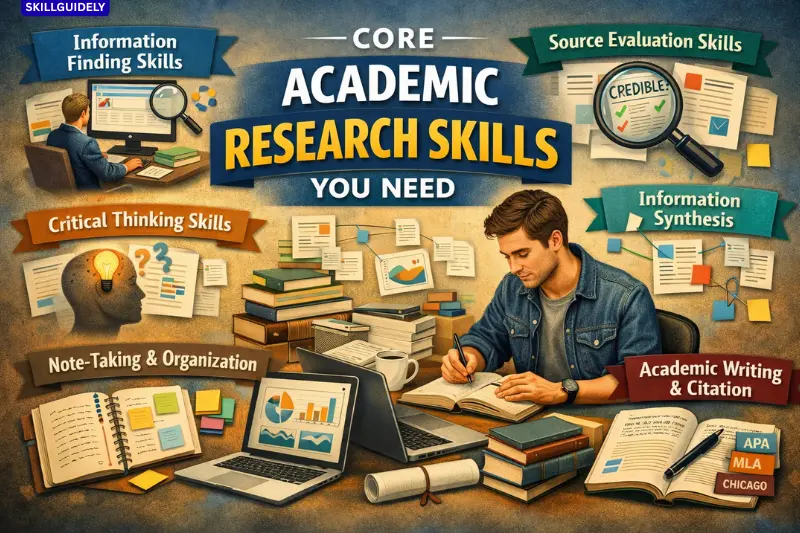
To master academic research, you need to develop several connected skills. Let’s break them down in a simple way.
Information Finding Skills
This is your ability to locate relevant and reliable information.
It includes:
- Using search engines effectively
- Finding academic journals and books
- Using Google Scholar and library databases
- Understanding keywords and search queries
A strong researcher does not just search randomly. They search strategically.
Source Evaluation Skills
Not every source on the internet is trustworthy. Academic research requires careful checking.
You should evaluate:
- Who wrote the information
- When it was published
- Whether it is backed by evidence
- If it comes from a reliable platform
This skill protects you from using weak or fake information in your work.
Critical Thinking Skills
Critical thinking is the heart of academic research skills.
It means:
- Questioning information instead of accepting it
- Comparing different viewpoints
- Identifying bias or misleading claims
- Drawing logical conclusions
Without critical thinking, research becomes simple copying. With it, research becomes powerful analysis.
Note-Taking and Organization
Good research is useless if you forget it.
Strong students:
- Write structured notes
- Summarize key ideas in simple words
- Organize information by topic
- Use tools like digital notebooks or folders
This makes writing essays much faster and cleaner.
Data Interpretation Skills
Some academic work includes charts, statistics, and reports.
You should be able to:
- Understand graphs and tables
- Identify trends and patterns
- Explain what data actually means
- Connect numbers to real-world ideas
This skill is especially important in science, business, and social studies.
Information Synthesis
This is a high-level academic skill that many students struggle with.
Synthesis means combining ideas from different sources into one clear explanation.
Instead of repeating one article, you:
- Compare multiple sources
- Find similarities and differences
- Build your own explanation
This is what makes academic writing original and strong.
Academic Writing and Citation
Research is incomplete without proper writing.
You must:
- Present information clearly
- Use structured paragraphs
- Follow citation styles like APA or MLA
- Give credit to original authors
This avoids plagiarism and increases credibility.
Step-by-Step Process of Academic Research (Detailed Guide)

A strong research process is the backbone of every good assignment, essay, or academic project. If you follow a clear system, you don’t just collect information—you actually understand it and turn it into meaningful academic work.
Below is a simple but powerful step-by-step workflow for academic research that works for any subject.
Step 1: Understand the Topic Clearly
The first and most important step in academic research is fully understanding what the question is asking. Many students lose marks here because they rush into searching without clarity.
Start by reading the question slowly and carefully. Break it into smaller parts so you clearly understand the focus, the task, and the expected outcome.
Ask yourself:
- What is the main topic?
- Am I being asked to explain, analyze, compare, or evaluate?
- What specific keywords define this question?
- What is the scope—broad or narrow?
Once you understand the topic, try rewriting it in your own simple words. This helps you stay focused and avoid going off-track during research.
A clear understanding at this stage saves time later and makes your entire research process more effective.
Step 2: Search for Reliable Information
After understanding the topic, the next step is to collect relevant and trustworthy information.
This is where your research skills really begin to matter.
Instead of using random websites, focus on credible academic and professional sources such as:
- Academic databases like Google Scholar or university libraries
- Published books and textbooks
- Research journals and articles
- Educational and government websites
While searching, use specific keywords instead of broad terms. For example, instead of searching “climate change,” try “effects of climate change on agriculture.”
This helps you find more accurate and useful information quickly.
The goal here is not to collect everything, but to collect the right information.
Step 3: Filter and Evaluate Sources Carefully
Not all information you find is useful or reliable. This step is about separating strong sources from weak ones.
Before using any source, check its credibility by asking:
- Who is the author, and are they an expert in the field?
- Is the information recent and up to date?
- Is the source backed by evidence or just opinion?
- Is it from a trusted platform like a journal, university, or research site?
Also, compare multiple sources. If different reliable sources say the same thing, the information is more likely to be accurate.
Avoid using blogs, unverified websites, or outdated material unless they are necessary for context.
This step ensures your research is academically strong and trustworthy.
Step 4: Take Organized and Clear Notes
Once you have reliable sources, the next step is organizing the information in a simple and structured way.
Do not copy and paste. Instead, read, understand, and then rewrite the key points in your own words.
Good note-taking should include:
- Main ideas from each source
- Important facts or evidence
- Key definitions or concepts
- Your own short comments or thoughts
You can organize notes by headings, topics, or themes. This makes it easier to use them later when writing your final assignment.
Clear notes save time and reduce confusion during writing.
Step 5: Analyze and Compare Information
This is where academic research becomes more advanced and meaningful.
Instead of just collecting facts, you now start thinking deeply about the information.
Ask yourself:
- What patterns can I see in the data or ideas?
- How are different sources similar or different?
- Which arguments are stronger and why?
- What conclusions can I draw from this information?
This step helps you move from simple learning to critical thinking.
When you compare different viewpoints, you also build stronger arguments in your academic writing. This is what makes your work stand out.
Step 6: Create Your Final Answer or Assignment
Now that you have all the information, it is time to turn it into a clear and structured final output.
Start by creating a basic outline of your work. Divide it into sections such as introduction, main discussion, and conclusion.
Then write in a clear and simple style:
- Use your own words instead of copying
- Explain ideas logically step by step
- Support your points with evidence from your research
- Keep paragraphs short and focused
Make sure your writing flows smoothly from one idea to another.
Finally, review your work to check:
- Clarity and readability
- Grammar and structure
- Proper use of references and citations
A well-written final answer reflects not just knowledge, but also strong academic research skills.
Final Tip
A good academic research process is not about speed—it is about clarity, accuracy, and understanding. When you follow these steps properly, your assignments become easier, more structured, and much more impressive.
Write your assignment using structured and clear explanations.
Tools That Improve Academic Research Skills
Modern students use digital tools to research faster and smarter.
Some useful tools include:
- Google Scholar for academic papers
- Zotero for reference management
- Notion for note organization
- Grammarly for writing improvement
- ChatGPT for idea structuring and explanation support
These tools do not replace skills—they enhance them.
Common Mistakes Students Make in Research
Many students lose marks because of simple mistakes.
Avoid these:
- Using only one source
- Copy-pasting instead of understanding
- Ignoring source credibility
- Poor note organization
- Not citing sources properly
Fixing these mistakes instantly improves your academic performance.
Real-Life Use of Academic Research Skills
Academic research skills are not just for exams. They are useful in real life too.
You use them when:
- Making important decisions
- Comparing products or services
- Writing blogs or content
- Preparing presentations
- Solving personal or professional problems
These skills make you more independent and confident in thinking.
How to Improve Academic Research Skills
Improving research skills takes practice, not pressure.
You can improve by:
- Reading academic articles regularly
- Practicing summary writing
- Comparing multiple sources daily
- Using digital research tools
- Asking “why” and “how” questions often
The more you practice, the sharper your thinking becomes.
FAQs on Academic Research Skills
What are academic research skills?
Academic research skills are the abilities used to find, evaluate, organize, and apply information in a structured and reliable way for study, assignments, and academic writing. These skills help students understand topics deeply instead of just memorizing facts.
Why are academic research skills important for students?
Academic research skills are important because they improve critical thinking, writing quality, and problem-solving ability. Students who develop these skills can complete assignments more effectively, use credible sources, and present well-structured arguments in exams and projects.
What are the main academic research skills?
The main academic research skills include information searching, source evaluation, critical thinking, note-taking, data interpretation, information synthesis, and academic writing with proper citation. Each skill helps improve the overall quality of research and learning.
How can I improve my academic research skills?
You can improve academic research skills by practicing regular reading, using reliable academic sources, taking organized notes, comparing different viewpoints, and analyzing information instead of copying it. Using tools like Google Scholar and digital note apps also helps a lot.
What is the first step in academic research?
The first step is understanding the topic clearly. You must read the question carefully, identify keywords, and understand what is being asked before starting your research. This helps you stay focused and avoid irrelevant information.
How do I find reliable sources for academic research?
Reliable sources include academic journals, books, university websites, research databases, and trusted educational platforms. Always check the author’s expertise, publication date, and evidence before using any source in your work.
What is source evaluation in academic research?
Source evaluation is the process of checking whether information is trustworthy and accurate. It involves analyzing the credibility of the author, the quality of evidence, and whether the information is up to date and unbiased.
What is the difference between research and information gathering?
Information gathering is simply collecting data, while research involves analyzing, evaluating, and interpreting that data to form meaningful conclusions. Research is deeper and more structured than just collecting information.
Can academic research skills be used outside school?
Yes, academic research skills are very useful in real life. They help in making informed decisions, understanding complex topics, comparing options, and solving problems in professional and personal situations.
What tools can help improve academic research skills?
Useful tools include Google Scholar for academic papers, Zotero for references, Notion for organizing notes, Grammarly for writing improvement, and AI tools for summarizing and structuring information.
Final Thoughts on Academic Research Skills
Academic research skills are not just study tools—they are life skills. They help you understand information clearly, think critically, and express ideas with confidence.
Students who master these skills don’t just pass exams—they understand the world better.
If you build strong academic research skills today, you are not just preparing for school—you are preparing for success in every field you enter.