

When I first started helping family law attorneys with their marketing, I noticed something striking: most of them were brilliant lawyers, but almost invisible online. Meanwhile, potential clients — people going through some of the hardest moments of their lives — were desperately searching Google for help and landing on the wrong firm, or giving up entirely.
That gap between a great attorney and the client who needs them is exactly what family law digital marketing is designed to close.
This guide is not a generic list of tips you have already seen a dozen times. It goes deeper. It covers what most competitors skip — the emotional psychology of your potential clients, how to use AI tools to save hours every week, how to build a referral network that feeds your firm for years, and how to measure every dollar you spend on marketing.
Whether you are a solo attorney just starting out or a multi-attorney firm ready to scale, this guide will give you a clear, practical roadmap.
Why Family Law Digital Marketing Is Different — And Why Most Firms Get It Wrong
Family law is not like other legal niches. Someone searching for a divorce attorney is not comparison-shopping the way they might look for a plumber. They are scared, overwhelmed, possibly sleep-deprived, and under enormous emotional pressure. Many are searching from their phones at 11 PM, hiding in the bathroom so their spouse does not see.
Most family law digital marketing treats these people like any other consumer looking for a service. That is a mistake.
In my experience working with family law firms, the attorneys who attract the most clients online share one trait: they market with genuine empathy. Their websites feel human. Their content acknowledges real pain. Their tone says, “We understand what you are going through” — not just “We win cases.”
That human-first approach, combined with technical digital marketing excellence, is what this guide is built around.
Build a Website That Earns Trust in 10 Seconds
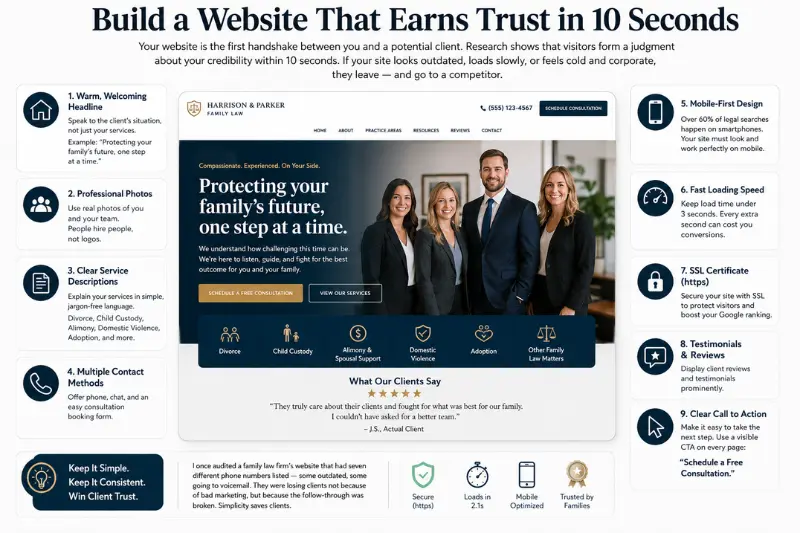
Your website is the first handshake between you and a potential client. Research shows that visitors form a judgment about your credibility within 10 seconds. If your site looks outdated, loads slowly, or feels cold and corporate, they leave — and go to a competitor.
What your family law website must have:
- A warm, welcoming homepage headline that speaks to the client’s situation, not just your services. Example: “Protecting your family’s future, one step at a time.”
- A professional photo of you and your team — not a stock image. People hire people, not logos.
- Clear, jargon-free descriptions of each service: divorce, child custody, alimony, domestic violence, adoption, and more.
- Multiple contact methods: phone, chat, and an easy consultation booking form.
- A mobile-first design, since over 60% of legal searches happen on smartphones.
- Page load speed under 3 seconds — every additional second costs you conversions.
- An SSL certificate (“https”) to signal security to both visitors and Google.
- Testimonials and client reviews displayed prominently.
- A clear, visible call to action on every page: “Schedule a Free Consultation.”
I once audited a family law firm’s website that had seven different phone numbers listed — some outdated, some going to voicemail. They were losing clients not because of bad marketing, but because the follow-through was broken. Simplicity saves clients.
SEO for Family Law Firms: How to Rank Where It Counts
Search engine optimization (SEO) is the backbone of sustainable family law digital marketing. Unlike paid ads, which stop the moment you stop paying, good SEO keeps delivering traffic for months and years.
Target the right keywords
Most family law firms make the mistake of targeting broad terms like “family lawyer” or “divorce attorney.” These are competitive and expensive. Instead, focus on long-tail, intent-driven keywords:
- “divorce attorney in [your city]”
- “how to get full custody of my child in [state]”
- “what happens to the house in a divorce [state]”
- “emergency custody order [city]”
- “contested vs uncontested divorce [state]”
These keywords have lower competition and attract people who are ready to hire — not just browsing.
On-page SEO checklist
- Include your target keyword in the page title, H1 heading, first paragraph, and at least two subheadings.
- Write unique meta descriptions for every page — not auto-generated snippets.
- Use internal links to connect related pages (e.g., your divorce page should link to your child custody page).
- Optimize images with descriptive alt text.
- Add schema markup (LocalBusiness and LegalService schemas) so Google understands your firm’s location, services, and reviews.
- Create a dedicated page for each service and each location you serve.
Hyper-Local SEO: Win Clients in Your Own Backyard
Most guides on family law digital marketing mention “local SEO” and leave it at that. But local SEO is where the real opportunity lives, especially for small and mid-size firms. Here is how to go beyond the basics.
Optimize your Google Business Profile
- Claim and verify your profile at business.google.com.
- Fill out every field: hours, services, attributes, photos of your office and team.
- Post weekly Google Business updates — announcements, legal tips, community events.
- Enable messaging so potential clients can text you directly from the search results.
- Respond to every review, positive or negative, within 24 hours.
- Use your service area keywords in your business description.
Go neighborhood-level
If you serve multiple neighborhoods or suburbs, create separate landing pages for each one. A page titled “Divorce Attorney in Plano, TX” will outrank a generic Dallas page for someone in Plano. Include local landmarks, courthouse names, and county-specific legal information to signal geographic relevance to Google.
Also make sure your Name, Address, and Phone number (NAP) is identical across every directory: Google, Yelp, Avvo, FindLaw, Justia, and your own website. Even small inconsistencies hurt your local rankings.
PPC Advertising: Fast-Track Results While SEO Builds
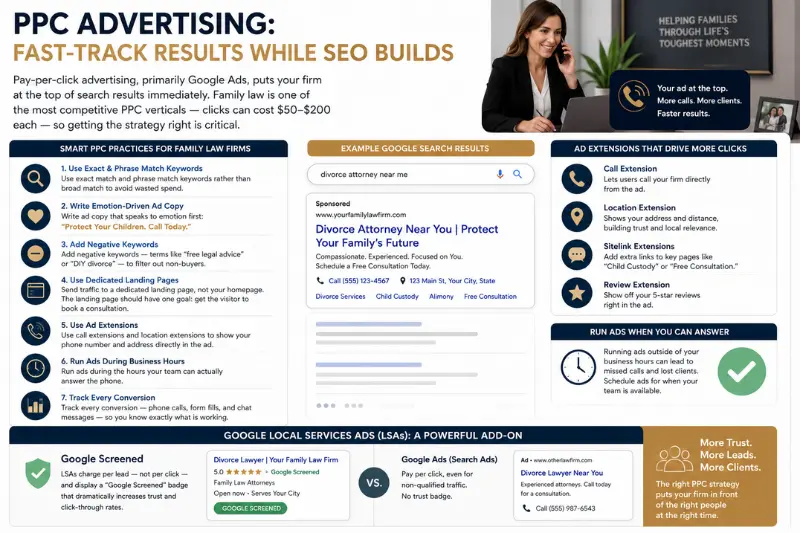
Pay-per-click advertising, primarily Google Ads, puts your firm at the top of search results immediately. Family law is one of the most competitive PPC verticals — clicks can cost $50–$200 each — so getting the strategy right is critical.
Smart PPC practices for family law firms
- Use exact match and phrase match keywords rather than broad match to avoid wasted spend.
- Write ad copy that speaks to emotion first: “Protect Your Children. Call Today.”
- Add negative keywords — terms like “free legal advice” or “DIY divorce” — to filter out non-buyers.
- Send traffic to a dedicated landing page, not your homepage. The landing page should have one goal: get the visitor to book a consultation.
- Use call extensions and location extensions to show your phone number and address directly in the ad.
- Run ads during the hours your team can actually answer the phone.
- Track every conversion — phone calls, form fills, and chat messages — so you know exactly what is working.
Google Local Services Ads (LSAs) are a powerful add-on for family law firms. Unlike regular Google Ads, LSAs charge per lead — not per click — and display a “Google Screened” badge that dramatically increases trust and click-through rates.
Content Marketing: Answer Questions, Build Authority
A well-run family law blog does two things: it ranks on Google for questions your clients are already asking, and it positions you as the trusted authority they want in their corner.
What to write about
- “How is child custody decided in [your state]?”
- “What is the difference between legal separation and divorce?”
- “Can I get alimony if I was a stay-at-home parent?”
- “What happens to my retirement account in a divorce?”
- “How long does a divorce take in [your state]?”
- “What are my rights if my spouse is hiding assets?”
Each blog post should end with a clear invitation to contact you. Something like: “If you have questions about your specific situation, I am happy to talk. Book a free 30-minute call here.”
Aim for at least 1,000–1,500 words per article, include real state-specific legal information (not generic advice), and update older posts every 12–18 months to stay current.
Video Marketing: The Untapped Edge in Family Law
Only a handful of family law firms invest seriously in video — which means it is one of the best opportunities to differentiate yourself right now. Video builds trust faster than any other medium because people can see your face, hear your voice, and get a sense of whether they like you — before ever calling.
Video ideas that work for family law
- “A Day in the Life of a Divorce Case” — walk through the process step by step.
- “Top 5 Mistakes People Make During a Divorce” — actionable and shareable.
- “What to Bring to Your First Consultation” — practical and eliminates client anxiety.
- Short Q&A videos answering one common question each (2–3 minutes max).
- Office tour video — show your space and introduce your team.
- Client story videos (with permission) showing real outcomes.
Post videos on YouTube with keyword-optimized titles and descriptions. YouTube is the second-largest search engine in the world, and most law firms ignore it entirely. Upload the same video to your website, Facebook, and LinkedIn for maximum reach.
AI Tools in Family Law Digital Marketing: Work Smarter, Not Harder
This is the section most of your competitors have not written yet — and it is becoming more important every month.
Artificial intelligence is changing how law firms attract, engage, and convert clients. You do not need to be a tech expert to benefit from it. Here is how family law attorneys are using AI right now:
AI-powered client intake
Tools like Clio Grow, Lawmatics, and MyCase use AI to automate the intake process. Instead of playing phone tag, potential clients fill out a smart intake form on your website, get an instant confirmation, and are automatically added to your CRM. You wake up to qualified leads — without your staff spending hours on paperwork.
AI for content creation
AI writing tools can help you draft blog post outlines, social media captions, email newsletters, and first drafts of FAQ pages. You provide the legal expertise and real-world insight — the AI handles the heavy lifting of formatting and structure. Always review and edit AI content before publishing to ensure accuracy and your personal voice.
AI chatbots on your website
A well-configured AI chatbot can greet visitors at 2 AM, answer basic questions about your services, collect their name and contact info, and schedule a consultation — all without any human involvement. For family law, where clients often search late at night during emotional moments, this 24/7 availability can be the difference between winning a client and losing them to a competitor.
Building a Referral Network: The Strategy No One Talks About
Digital marketing is essential, but the most cost-effective source of clients for most family law firms is referrals. And building a referral network is a marketing strategy that belongs in this guide — because so few competitors mention it.
Think about the other professionals your potential clients are already talking to when their marriage breaks down. These are your referral partners:
- Therapists and marriage counselors — they hear about divorce before a lawyer does.
- Financial advisors — couples splitting assets often need both legal and financial guidance.
- Real estate agents — a divorcing couple usually needs to sell or transfer property.
- Domestic violence advocates and shelters — they frequently refer clients to family law attorneys.
- Other attorneys — estate planners, business lawyers, and immigration attorneys often encounter clients who need family law help.
- School counselors and pediatricians — who notice children experiencing family disruption.
Build these relationships by attending local professional networking events, co-hosting webinars, writing guest posts for each other’s websites, and simply reaching out with a warm introduction. A relationship with one good referral partner can be worth tens of thousands of dollars in clients over a year.
Online Reviews: Your Most Powerful Marketing Asset
Studies consistently show that over 80% of people read online reviews before choosing a professional service — and family law clients are even more review-dependent than average, because the stakes are so high.
How to build your review profile the right way
- Ask for reviews at the right moment — right after a positive outcome, when the client is grateful and energized.
- Make it easy: send a direct link to your Google Business review page in a follow-up email or text.
- Never offer incentives for reviews — this violates Google’s policies and bar association ethics rules.
- Respond to every review, even negative ones, professionally and without revealing case details.
- Build reviews on multiple platforms: Google, Avvo, Yelp, and Facebook.
- Feature testimonials on your website with the client’s first name and case type (with permission).
One attorney I worked with went from 4 reviews to 47 in six months simply by adding a one-sentence review request to her post-case wrap-up email. Her Google ranking for local searches jumped two positions in that same period.
Email Marketing: Stay Top of Mind Without Being Pushy
Email marketing is one of the highest-ROI channels in digital marketing — and in family law, it serves a purpose that other channels cannot: nurturing prospects who are not ready to hire yet.
Many people research divorce or custody for weeks or months before taking action. A monthly email newsletter keeps you on their radar so that when they are ready, you are the first name they think of.
What to include in your newsletter
- One useful legal tip or explanation (“What is a parenting plan and why does it matter?”)
- A recent blog post or video you have published.
- A brief personal note — an insight, a lesson, or something you observed this month.
- A soft call to action: “If you have questions, I am just an email away.”
Keep it short — 300 to 500 words. Send it monthly, not weekly. Consistency matters more than volume.
Measuring ROI: Know Exactly What Is Working
One of the biggest frustrations I hear from family law attorneys is: “I am spending money on marketing but I have no idea if it is working.” That ends here. Measuring your family law digital marketing does not require a data science degree — it requires the right setup and the right questions.
Essential tools to install today
- Google Analytics 4 (GA4) — tracks website traffic, user behavior, and goals like form submissions.
- Google Search Console — shows which keywords bring people to your site and flags technical issues.
- Call tracking software (CallRail or WhatConverts) — assigns unique phone numbers to each marketing channel so you know whether a call came from Google Ads, SEO, or your website.
- Your CRM (Clio Grow, Lawmatics, or similar) — tracks every lead from first contact to signed client.
Key metrics to track monthly
- Cost per lead (CPL): total marketing spend divided by number of leads.
- Lead-to-client conversion rate: what percentage of inquiries become paying clients?
- Revenue per client: helps you calculate how much you can afford to spend per lead.
- Top traffic sources: which channels (organic, paid, social, referral) bring the most visitors?
- Top converting pages: which pages generate the most consultations?
Review these numbers once a month. If a channel is not producing leads at an acceptable cost, reallocate that budget. Marketing is not a “set and forget” exercise — it is a continuous process of testing, learning, and improving.
Social Media: Build Awareness Without Crossing Ethical Lines
Social media is a brand-building channel for family law firms, not a direct lead generation machine. That said, consistent, thoughtful social media presence keeps your name in front of potential clients and referral partners in your community.
Platform priorities
- Facebook: still the best platform for reaching adults 35–60, which is the core family law demographic. Run targeted local awareness ads and post educational content weekly.
- LinkedIn: ideal for building your referral network with other professionals. Share thought leadership articles and connect with therapists, financial advisors, and other attorneys.
- YouTube: the best long-term investment for video content. Videos rank in Google search results and compound in value over time.
- Instagram: useful for showing the human side of your firm — team photos, office culture, community involvement.
Important ethical reminder: always check your state bar’s advertising rules before running paid social ads or making specific outcome claims. Every state has different rules, and violating them can have serious professional consequences.
Your 90-Day Family Law Digital Marketing Quick-Start Plan
Feel overwhelmed? Do not try to do everything at once. Here is a 90-day priority plan:
Month 1 — Foundation
- Audit your website for speed, mobile usability, and trust signals.
- Claim and fully optimize your Google Business Profile.
- Set up Google Analytics 4 and Google Search Console.
- Install call tracking software.
- Start asking satisfied clients for Google reviews.
Month 2 — Traffic
- Publish your first three SEO blog posts targeting local, long-tail keywords.
- Launch a Google Ads campaign with a focused budget on your highest-value service.
- Record and publish your first two YouTube videos.
- Start posting consistently on Facebook and LinkedIn (three times per week).
Month 3 — Growth
- Send your first monthly email newsletter to past clients and leads.
- Reach out to five potential referral partners in your community.
- Review your analytics and double down on what is working.
- Set up an AI chatbot on your website for after-hours lead capture.
- Plan next quarter’s content calendar.
FAQ Content: Family Law Digital Marketing
What is family law digital marketing, and why does my firm need it?
Family law digital marketing is the process of promoting a law firm online using Google, social media, content marketing, and paid ads. It helps attract clients who are searching for legal help such as divorce or child custody. Without it, a law firm may miss many potential clients who are actively searching online.
How much should a family law firm spend on digital marketing?
Most law firms spend around 7% to 12% of their yearly revenue on marketing. Beginners can start with a small monthly budget focused on Google Ads and SEO. Tracking cost per lead is important to understand performance.
What is the most effective digital marketing strategy?
The best strategy is a combination of local SEO, Google Ads, and online reviews. SEO builds long-term traffic, Google Ads gives instant visibility, and reviews build trust with potential clients.
How long does it take to see results?
Google Ads can bring results in days, while SEO usually takes 3 to 6 months for noticeable growth. Long-term content marketing provides steady and increasing results over time.
Do family law attorneys need social media?
Yes, but not mainly for direct leads. Social media helps build trust, visibility, and personal connection with potential clients. Consistent posting is more important than posting daily.
What keywords should be targeted?
Focus on location-based and intent-driven keywords like “divorce lawyer in [city]” or “child custody lawyer near me.” Long-tail keywords often convert better than general terms.
How can AI be used in digital marketing?
AI can help create content, manage social media, and automate client responses. Chatbots and CRM tools can also improve lead management and follow-ups.
Why are online reviews important?
Reviews strongly influence client decisions. More positive reviews improve trust and help improve Google rankings, leading to more inquiries.
What makes family law marketing different?
Family law clients are often emotional and stressed. Marketing must focus on empathy, trust, and understanding rather than just legal expertise.
How do I measure marketing success?
Track cost per lead, conversion rates, traffic sources, and keyword performance. Tools like call tracking help identify where leads come from.
Final Thoughts: Marketing Is a Practice, Not a Project
Family law digital marketing works — but only when you commit to it consistently. The attorneys who succeed online are not the ones who spend the most money. They are the ones who show up with genuine expertise, human warmth, and a steady presence across the channels their clients use.
You already have the most important ingredient: the ability to genuinely help people through one of the most difficult experiences of their lives. Digital marketing simply gives you a louder voice — so the people who need you can actually find you.
Start with the foundations. Build from there. Measure everything. And never forget that behind every click and every contact form is a real person who needs real help.