
The praxis core academic skills for educators test is one of the most important exams for future teachers in the United States. It checks your basic reading, writing, and math skills before you can enter many teacher preparation programs or apply for a teaching license. Many states use the praxis core academic skills for educators exam as part of their teacher certification process.
This teacher certification test is designed by Educational Testing Service and helps schools make sure future educators have strong academic foundations. The exam includes three main sections: reading, writing, and mathematics. Many students consider it the first big step toward becoming a licensed teacher.
If you are planning a career in education, understanding the Praxis Core exam can make your preparation much easier. From test codes and passing scores to study tips and online testing options, this guide explains everything in simple English. You will also learn useful details about teacher licensure exams, Praxis Core preparation, and educator certification requirements.
What Is the Praxis Core Academic Skills for Educators Test?
If you want to become a licensed teacher in the United States, you will almost certainly need to pass the Praxis Core Academic Skills for Educators exam. Think of it as the academic foundation test that proves you have the reading, writing, and math skills needed to succeed in a classroom — before you even set foot in one as a teacher.
The Praxis Core is developed by Educational Testing Service (ETS) and is required for teacher licensure in most U.S. states. It is not a test about how to teach. Instead, it checks whether you have strong enough core academic skills to handle the demands of teacher preparation programs and, ultimately, a career in education.
Whether you are just starting your education degree, switching careers into teaching, or re-entering the profession, this guide tells you everything you need to know — including the things most other resources leave out.
Who Needs to Take the Praxis Core?
You likely need the Praxis Core if you are:
- Applying for admission into a teacher preparation program
- Working toward a teaching license or certification in a state that requires it
- Seeking a limited certificate of eligibility (CE) or a certificate of eligibility with advanced standing (CEAS)
- An international educator exploring the U.S. teaching credential pathway
Good news: Not every state requires the Praxis Core. Some states have dropped the requirement, while others have added GPA flexibility options. Always check your specific state’s requirements before registering.
The Three Subtests: What the Praxis Core Covers
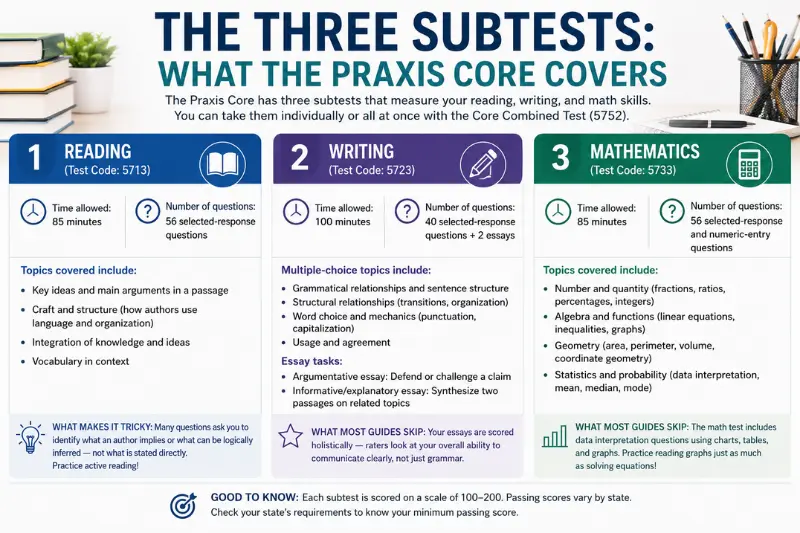
The Praxis Core is made up of three separate subtests. You can take them individually or all at once using the Core Combined Test (5752).
1. Reading (Test Code: 5713)
Time allowed: 85 minutes Number of questions: 56 selected-response questions
The Reading subtest measures your ability to understand, analyze, and evaluate written material. You will not be tested on memorized facts — instead, you will read passages and answer questions about them.
Topics covered include:
- Key ideas and main arguments in a passage
- Craft and structure (how authors use language and organization)
- Integration of knowledge and ideas
- Vocabulary in context
What makes it tricky: Many questions ask you to identify what an author implies or what can be logically inferred — not what is stated directly. Practicing active reading is the most important skill you can build.
2. Writing (Test Code: 5723)
Time allowed: 100 minutes Number of questions: 40 selected-response questions + 2 essays
The Writing subtest is split into two sections: multiple-choice grammar and usage questions, plus two written essays.
Multiple-choice topics include:
- Grammatical relationships and sentence structure
- Structural relationships (transitions, organization)
- Word choice and mechanics (punctuation, capitalization)
- Usage and agreement
Essay tasks:
- Argumentative essay: You are given a claim and asked to write a well-reasoned argument either defending or challenging it
- Informative/explanatory essay: You are given two short passages on related topics and asked to synthesize them into a coherent response
What most guides skip: Your essays are scored holistically — raters look at your overall ability to communicate clearly, not just grammar. A well-structured essay with a few minor errors will outscore a technically perfect essay with no clear argument.
3. Mathematics (Test Code: 5733)
Time allowed: 85 minutes Number of questions: 56 selected-response and numeric-entry questions
The Math subtest covers the kind of mathematics a well-educated adult should know — not advanced calculus. A four-function calculator is available on-screen for about half the questions.
Topics covered include:
- Number and quantity (fractions, ratios, percentages, integers)
- Algebra and functions (linear equations, inequalities, graphs)
- Geometry (area, perimeter, volume, coordinate geometry)
- Statistics and probability (data interpretation, mean, median, mode)
What most guides skip: The math test includes data interpretation questions using charts, tables, and graphs. Many test-takers focus only on equations and get caught off-guard by these. Practice reading graphs just as much as solving equations.
Core Combined Test (5752): Taking All Three at Once
If you want to take all three subtests in a single sitting, register for the Core Combined Test (5752). Here is how it works:
- You sit for all three subtests in one test session
- Your scores are reported separately for each subtest (5713, 5723, and 5733)
- The combined registration costs less than registering for each test individually
- It is a smart choice if you are well-prepared and want to get the testing done in one day
Pro tip: The combined sitting is a long day — roughly five hours of active testing. Make sure you have practiced your stamina, not just your content knowledge.
Praxis Core Test Fees
| Test | Fee |
|---|---|
| Reading (5713) | $90 |
| Writing (5723) | $90 |
| Mathematics (5733) | $90 |
| Core Combined (5752) | $150 |
Fee waivers are available. ETS offers the Praxis Fee Waiver Program for test-takers who demonstrate financial need. You can apply through your educator preparation program or directly through the ETS website. This is an option many candidates do not know about — do not leave money on the table.
Passing Scores by State
Passing scores are not the same in every state. Each state sets its own minimum passing score for each subtest. Here are some examples to illustrate the range:
| State | Reading (5713) | Writing (5723) | Math (5733) |
|---|---|---|---|
| New Jersey | 156 | 162 | 150 |
| Virginia | 156 | 158 | 150 |
| Pennsylvania | 156 | 162 | 150 |
| North Carolina | 156 | 162 | 150 |
Important: Always verify your state’s current passing scores directly with your state’s Department of Education or on the ETS website — requirements can change, and acting on outdated information could delay your certification.
Score scale: Each subtest is scored on a scale of 100–200.
How and Where to Register
Registering for the Praxis Core is straightforward:
- Create an account at praxis.ets.org
- Search for your test using the test name or code (5713, 5723, 5733, or 5752)
- Choose your testing option — test center or at-home proctored testing
- Select your date and time
- Pay your fee (or apply a waiver)
- Request score recipients — add your state’s Department of Education or your educator preparation program
Testing is available year-round at Praxis testing centers and via online proctoring from your home or office.
At-Home Testing: What You Need to Know
The Praxis Core is available as an at-home proctored test — something not all candidates realize. Here is what to prepare:
Technical requirements:
- A reliable computer (desktop or laptop — no tablets or Chromebooks)
- A stable internet connection
- A working webcam and microphone
- A clean, quiet, private room
Rules during the test:
- No other people in the room
- No notes, scratch paper, or books (you will be given an on-screen whiteboard)
- Your desk must be clear of everything except your computer
Who should choose at-home testing: If you live far from a test center or have scheduling constraints, at-home testing is a great option — but do a full tech check beforehand to avoid surprises on test day.
Disability Accommodations
ETS provides testing accommodations for candidates with documented disabilities. Common accommodations include:
- Extended testing time
- Additional rest breaks
- Screen magnification or screen readers
- Alternative test formats
Apply for accommodations well in advance — at least 6 weeks before your desired test date. Approval is not guaranteed on short notice.
How Scores Are Reported — and How Long They Last
- Score release timeline: Scores are typically available within 10–16 days after your test date
- Score validity: Most states accept scores that are no more than 5–10 years old, but this varies — check with your state
- Sending scores: You can send scores to recipients (states, programs) during registration or afterward from your ETS account
- NJ-specific note: If you test outside of New Jersey, you must add code R7666 when registering to have scores sent to the NJDOE automatically
What Happens If You Do Not Pass?
You are not out of options if you do not pass a subtest. Here is what to know:
- You can retake any subtest after a 21-day waiting period
- There is no limit on the total number of attempts
- ETS offers a “Free After Three” program — if you have taken a Core test three or more times and still have not passed, you may be eligible for a free retest
- Some states offer GPA flexibility — if your undergraduate GPA is above a certain threshold, you may be exempt from the Praxis Core requirement
GPA and Praxis Flexibility: An Option Many Candidates Miss

Several states — including New Jersey — allow candidates to substitute a qualifying GPA for the Praxis Core requirement. If your cumulative undergraduate GPA meets the state’s threshold, you may not need to pass the Praxis Core at all.
Check your state’s Department of Education website for GPA flexibility rules. This is one of the most underreported options in teacher certification, and many candidates spend time and money testing when they did not need to.
Praxis Core Prep: How to Study Effectively
Here is an honest, practical approach to preparing — not just a list of products.
Start with a Diagnostic
Before you study anything, take a free practice test to identify your weak areas. ETS offers free study companions for each subtest (downloadable PDFs) that include sample questions and answer explanations. Use these first.
Build a Realistic Study Schedule
Give yourself at least 6–8 weeks of dedicated preparation, especially if math or writing is not your strongest subject. Spread your study sessions across the week rather than cramming.
Reading: Practice Active Reading Daily
- Read editorial articles, essays, and long-form journalism every day
- After each passage, summarize the author’s main argument in one sentence
- Practice identifying tone, purpose, and implied meaning
Writing: Learn the Essay Framework
- For argumentative essays: state your position clearly in the opening paragraph, use two to three supporting reasons with examples, and end with a strong conclusion
- For informative essays: identify the connection between the two source texts before you write
- Proofread for comma splices, subject-verb agreement, and pronoun-antecedent agreement — these are the most commonly tested grammar issues
Math: Do Not Skip Data Interpretation
- Review fractions, percentages, and ratios first — these appear throughout the test
- Practice reading bar graphs, line charts, and two-way tables
- Use the on-screen calculator strategically — save it for complex calculations, not simple arithmetic
Stamina Is a Real Factor
If you are taking the combined test, practice sitting and focusing for long periods. Take full-length practice tests under timed, realistic conditions at least twice before your real test date.
Praxis Core vs. Other Teacher Certification Tests
Many candidates wonder how the Praxis Core compares to other exams. Here is a quick overview:
| Test | What It Covers | Who It Is For |
|---|---|---|
| Praxis Core (5713/5723/5733) | Reading, writing, math basics | Aspiring teachers (most U.S. states) |
| Praxis Subject Assessments | Content knowledge in a specific subject | Teachers of a specific grade/subject |
| edTPA | Actual teaching performance | Student teachers during clinical practice |
| ParaPro | Basic skills for paraprofessionals | Teaching assistants and aides |
| FTCE (Florida) | Reading, writing, math + subject area | Florida teacher candidates specifically |
The Praxis Core is the entry-level skills test. Once you pass it, you will likely need to pass additional Praxis Subject Assessments in your teaching area before you receive full licensure.
The Human Side of Taking the Praxis Core
Something no other guide talks about enough: test anxiety is real, and it affects performance. Here are a few things that genuinely help:
- Sleep matters more than last-minute studying. A well-rested brain outperforms a tired one on test day, every time.
- You are allowed to feel nervous. Acknowledge it, then redirect your focus to what you can control — your preparation and your process.
- Eat a real meal before the test. Low blood sugar impairs concentration. This sounds obvious, but many test-takers skip it.
- If you fail, it is not the end. Many successful teachers failed the Praxis Core on their first attempt. The exam does not measure your potential as a teacher — it measures a narrow set of academic skills on one particular day.
Frequently Asked Questions on Praxis Core Academic Skills for Educators
Can I take the Praxis Core before applying to a teacher prep program?
Yes. In fact, many programs require you to pass it before admission, so taking it early makes sense.
Is the Praxis Core the same as the Praxis II?
No. “Praxis II” historically referred to the subject-specific assessments. ETS has moved away from numbering them that way, but Praxis Core is a separate, foundational exam.
Does the Praxis Core expire?
Score validity varies by state — typically five to ten years. Check your state’s specific policy.
What is a good score on the Praxis Core?
“Good” means passing your state’s required threshold. Focus on your state’s minimum score, not a universal benchmark.
Is the Praxis Core hard?
For most candidates, the math is the most challenging subtest. The content is not advanced, but the timing can feel tight. Regular practice under timed conditions is the most effective preparation.
Can international educators take the Praxis Core?
Yes. International candidates can register for the Praxis Core through the ETS website. At-home proctored testing makes access much easier regardless of location.
Quick-Reference Cheat Sheet
| Item | Detail |
|---|---|
| Test codes | Reading: 5713 · Writing: 5723 · Math: 5733 · Combined: 5752 |
| Score scale | 100–200 per subtest |
| Fee (combined) | $150 |
| Registration | praxis.ets.org |
| Results | 10–16 days after testing |
| Retake wait | 21 days |
| At-home testing | Yes — available year-round |
| Accommodations | Apply 6+ weeks in advance |
| Free After Three | Yes — contact ETS for eligibility |
Final Verdict
The praxis core academic skills for educators exam is an important step for anyone who wants to become a licensed teacher in the United States. With the right preparation, study plan, and understanding of the test format, passing the praxis core academic skills for educators test becomes much more achievable.
Suggested Guide for you
Academic Skills: Complete Guide to Learn, Improve & Succeed