Physical education has five core physical education goals: building competent movement and motor skills, teaching the knowledge behind that movement (strategy, biomechanics, rules), developing and maintaining physical fitness, fostering responsible personal and social behavior, and helping students genuinely value being active. Together, these physical education goals aim to produce what the field calls a “physically literate” person — someone with the skills, knowledge, and confidence to stay active for life, not just someone who can run a fast mile in seventh grade.
That’s a more ambitious description than most people would give if you stopped them on the street and asked what physical education goals are meant to achieve. Ask around, and you’ll mostly hear “exercise,” “sports,” or — if someone had a rough time with it in school — “humiliation in front of your classmates.” None of that is entirely wrong, but it’s incomplete, and the gap between what physical education goals are supposed to accomplish and what people think PE accomplishes is a real problem for how schools fund it, staff it, and schedule it.
This guide breaks down what physical education goals actually are, where they come from, how they shift as kids move from kindergarten to senior year, and — because this part gets skipped a lot — why most U.S. schools currently fall short of meeting those physical education goals.
Where Physical Education Goals Actually Come From
Unlike math or reading, the United States doesn’t have a national curriculum for PE. There’s no federal mandate telling a school district in Ohio and one in Oregon to teach the same content the same way. Instead, the leading professional organization for the field, SHAPE America (Society of Health and Physical Educators, formerly NASPE), publishes national standards describing what a “physically literate” student should know and be able to do. Most state education departments then build their own, far more detailed standards on top of that national framework.
That’s why a Nebraska PE teacher and a California PE teacher are technically working toward the same five broad goals, but the day-to-day content can look pretty different. California’s standards spell out grade-by-grade benchmarks down to specific skills, like striking a ball with a paddle in second grade or analyzing biomechanical principles in eleventh. Illinois breaks its goals into ten developmental stages layered across grade bands. Nebraska keeps its public-facing language closer to the plain-English version of the national standard. Same destination, different maps.
The 5 Core Goals of Physical Education

Here’s the national framework in plain language, with what each goal actually looks like in a real gym class.
1. Motor skill development.
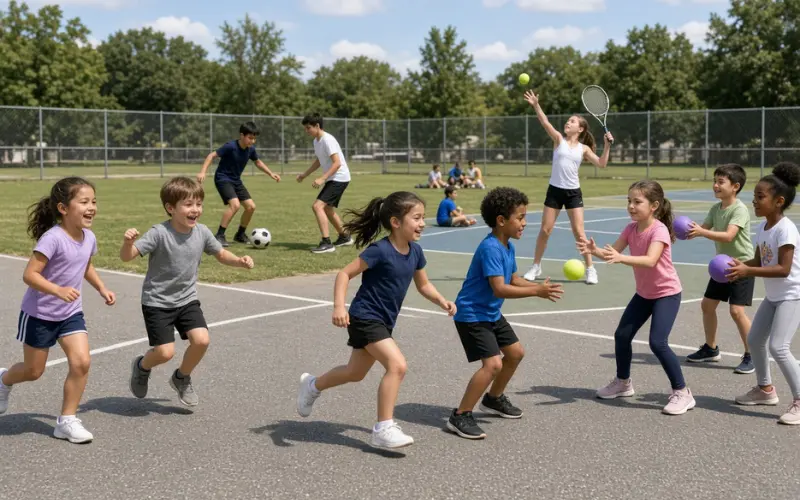
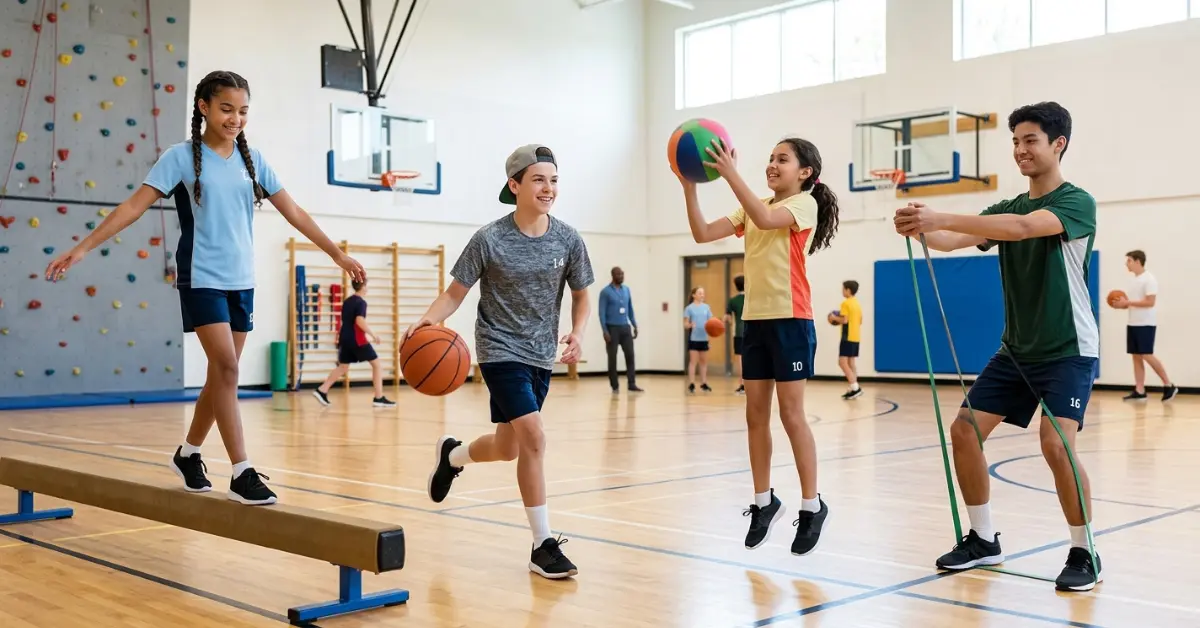
Students build competence in fundamental movement — running, jumping, throwing, catching, balancing — and gradually combine those into more complex, sport-specific skills. In kindergarten, that might mean learning to gallop and skip to a beat. By eighth grade, it’s combining skills inside a modified game, like dribbling and passing in a small-sided soccer match. This goal matters more than it sounds: research on motor development has found that kids who don’t build solid movement competency early tend to opt out of physical activity later, simply because they feel clumsy or incapable — a pattern that can follow people into adulthood.
2. Knowledge of movement concepts and strategy.
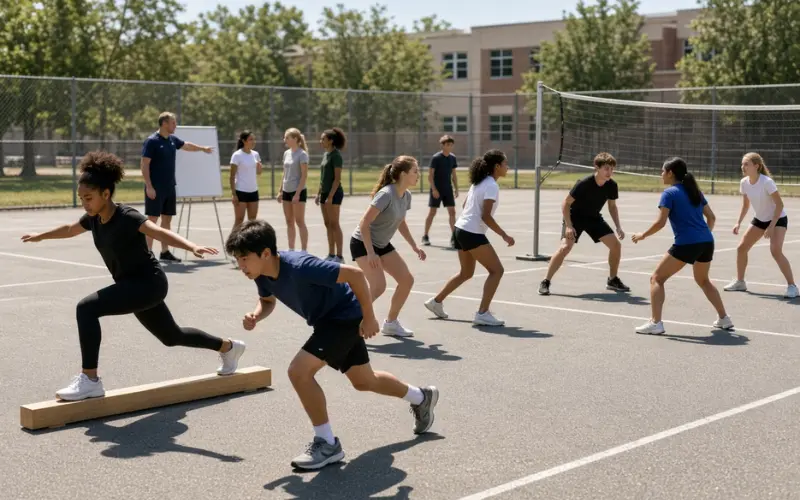
This is the “why” behind the “how.” Students learn things like why bending your knees on a layup increases control, how spacing and offense/defense work in a game, or what the FITT principle (frequency, intensity, time, type) means for designing a workout. It’s the cognitive half of PE that rarely shows up when people picture the subject, and it’s a big part of why state standards documents run hundreds of pages — there’s a lot of conceptual content underneath the activity.
3. Fitness knowledge and habits.
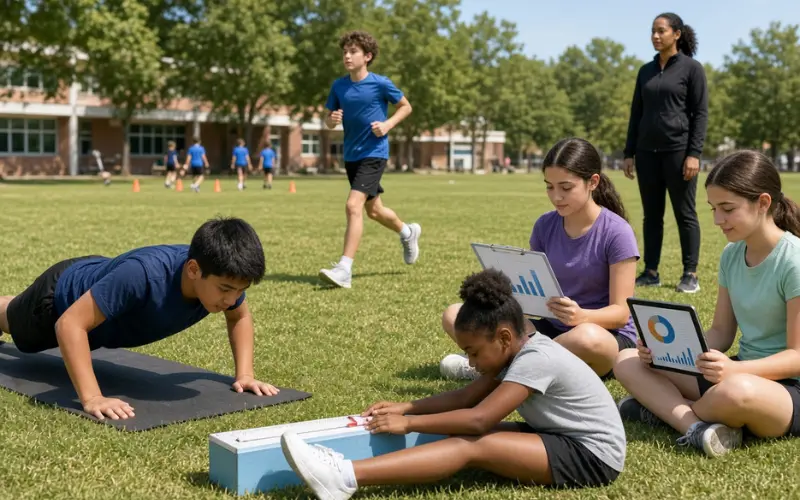
This goal covers both doing (participating in activities that build cardiovascular endurance, strength, flexibility, and healthy body composition) and understanding (knowing how to read your own fitness data and set realistic goals from it). Most schools use a standardized assessment like FitnessGram to track this over time, and by high school, students are often expected to design and adjust their own fitness plans rather than just complete whatever the teacher assigns that day.
4. Responsible personal and social behavior.
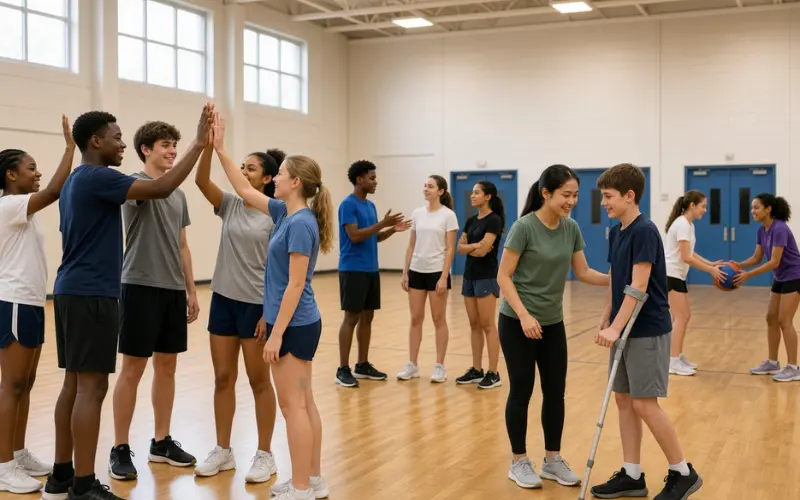
Teamwork, sportsmanship, following safety procedures, including teammates of different skill levels, handling conflict without a meltdown — this is the goal most directly tied to social-emotional learning, and it’s graded surprisingly often through informal observation rather than a rubric.
5. Valuing physical activity.
The least concrete goal, and arguably the most important one long-term: does the student actually want to keep doing this once nobody’s making them? This is where enjoyment, self-expression, challenge, and social connection come in. A student can ace every fitness test and still walk away from PE hating movement if this piece gets ignored — which is exactly what tends to happen in programs built entirely around competition and grades.
How These Goals Shift From Kindergarten to Senior Year
The five goals above don’t change — but what they look like in practice changes a lot.
Elementary school (K–5) is almost entirely about the first goal: building the fundamental movement vocabulary — locomotor skills, body management, basic manipulative skills like throwing and catching — that everything later depends on. Fitness and strategy concepts get introduced, but kept simple and play-based.
Middle school (6–8) is where things consolidate. Students start combining locomotor and manipulative skills into actual game play, get introduced to real biomechanics and training-principle vocabulary, and begin tracking their own fitness data instead of just being told to run a lap.
High school (9–12) shifts toward independence and choice. Many states require two years of PE for graduation, after which students often choose electives — weight training, dance, individual sports, outdoor adventure activities — built around the idea that they’re now picking what they’ll actually carry into adult life. The goal here isn’t mastering dodgeball; it’s walking out with a personal fitness plan and enough self-direction to keep using it.
Why These Goals Matter Beyond the Gym
It’s easy to treat PE goals as a checkbox exercise for accreditation, but the research behind them goes well beyond “exercise is good for you.”
Physical activity during the school day has been linked to improved on-task classroom behavior, better attendance, and stronger academic performance — not because kids get smarter from running laps, but because regular movement supports concentration and reduces stress in ways that show up in test scores and discipline referrals. There’s also a quieter point worth saying plainly: physical education is the only setting guaranteed to reach almost every school-age child, regardless of whether their family can afford club sports, has a safe neighborhood to play in, or has time to drive them to practice. For a meaningful share of kids, PE class is the only structured physical activity they get all week.
And yet — this is the part most articles on this topic skip — national data consistently show schools aren’t hitting the targets tied to these goals. Health organizations recommend 150 minutes of weekly PE for elementary students and 225 minutes for middle and high schoolers. CDC survey data has found that only around 4% of U.S. schools actually provide daily PE at those recommended minutes. The goals exist; the time and staffing to reach them often doesn’t.
A Few Misconceptions Worth Clearing Up

PE is just unstructured playtime
It’s supposed to be a standards-based, assessed academic subject, not recess with a whistle. Whether it functions that way at your local school is a separate, and legitimate, question.
These goals are about producing athletes
They’re written for every ability level, including students with disabilities, who are entitled under adapted physical education programs to pursue the same five goals through modified activities, equipment, or instruction — not a different, lesser version of PE.
If a state has standards, every school is meeting them
Not necessarily. More than half the states allow waivers or substitutions for PE credit (JROTC, marching band, and interscholastic sports are common stand-ins), and there’s no federal requirement forcing schools to track whether students are actually progressing toward the standards. Standards on paper and standards in practice are two different things.
As long as kids are moving, it doesn’t matter how the time gets graded
Older research on grading practices found PE teachers historically based grades far more on participation, effort, and dressing out than on measured skill or fitness data — meaning a student could earn an “A” without demonstrating real progress on any of the five goals above. Newer standards-based grading approaches are trying to close that gap, but it’s inconsistent from district to district.
How Schools, Teachers, and Parents Can Actually Support These Goals
If you’re a teacher, the highest-leverage move is tying grades to the actual goal domains — skill, knowledge, fitness data, and behavior — rather than defaulting to attendance and effort, which tells you almost nothing about whether a student is becoming more physically literate.
If you’re an administrator, the research is fairly blunt: certified PE specialists produce measurably more activity time and better outcomes than generalist classroom teachers covering PE as an extra duty, and protecting the recommended weekly minutes matters more than almost any curriculum choice you could make. Programs that adopt the Comprehensive School Physical Activity Program (CSPAP) framework — pairing PE with activity during the school day, before/after-school options, staff involvement, and family engagement — consistently outperform programs that treat PE as an isolated class period.
If you’re a parent, the most useful thing you can do is simply ask: how many minutes of PE does my child actually get each week, who teaches it, and how is progress measured? Most parents have never asked, and most schools have an answer ready if you do.
Frequently Asked Questions physical education goals
What are the 5 main physical education goals?
Motor skill development, knowledge of movement concepts and strategy, achieving and maintaining fitness, responsible personal and social behavior, and valuing physical activity for life. These come from SHAPE America’s national standards, which most state PE standards are built on, and are often referred to as the core physical education goals.
What’s the difference between a physical education goal and a physical education objective?
Physical education goals are the big-picture outcomes, like developing motor competence or learning to value physical activity. Objectives are the specific, measurable steps a teacher uses to get there within a single lesson or unit, such as “students will successfully complete eight out of ten underhand throws by the end of the week.” State standards documents are essentially long lists of objectives; the five physical education goals are what all of those objectives are ultimately working toward.
Who decides physical education goals — the school, the state, or the teacher?
All three, at different levels. SHAPE America sets the national framework for physical education goals, state education departments translate that into detailed, grade-by-grade standards, and individual teachers or districts decide how to actually teach toward those standards day to day — which curriculum, which activities, which assessments. That layered system is also a big reason PE quality varies so much between schools, even within the same state.
What is the most important goal of physical education?
There’s a reasonable argument that “valuing physical activity” matters most long-term among all physical education goals, since it’s the goal that determines whether a student keeps moving once school is no longer requiring it. The other four physical education goals largely exist to support that one.
How is physical education different from recess or general physical activity?
Recess and free play are unstructured. Physical education is a planned, sequential, standards-based academic subject with specific learning outcomes tied to physical education goals, and, ideally, assessment — taught by someone trained to teach it, not just someone supervising it.
How are physical education goals assessed in the classroom?
In theory, through a mix of skill demonstrations, knowledge checks, fitness assessments like FitnessGram, and observed behavior during activities aligned with physical education goals. In practice, it varies a lot by school: some programs use detailed rubrics tied directly to the standards, while others still lean heavily on participation and effort, which doesn’t really measure whether the five physical education goals are being met.
How many minutes of PE should students get each week?
National health guidance recommends 150 minutes per week for elementary students and 225 minutes per week for middle and high school students to properly support physical education goals. Very few schools currently meet this.
Do the goals change for students with disabilities?
No — the goals stay the same. Adapted physical education provides modified activities, equipment, or instruction so students with disabilities can work toward the same five physical education goals as their peers, rather than being excluded or given a separate, lower-bar program.
What happens when a school doesn’t meet its physical education goals or standards?
Usually, not much immediately. Unlike core subjects with high-stakes testing, there’s no federal accountability system tracking whether schools meet physical education goals, and most states don’t penalize schools for falling short on instructional minutes or outcomes. Accountability tends to come from state monitoring, accreditation reviews, or parent and community pressure rather than automatic consequences.
What does “physically literate” mean?
It’s the field’s term for someone with the motor skills, knowledge, confidence, and motivation to stay physically active throughout life — the cumulative result of all five physical education goals working together, rather than any single skill or fitness number.
Final Thoughts
At their core, physical education goals are designed to do far more than improve athletic performance or help students pass fitness tests. These physical education goals provide a framework for developing movement skills, health knowledge, personal responsibility, social awareness, and lifelong appreciation for physical activity. When taught effectively, physical education equips students with the confidence and competence to make active, healthy choices long after their school years are over.
The challenge with physical education goals is not a lack of standards but ensuring those standards are consistently implemented, properly assessed, and supported with adequate instructional time and qualified educators. Schools, teachers, parents, and policymakers all play a role in turning these expectations into meaningful outcomes.
Ultimately, the success of physical education goals should not be measured by how many students become athletes, but by how many leave school with the skills, knowledge, and motivation to stay active, healthy, and engaged throughout their lives.
Physical education has five core physical education goals: building competent movement and motor skills, teaching the knowledge behind that movement (strategy, biomechanics, rules), developing and maintaining physical fitness, fostering responsible personal and social behavior, and helping students genuinely value being active. Together, these physical education goals aim to produce what the field calls a “physically literate” person — someone with the skills, knowledge, and confidence to stay active for life, not just someone who can run a fast mile in seventh grade.
That’s a more ambitious description than most people would give if you stopped them on the street and asked what physical education goals are meant to achieve. Ask around, and you’ll mostly hear “exercise,” “sports,” or — if someone had a rough time with it in school — “humiliation in front of your classmates.” None of that is entirely wrong, but it’s incomplete, and the gap between what physical education goals are supposed to accomplish and what people think PE accomplishes is a real problem for how schools fund it, staff it, and schedule it.
This guide breaks down what physical education goals actually are, where they come from, how they shift as kids move from kindergarten to senior year, and — because this part gets skipped a lot — why most U.S. schools currently fall short of meeting those physical education goals.
Where Physical Education Goals Actually Come From
Unlike math or reading, the United States doesn’t have a national curriculum for PE. There’s no federal mandate telling a school district in Ohio and one in Oregon to teach the same content the same way. Instead, the leading professional organization for the field, SHAPE America (Society of Health and Physical Educators, formerly NASPE), publishes national standards describing what a “physically literate” student should know and be able to do. Most state education departments then build their own, far more detailed standards on top of that national framework.
That’s why a Nebraska PE teacher and a California PE teacher are technically working toward the same five broad goals, but the day-to-day content can look pretty different. California’s standards spell out grade-by-grade benchmarks down to specific skills, like striking a ball with a paddle in second grade or analyzing biomechanical principles in eleventh. Illinois breaks its goals into ten developmental stages layered across grade bands. Nebraska keeps its public-facing language closer to the plain-English version of the national standard. Same destination, different maps.
The 5 Core Goals of Physical Education
Here’s the national framework in plain language, with what each goal actually looks like in a real gym class.
1. Motor skill development.
Students build competence in fundamental movement — running, jumping, throwing, catching, balancing — and gradually combine those into more complex, sport-specific skills. In kindergarten, that might mean learning to gallop and skip to a beat. By eighth grade, it’s combining skills inside a modified game, like dribbling and passing in a small-sided soccer match. This goal matters more than it sounds: research on motor development has found that kids who don’t build solid movement competency early tend to opt out of physical activity later, simply because they feel clumsy or incapable — a pattern that can follow people into adulthood.
2. Knowledge of movement concepts and strategy.
This is the “why” behind the “how.” Students learn things like why bending your knees on a layup increases control, how spacing and offense/defense work in a game, or what the FITT principle (frequency, intensity, time, type) means for designing a workout. It’s the cognitive half of PE that rarely shows up when people picture the subject, and it’s a big part of why state standards documents run hundreds of pages — there’s a lot of conceptual content underneath the activity.
3. Fitness knowledge and habits.
This goal covers both doing (participating in activities that build cardiovascular endurance, strength, flexibility, and healthy body composition) and understanding (knowing how to read your own fitness data and set realistic goals from it). Most schools use a standardized assessment like FitnessGram to track this over time, and by high school, students are often expected to design and adjust their own fitness plans rather than just complete whatever the teacher assigns that day.
4. Responsible personal and social behavior.
Teamwork, sportsmanship, following safety procedures, including teammates of different skill levels, handling conflict without a meltdown — this is the goal most directly tied to social-emotional learning, and it’s graded surprisingly often through informal observation rather than a rubric.
5. Valuing physical activity.
The least concrete goal, and arguably the most important one long-term: does the student actually want to keep doing this once nobody’s making them? This is where enjoyment, self-expression, challenge, and social connection come in. A student can ace every fitness test and still walk away from PE hating movement if this piece gets ignored — which is exactly what tends to happen in programs built entirely around competition and grades.
How These Goals Shift From Kindergarten to Senior Year
The five goals above don’t change — but what they look like in practice changes a lot.
Elementary school (K–5) is almost entirely about the first goal: building the fundamental movement vocabulary — locomotor skills, body management, basic manipulative skills like throwing and catching — that everything later depends on. Fitness and strategy concepts get introduced, but kept simple and play-based.
Middle school (6–8) is where things consolidate. Students start combining locomotor and manipulative skills into actual game play, get introduced to real biomechanics and training-principle vocabulary, and begin tracking their own fitness data instead of just being told to run a lap.
High school (9–12) shifts toward independence and choice. Many states require two years of PE for graduation, after which students often choose electives — weight training, dance, individual sports, outdoor adventure activities — built around the idea that they’re now picking what they’ll actually carry into adult life. The goal here isn’t mastering dodgeball; it’s walking out with a personal fitness plan and enough self-direction to keep using it.
Why These Goals Matter Beyond the Gym
It’s easy to treat PE goals as a checkbox exercise for accreditation, but the research behind them goes well beyond “exercise is good for you.”
Physical activity during the school day has been linked to improved on-task classroom behavior, better attendance, and stronger academic performance — not because kids get smarter from running laps, but because regular movement supports concentration and reduces stress in ways that show up in test scores and discipline referrals. There’s also a quieter point worth saying plainly: physical education is the only setting guaranteed to reach almost every school-age child, regardless of whether their family can afford club sports, has a safe neighborhood to play in, or has time to drive them to practice. For a meaningful share of kids, PE class is the only structured physical activity they get all week.
And yet — this is the part most articles on this topic skip — national data consistently show schools aren’t hitting the targets tied to these goals. Health organizations recommend 150 minutes of weekly PE for elementary students and 225 minutes for middle and high schoolers. CDC survey data has found that only around 4% of U.S. schools actually provide daily PE at those recommended minutes. The goals exist; the time and staffing to reach them often doesn’t.
A Few Misconceptions Worth Clearing Up
PE is just unstructured playtime
It’s supposed to be a standards-based, assessed academic subject, not recess with a whistle. Whether it functions that way at your local school is a separate, and legitimate, question.
These goals are about producing athletes
They’re written for every ability level, including students with disabilities, who are entitled under adapted physical education programs to pursue the same five goals through modified activities, equipment, or instruction — not a different, lesser version of PE.
If a state has standards, every school is meeting them
Not necessarily. More than half the states allow waivers or substitutions for PE credit (JROTC, marching band, and interscholastic sports are common stand-ins), and there’s no federal requirement forcing schools to track whether students are actually progressing toward the standards. Standards on paper and standards in practice are two different things.
As long as kids are moving, it doesn’t matter how the time gets graded
Older research on grading practices found PE teachers historically based grades far more on participation, effort, and dressing out than on measured skill or fitness data — meaning a student could earn an “A” without demonstrating real progress on any of the five goals above. Newer standards-based grading approaches are trying to close that gap, but it’s inconsistent from district to district.
How Schools, Teachers, and Parents Can Actually Support These Goals
If you’re a teacher, the highest-leverage move is tying grades to the actual goal domains — skill, knowledge, fitness data, and behavior — rather than defaulting to attendance and effort, which tells you almost nothing about whether a student is becoming more physically literate.
If you’re an administrator, the research is fairly blunt: certified PE specialists produce measurably more activity time and better outcomes than generalist classroom teachers covering PE as an extra duty, and protecting the recommended weekly minutes matters more than almost any curriculum choice you could make. Programs that adopt the Comprehensive School Physical Activity Program (CSPAP) framework — pairing PE with activity during the school day, before/after-school options, staff involvement, and family engagement — consistently outperform programs that treat PE as an isolated class period.
If you’re a parent, the most useful thing you can do is simply ask: how many minutes of PE does my child actually get each week, who teaches it, and how is progress measured? Most parents have never asked, and most schools have an answer ready if you do.
Frequently Asked Questions physical education goals
What are the 5 main physical education goals?
Motor skill development, knowledge of movement concepts and strategy, achieving and maintaining fitness, responsible personal and social behavior, and valuing physical activity for life. These come from SHAPE America’s national standards, which most state PE standards are built on, and are often referred to as the core physical education goals.
What’s the difference between a physical education goal and a physical education objective?
Physical education goals are the big-picture outcomes, like developing motor competence or learning to value physical activity. Objectives are the specific, measurable steps a teacher uses to get there within a single lesson or unit, such as “students will successfully complete eight out of ten underhand throws by the end of the week.” State standards documents are essentially long lists of objectives; the five physical education goals are what all of those objectives are ultimately working toward.
Who decides physical education goals — the school, the state, or the teacher?
All three, at different levels. SHAPE America sets the national framework for physical education goals, state education departments translate that into detailed, grade-by-grade standards, and individual teachers or districts decide how to actually teach toward those standards day to day — which curriculum, which activities, which assessments. That layered system is also a big reason PE quality varies so much between schools, even within the same state.
What is the most important goal of physical education?
There’s a reasonable argument that “valuing physical activity” matters most long-term among all physical education goals, since it’s the goal that determines whether a student keeps moving once school is no longer requiring it. The other four physical education goals largely exist to support that one.
How is physical education different from recess or general physical activity?
Recess and free play are unstructured. Physical education is a planned, sequential, standards-based academic subject with specific learning outcomes tied to physical education goals, and, ideally, assessment — taught by someone trained to teach it, not just someone supervising it.
How are physical education goals assessed in the classroom?
In theory, through a mix of skill demonstrations, knowledge checks, fitness assessments like FitnessGram, and observed behavior during activities aligned with physical education goals. In practice, it varies a lot by school: some programs use detailed rubrics tied directly to the standards, while others still lean heavily on participation and effort, which doesn’t really measure whether the five physical education goals are being met.
How many minutes of PE should students get each week?
National health guidance recommends 150 minutes per week for elementary students and 225 minutes per week for middle and high school students to properly support physical education goals. Very few schools currently meet this.
Do the goals change for students with disabilities?
No — the goals stay the same. Adapted physical education provides modified activities, equipment, or instruction so students with disabilities can work toward the same five physical education goals as their peers, rather than being excluded or given a separate, lower-bar program.
What happens when a school doesn’t meet its physical education goals or standards?
Usually, not much immediately. Unlike core subjects with high-stakes testing, there’s no federal accountability system tracking whether schools meet physical education goals, and most states don’t penalize schools for falling short on instructional minutes or outcomes. Accountability tends to come from state monitoring, accreditation reviews, or parent and community pressure rather than automatic consequences.
What does “physically literate” mean?
It’s the field’s term for someone with the motor skills, knowledge, confidence, and motivation to stay physically active throughout life — the cumulative result of all five physical education goals working together, rather than any single skill or fitness number.
Final Thoughts
At their core, physical education goals are designed to do far more than improve athletic performance or help students pass fitness tests. These physical education goals provide a framework for developing movement skills, health knowledge, personal responsibility, social awareness, and lifelong appreciation for physical activity. When taught effectively, physical education equips students with the confidence and competence to make active, healthy choices long after their school years are over.
The challenge with physical education goals is not a lack of standards but ensuring those standards are consistently implemented, properly assessed, and supported with adequate instructional time and qualified educators. Schools, teachers, parents, and policymakers all play a role in turning these expectations into meaningful outcomes.
Ultimately, the success of physical education goals should not be measured by how many students become athletes, but by how many leave school with the skills, knowledge, and motivation to stay active, healthy, and engaged throughout their lives.