
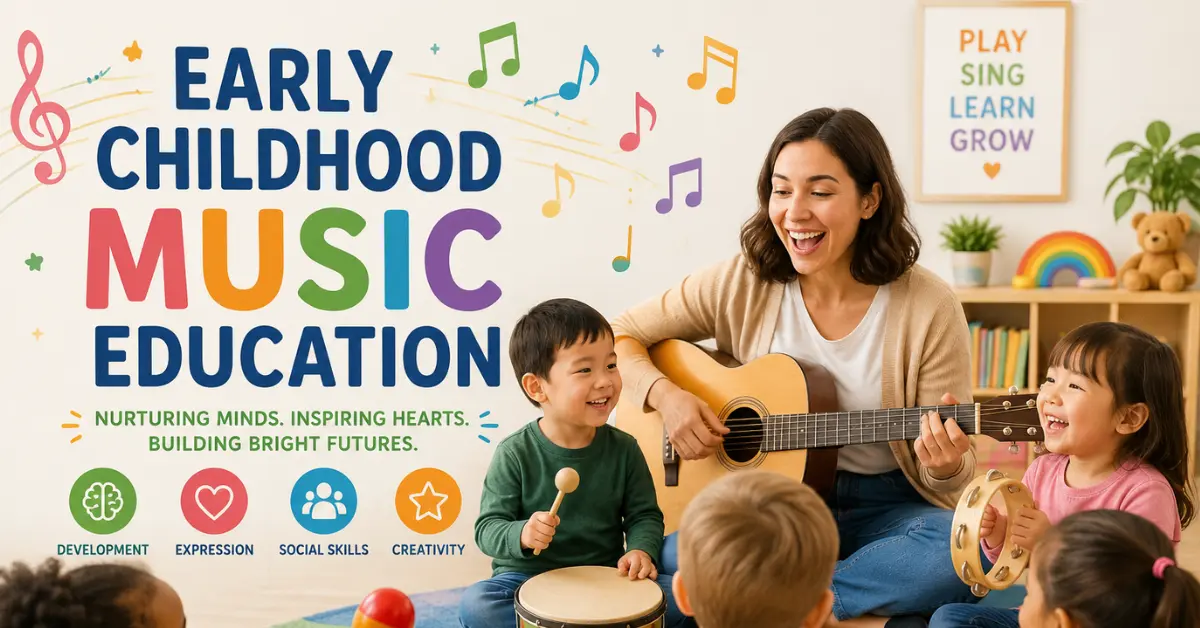
You’ve probably watched your baby kick their legs when a song comes on, or seen your two-year-old stop mid-tantrum the moment music plays. That reaction isn’t random. It’s biology doing exactly what it was designed to do.
Early childhood music education isn’t about turning your child into the next Mozart. It’s about using one of the most powerful developmental tools available during the years when the brain is growing faster than it ever will again. And the research on this is detailed, consistent, and frankly remarkable.
This guide brings together the science, the practical advice, and the honest answers to the questions parents actually ask — including things most programs and articles won’t tell you.
What Is Early Childhood Music Education?
Early childhood music education refers to structured and informal musical experiences designed for children from birth through approximately age eight. This window aligns with what researchers call a “sensitive period” — a phase of development when the brain is especially receptive to learning, pattern recognition, language, and emotional regulation.
It includes everything from a caregiver humming a lullaby to a newborn, to parent-child music classes for toddlers, to structured group music programs for preschoolers and early elementary students.
Importantly, early childhood music education is not the same as early instrument instruction. While some children begin learning violin or piano at age three or four, the broader field is focused on musical engagement — singing, moving, listening, chanting, and playing with sound — rather than technical performance.
According to the National Association for Music Education (NAfME), music learning actually begins before birth. A typically developing fetus responds to sound at around five months gestation. From that moment, every child arrives in the world already primed for music.
Why Early Childhood Is the Most Important Window for Music
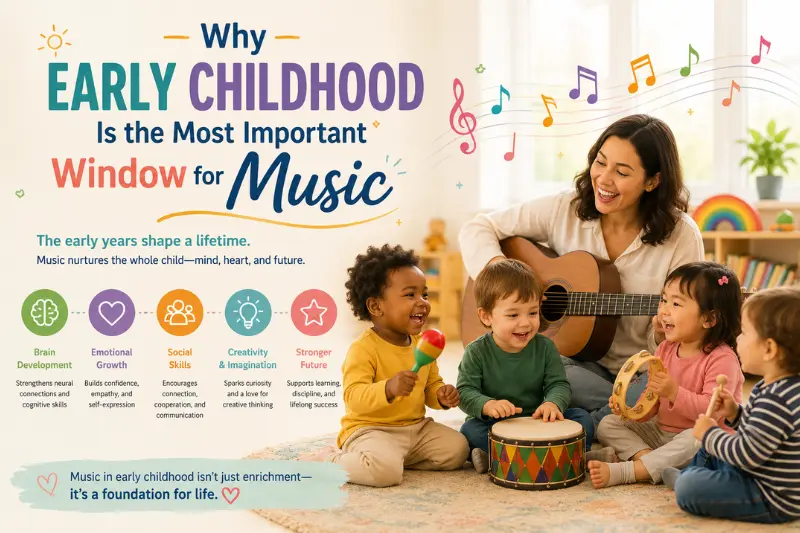
The first eight years of life are often described as the “golden window” for music education, and for good reason. Between birth and age eight, the brain forms more than one million new neural connections per second. Experiences during this period don’t just influence development — they shape the architecture of the brain itself.
This is why starting music early matters in ways that simply starting later cannot replicate:
Auditory pathways are still forming.
The neural circuits that process pitch, rhythm, and tone are built through exposure and experience. Children who engage with music during this period develop stronger auditory discrimination — the ability to hear subtle differences in sound — which directly supports language acquisition and reading.
Musical aptitude is “use it or lose it.”
Music researchers, particularly Edwin Gordon whose work underpins many early childhood programs, describe a concept called music aptitude — an innate musical potential that every child is born with. Like most aspects of early development, this potential reaches a stabilization point around age nine. The musical potential that isn’t nurtured during early childhood is largely permanent.
The window for tonal and rhythmic language is open
Just as children learn spoken languages most easily before age seven, they absorb the “vocabulary” of music — tonal patterns, rhythmic phrases, cultural musical idioms — with remarkable ease during early childhood. After this window closes, learning these same things requires significantly more conscious effort.
None of this means music education after age eight is pointless. Far from it. But it does mean that early childhood is genuinely different, developmentally, from any other phase of life.
Guide For You!
How to Open an Early Childhood Education Franchise: The Complete Step-by-Step Guide
The Science-Backed Benefits of Early Childhood Music Education
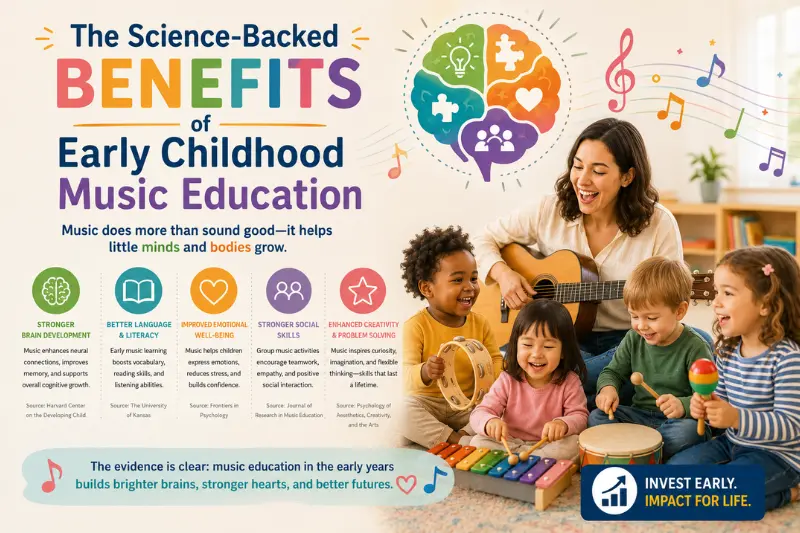
The research literature on early childhood music education spans decades and multiple scientific disciplines. Here is what the evidence actually shows — not marketing language, but findings from peer-reviewed research.
Music and Brain Development
Neuroscientists at Northwestern University found that musical training strengthens the neural response to sound in ways that transfer across all auditory tasks. Children with music exposure show enhanced processing in the auditory brainstem — the most fundamental level of sound processing — which has downstream effects on language, reading, and attention.
A 2016 study published in the Journal of Neuroscience found that even passive musical engagement (singing to babies, playing music at home) measurably altered infants’ brain responses to rhythmic patterns. Active engagement in music classes produced even larger effects.
Early Childhood Music Education and Language Development
The connection between music and language is one of the most robust findings in developmental science. Music and language share overlapping neural systems. They both rely on the same skills: auditory discrimination, working memory, phonological awareness, and the ability to segment sound streams into meaningful units.
Children in early childhood music programs consistently outperform peers in:
- Phonological awareness (the ability to hear and manipulate sounds within words)
- Vocabulary acquisition
- Reading readiness
- Second language learning
This isn’t incidental. Music is, in many ways, structured language — it has syntax, grammar, and semantics of its own. Learning to navigate musical structure trains the brain for linguistic structure.
Social and Emotional Development
Group music-making is unlike most other early childhood activities. It requires children to listen to others, match their own voice or movement to a group, take turns, and co-create something together. These aren’t incidental social byproducts — they’re baked into the structure of music-making itself.
Noralyn Baroja, a Musikgarten instructor with over twenty years of experience at the Music Institute of Chicago, notes that music programs like Musikgarten are particularly effective for shy or reluctant children because they offer “a natural, non-threatening way to encourage self-expression.” The routine and predictability of music class reduces anxiety; the group activity creates connection without requiring direct verbal interaction.
Research also shows that music activates the brain’s reward pathways — the same systems involved in social bonding. When children make music together, they experience a kind of neurological synchrony that deepens social cohesion. Studies of synchronized music-making in young children show increased prosocial behavior, cooperation, and empathy toward peers.
Motor Development
Rhythm is movement. Before children can sing on pitch, they feel music in their bodies — bouncing, swaying, clapping, and stomping are all expressions of musical understanding developing through the motor system.
Early childhood music education consistently supports both gross motor development (coordination, balance, bilateral movement) and fine motor development (hand-eye coordination, finger dexterity). This is one reason many early childhood music curricula pair percussion instrument exploration with movement activities — the two systems reinforce each other.
Cognitive Benefits Beyond Music
Early childhood music education has demonstrated measurable effects on executive function — the cluster of cognitive skills that include working memory, cognitive flexibility, and inhibitory control. These are the exact skills associated with academic success and social competence throughout life.
In a landmark study at the University of Toronto, six-year-olds who received keyboard lessons for one year showed significantly greater gains in general cognitive ability compared to control groups. Music instruction was the only tested intervention to produce this effect.
Separately, research from the Dana Foundation found strong correlations between musical training and spatial-temporal reasoning — the ability to think in patterns and visualize complex relationships — which underlies mathematical thinking.
What Actually Happens in an Early Childhood Music Class?
One of the biggest misconceptions about early childhood music education is that it’s essentially just singing nursery rhymes. Real programs are far more intentional and developmentally sophisticated than that.
Here’s what quality early childhood music education actually looks like across the key developmental stages:
Infant Music Classes (Birth to 18 Months)
Infant music classes are almost always caregiver-and-child classes. The caregiver is the primary learner in many ways — learning songs, rhythms, and movement patterns to use at home throughout the week.
Activities include:
- Gentle rocking and bouncing songs that introduce pulse and meter
- Lullabies and simple tonal patterns that develop pitch memory
- Peek-a-boo and anticipation games set to music (which also build social cognition)
- Simple percussion and shaker exploration
- Focused listening to diverse musical styles and cultures
What looks like “simple singing” is actually introducing the infant to the musical vocabulary of their culture, developing listening attention, and building the neural patterns that will underpin language.
Toddler Music Classes (18 Months to 3 Years)
Toddlers are in an explosion of language, independence, and motor development. Good music classes capitalize on all three simultaneously.
Activities at this stage include:
- Call and response singing (supports language turn-taking)
- Movement-based rhythm activities (marching, jumping, spinning to beats)
- Simple instrument exploration — maracas, hand drums, resonator bars
- Folk songs, cumulative songs, and songs with actions
- Creative sound exploration — what does the drum sound like when you tap gently vs. hit hard?
The “messiness” of toddler music class — kids wandering, not following directions, doing their own thing — is developmentally appropriate and not a sign that the class isn’t working. Much of the learning is happening in the background.
Preschool and Pre-K Music (Ages 3–5)
This is where more structured musical concepts begin to emerge, though always through play.
Preschool-level early childhood music education introduces:
- Steady beat vs. rhythm (one of the fundamental musical distinctions)
- High/low pitch, fast/slow tempo, loud/soft dynamics
- Simple melodic patterns and ostinatos
- Musical storytelling and dramatic play
- Beginning movement to notation concepts (long sounds vs. short sounds)
- Ensemble activities and the social negotiation of group music-making
Research-based programs like Musikgarten, Music Together, and programs following Gordon’s Music Learning Theory are deliberately sequential — each stage builds on the last, even when activities appear unstructured.
Early Elementary (Ages 5–8)
By kindergarten through second grade, children can engage with formal musical concepts in age-appropriate ways. This is the stage where:
- Music literacy begins (connecting sounds to written symbols)
- Instrument study becomes developmentally accessible for many children
- Choir, group singing, and ensemble work build community and discipline
- The connection between music and academic subjects (math, language arts, science) becomes explicit and teachable
Starting Early Childhood Music Education at Home: What Parents Can Do Right Now
You don’t need a program, an instrument, or a music degree to provide meaningful early childhood music education. What you need is intention and consistency.
Sing Every Day — Even If You Think You Can’t Sing
This is the single most important thing you can do. Research by Dr. Sandra Trehub at the University of Toronto shows that infants respond more strongly to their parent’s singing voice than to any other music, regardless of that parent’s vocal quality. Your imperfect voice is irreplaceable.
Sing during diaper changes, mealtimes, bath time, and car rides. Sing the same songs repeatedly — repetition is how young children learn. Make up simple songs about what you’re doing: “Now we’re putting on your shoes, your shoes, your shoes.” The melodic contour of infant-directed singing (what researchers call “motherese”) supports language acquisition and emotional regulation simultaneously.
Establish a Beat
Keeping a steady beat — bouncing a baby on your knee to music, clapping with a toddler, marching around the kitchen — is foundational to all later musical learning. The beat is the heartbeat of music, and children who have internalised a steady beat through physical experience become more accurate musicians, better readers, and stronger athletes.
Build a Musically Rich Home Environment
This doesn’t mean Mozart 24/7. It means:
- Playing a variety of music genres throughout the week (children’s music, classical, jazz, folk, world music)
- Exposing children to live music when possible — even a street musician or a family member playing guitar
- Having simple instruments accessible: shakers, a small drum, a xylophone, a keyboard
- Responding to your child’s musical moments — if they start humming, hum back
Respond to Your Child’s Musical Initiatives
One of the most powerful things a caregiver can do is notice and respond to a child’s natural musical expressions. When your toddler bangs rhythmically on the table, join in. When your preschooler makes up a song, ask them to sing it again. When your child dances to music, dance with them.
These responses send a message — music is meaningful, music is communication, music is worth your attention — that shapes the child’s relationship with music for life.
How to Choose an Early Childhood Music Program
If you’re looking for structured early childhood music education beyond the home, here’s what to look for.
Research-Based Curriculum
Ask whether the program is based on an established educational framework. The most widely researched approaches include:
- Music Learning Theory (Edwin Gordon): Focuses on audiation — the ability to think music in the mind — as the foundation of all musical literacy. Programs based on Gordon’s research (including MSU Community Music School’s early childhood program) are highly sequential and developmentally grounded.
- Musikgarten: Developed by Dr. Lorna Heyge, Musikgarten offers a sequential curriculum from birth to age seven that integrates music, movement, and whole-child development. It’s one of the most widely available early childhood music programs in North America.
- Music Together: A globally available program operating in over 2,000 locations and 35 countries. It emphasizes family participation — caregivers are active participants in every class — and draws on a large original repertoire of songs across diverse musical styles.
- Orff Schulwerk: Developed by composer Carl Orff and educator Gunild Keetman, this approach uses elemental music — simple, accessible musical patterns — combined with movement, speech, and improvisation. Many early elementary music programs are Orff-based.
- Suzuki Method: Best known as an instrument instruction approach (typically violin or piano starting around age three), Suzuki is grounded in the belief that any child can learn music the way children learn their mother tongue — through listening, repetition, and parental involvement.
Caregiver Involvement
For children under age four, programs that actively involve the caregiver are developmentally superior to drop-off formats. The research is consistent on this: children’s music learning is deeper and more durable when a trusted adult participates, models engagement, and reinforces learning at home.
Be skeptical of infant or toddler programs where parents sit on the side and observe. Participation matters.
Qualified Teachers
Early childhood music education requires specialized training. A teacher might be an excellent musician or an experienced early childhood educator without being trained in early childhood music specifically. Look for credentials or training in programs like Musikgarten certification, Music Together teacher training, Orff Level certifications, or graduate work in music education with an early childhood focus (such as the program at Teachers College, Columbia University).
Play-Based, Developmentally Appropriate Methods
Quality early childhood music education should look and feel like play — joyful, child-led at moments, responsive to the group’s energy, and never coercive. Red flags include:
- Insisting children sit still for extended periods
- Correcting young children’s singing voices
- Emphasizing performance over exploration
- Using punitive approaches to manage behavior
Inclusion and Cultural Diversity
The best programs draw from a wide range of musical traditions and cultural contexts. Music from diverse cultures — lullabies, folk songs, children’s games, and rhythmic traditions from around the world — exposes children to a broader tonal and rhythmic vocabulary than any single tradition provides.
Programs should also be genuinely inclusive of children with different abilities, temperaments, and learning styles. Children with hearing impairments, physical differences, developmental delays, and sensory sensitivities can all benefit from thoughtfully designed music experiences.
If you’re a teacher or childcare professional looking to deepen your qualifications in this space, earning the right credentials is a practical first step. Our guide to early childhood education units online breaks down exactly which college-level credits you need for state permits, CDA credentials, and career advancement — and how to complete them on your own schedule.
For those considering early childhood music education as a career path — not just a class to enroll your child in — the field offers genuine long-term opportunity. Our guide to early childhood education jobs covers the full career landscape: roles available, realistic salary expectations, what qualifications employers actually look for, and how to get hired whether you’re entering the field fresh or making a switch.
What to Expect Month by Month: A Developmental Music Guide
One of the most common questions parents have is: what should my child actually be able to do musically at this age? Here’s an honest developmental picture:
- Birth to 3 months: Responds to sounds and voice. Settles or alerts to music. Prefers the caregiver’s voice above all others.
- 3 to 6 months: Begins vocalizing in response to singing. Shows clear preferences for certain voices and musical qualities. May kick or move in response to rhythmic music.
- 6 to 12 months: Begins babbling with melodic contour — going up and down in pitch. May attempt to match a pitch heard repeatedly. Responds to rhythm by bouncing or swaying. Anticipates favourite songs.
- 12 to 18 months: May spontaneously hum or sing fragments. Begins to imitate simple rhythmic patterns. Enjoys instruments to bang, shake, and explore.
- 18 to 24 months: May sing recognizable fragments of familiar songs. Moves more deliberately to music. Strong interest in repetition — the same songs requested again and again is developmentally healthy and important.
- 2 to 3 years: Can sing short, familiar songs with approximate pitch. Claps along to steady beat with some accuracy. Engages with musical games. Begins to understand simple concepts: loud/soft, fast/slow.
- 3 to 4 years: Singing voice becomes more consistent. Can maintain a beat more reliably. Enjoys made-up songs. Can follow simple musical sequences. Begins to show musical preferences.
- 4 to 5 years: Can sing many familiar songs with reasonable accuracy. May begin to recognize written symbols for music. Ensemble awareness grows — noticing other children’s contributions.
- 5 to 7 years: Ready for more formal music literacy (note reading, rhythm notation). Can sustain attention for longer musical activities. Instrument study becomes more productive. Growing ability to self-evaluate their own musical performance.
Common Questions Parents Ask About Early Childhood Music Education
My child doesn’t seem interested in music class. Should I stop going?
Not immediately. Young children often appear disengaged while actually absorbing everything around them. A toddler who runs to the back of the room during class and doesn’t participate visibly may be processing the music deeply — and may start singing those songs at home a week later. Give it at least six to eight classes before assessing whether a program is working.
That said, if a child is genuinely distressed (not just independent or distracted) at every session, trust that signal.
Is there a “too early” to start?
No. Music engagement from birth — even from before birth — is developmentally appropriate. The musical experiences of the first months of life are not “wasted” just because the child isn’t visibly responding in ways we recognize as musical.
My family isn’t musical. Will that limit my child?
This is one of the most important misconceptions to correct. Musical ability is not inherited in any meaningful way. It is developed through exposure and experience. A child from a non-musical family who receives quality early childhood music education will outperform a child from a musical family who receives no music education. What matters is engagement, not genes.
Do children need to learn to read music?
Not in early childhood. Music literacy — reading notation — is valuable and should be developed, but it is developmentally analogous to learning to read written language. We don’t teach children the alphabet before they’ve had years of hearing, speaking, and understanding spoken language. Similarly, children should have years of musical experience — singing, moving, listening, playing — before formal notation is introduced. Pushing notation too early can actually impede the development of genuine musical understanding.
How much does early childhood music education cost?
This varies widely. Community programs and university-affiliated programs (like MSU Community Music School, which charges around $90 for a five-week session) are among the most affordable. Private programs and conservatory-based programs (like NEC Prep in Boston) will be more expensive. Free options exist: public library music programs, online resources, and home-based singing and music-making cost nothing.
The Role of Inclusion in Early Childhood Music Education
Every child has the capacity for music. This is not a philosophy — it is a research finding. NAfME’s position statement explicitly includes children with hearing impairments, intellectual disabilities, and physical challenges in its assertion that all children are primed for music learning.
Children with autism spectrum disorder frequently show strong responses to music, and music therapy with young children on the spectrum has a robust evidence base. Children with Down syndrome often demonstrate strong rhythmic ability. Children who are deaf or hard of hearing can engage with music through vibrotactile perception — feeling the physical properties of sound — and many develop rich musical lives.
Inclusive early childhood music education also benefits neurotypical children by teaching them, from the earliest age, that music and community belong to everyone.
Early Childhood Music Education and School Readiness
The benefits of early childhood music education don’t exist in isolation from academic development — they feed directly into the skills that predict school success.
Children who have experienced quality early childhood music education consistently demonstrate:
- Stronger phonological awareness, the best single predictor of reading success
- Better executive function, including the ability to focus attention, remember instructions, and regulate impulses
- Enhanced mathematical thinking, particularly in pattern recognition and spatial reasoning
- Greater collaborative skills, including listening, taking turns, and working toward shared goals
- Higher emotional intelligence, including the ability to identify and express emotions constructively
Several school systems in the US, UK, and Scandinavia have incorporated early childhood music programs into their broader school readiness strategies specifically because of these findings. Music education is not a “soft” subject competing with academics — it is one of the most effective academic preparation tools available.
A Note on the “Mozart Effect” and What to Ignore
You may have heard that playing Mozart to babies makes them smarter. This claim, based on a 1993 study that was widely misrepresented in popular media, is not supported by the evidence.
The original study found a temporary improvement in one specific spatial reasoning task in college students after listening to Mozart — an effect that lasted about ten to fifteen minutes. It said nothing about babies, nothing about long-term intelligence, and nothing about passive music listening.
The genuine benefits of early childhood music education come from active engagement — singing, moving, making music, and being responded to musically — not from passive exposure to classical recordings.
This distinction matters for parents: putting a baby next to a speaker playing Bach does very little. Singing to that same baby while making eye contact and responding to their vocalisations does a great deal.
Bringing It Together: How to Start Today
Early childhood music education works at every level — from the simplest home practice to the most structured conservatory program. Here is a practical starting point depending on where you are:
- If your child is a newborn: Start singing. Any song you know. Repeat it. Sing it at every diaper change. That is early childhood music education.
- If your child is a toddler: Look for a caregiver-and-child music class in your area. Search for Musikgarten, Music Together, or a local music school with an early childhood program. Go weekly. Participate actively.
- If your child is preschool age: Consider a structured program alongside home music-making. Begin exposing your child to live music — even simple street performance. Follow their musical interests; if they’re drawn to drums, find a way to explore that.
- If your child is in early elementary: This is an ideal time to begin instrument instruction if they’re interested — but continue the broader musical engagement. Choir, group music classes, and home music-making remain valuable alongside formal lessons.
- At every stage: Respond to your child’s music. Sing back. Dance with them. Take their musical ideas seriously. The relationship between a child and music is built one small interaction at a time.
The research is overwhelming, the developmental window is real, and the most important tool is the one you already have: your voice, your presence, and your willingness to make music together.
Choosing the right environment for your child goes beyond music alone. If you’re based in the Tulsa, Oklahoma area and looking for a full early childhood setting that combines structured learning with genuine care, it’s worth exploring what accredited centers in your region offer. Our detailed guide to Legacy Childhood Education Centers covers everything parents need to know — from their 5-star OKDHS rating and nationally accredited programs to their infant-through-school-age curriculum and what makes them stand out in the Tulsa metro area.
FAQs — Early childhood music education
| Question | Why is it there |
|---|---|
| What age to start? | Highest-volume parent search query in this topic |
| Talent required? | Addresses the #1 objection parents have |
| ECE vs. music lessons? | Clears up the most common confusion |
| Non-musical parents? | Removes the biggest barrier to action |
| How to spot quality programs? | High commercial intent — converts browsers to enrollees |
| Screen time / recorded music? | Captures the “Mozart Effect adjacent” searchers |
| Child doesn’t enjoy class | Retention/reassurance question every parent eventually asks |
| Mozart Effect | Debunks the myth — high search volume, zero good content from competitors |
| When to introduce instruments? | One of the most-searched parent questions in music education |
| Special needs / developmental delays? | Underserved angle, strong E-E-A-T signal |
| School readiness connection | Bridges music to academic parents who need a “practical” reason |
Summary
Early childhood music education is one of the most powerful developmental investments available during the first eight years of life. It supports brain development, language acquisition, emotional regulation, social skills, motor development, and school readiness — all simultaneously, through joyful, play-based engagement with music.
The key principles to remember:
- Music learning begins before birth; every child has musical potential
- The early childhood years are a unique, irreplaceable developmental window
- Active music-making — singing, moving, playing, listening — drives the benefits; passive listening does not
- Caregiver involvement is essential, especially for children under four
- Home music-making is as important as formal programs
- No family is “too unmusical” to give their child a rich musical childhood
The youngest musicians in any program are not there to become performers. They are there to become fully human — and music is one of the oldest, most powerful means we have to help them do exactly that.