

If you’ve been searching for childcare options in the United States, chances are KinderCare has already come up. It’s one of the largest and most recognized names in early childhood education in the country. But between tuition costs, enrollment steps, curriculum questions, and safety policies, it can feel overwhelming to figure out whether KinderCare is the right fit for your family.
This guide covers everything in one place. Whether you’re comparing KinderCare to other daycare centers, looking up the daily schedule for infants, or trying to find a KinderCare near you, you’ll find clear and honest answers here — written from the perspective of someone who has spent real time researching what parents actually want to know.
What Is KinderCare? Understanding the Kinder Care Learning Program
KinderCare Learning Centers is one of the largest private childcare and early education providers in the United States. Founded in 1969, the company now operates more than 2,600 accredited centers across 41 states and the District of Columbia, serving children from six weeks old all the way through 12 years of age.
But KinderCare is more than just a daycare chain. It operates under the parent company Kinder Care Learning Companies, which also manages:
- Champions — before and after school care programs
- Crème de la Crème — a premium early education brand
- KLC for Employers — employer-sponsored childcare offered as a workplace benefit
The KinderCare learning program is built on a proprietary curriculum called World of Wonder, designed in collaboration with early childhood education training researchers. It focuses on developing the whole child — cognitively, socially, emotionally, and physically — through structured play, teacher-led activities, and age-appropriate learning milestones.
Each classroom is organized by age group, so children are always learning alongside peers at a similar developmental stage. Teachers are trained in child development, and many centers maintain accreditation through the National Association for the Education of Young Children (NAEYC), one of the most respected credentials in the early education field.
One thing that sets Kinder Care apart from a typical babysitting-style daycare is the intentionality behind the curriculum. Every activity — from art projects to outdoor play — is connected to a learning objective. That said, it’s not a rigid academic environment. The emphasis is on making learning joyful, especially for the youngest children.
KinderCare Curriculum for Toddlers: What Your Child Actually Learns

The KinderCare curriculum for toddlers is structured around the understanding that children ages one to three learn primarily through sensory exploration and hands-on interaction. You won’t find toddlers sitting at desks doing worksheets. Instead, teachers use movement, music, storytelling, and guided play to introduce foundational skills.
Here’s a breakdown of what the toddler curriculum typically includes:
Language and Literacy
- Teachers read aloud daily, introduce simple vocabulary through songs and rhymes, and encourage verbal communication. Even before toddlers can form full sentences, the classroom environment is designed to build language exposure.
Social and Emotional Development
- At this age, learning to share, take turns, and manage frustration is just as important as any academic skill. KinderCare teachers are trained to model emotional language — helping children name feelings and develop early self-regulation.
Fine and Gross Motor Skills
- Stacking blocks, painting with fingers, climbing on age-appropriate equipment, and scribbling with crayons all build the coordination toddlers need for later writing and physical tasks.
Math Readiness
- Through counting songs, sorting activities, and pattern recognition games, toddlers start building the number sense they’ll need in preschool.
Science and Curiosity
- Simple experiments — like pouring water, mixing colors, and observing plants — introduce the concept of cause and effect in a way that feels like pure fun.
The KinderCare toddler classroom is typically staffed at a 1:5 or 1:6 teacher-to-child ratio, depending on state regulations. This is important because toddlers require close supervision and frequent individual attention. For parents making the transition from home care, Kinder Care offers a gradual transition period at many locations, allowing the child to get comfortable before full-day enrollment begins.
KinderCare Tuition Cost Per Month: What to Expect
This is one of the most searched questions about Kinder Care — and understandably so. Childcare is one of the largest household expenses for American families, often exceeding the cost of rent in many cities.
KinderCare does not publish a national tuition rate, because costs vary significantly by location, age of the child, number of days per week, and program type. However, based on parent-reported data and regional averages across the US, here is a general picture:
| Age Group | Estimated Monthly Tuition (Full-Time) |
|---|---|
| Infants (6 weeks – 12 months) | $1,400 – $2,200 |
| Toddlers (1 – 2 years) | $1,200 – $2,000 |
| Discovery Preschool (2 – 3 years) | $1,100 – $1,800 |
| Preschool (3 – 4 years) | $950 – $1,600 |
| Pre-Kindergarten (4 – 5 years) | $900 – $1,500 |
| Kindergarten (5 – 6 years) | $800 – $1,400 |
Note: Costs in metro areas like New York City, San Francisco, Boston, and Washington D.C. tend to be significantly higher than rural or mid-sized city locations.
What’s included in KinderCare tuition?
Most KinderCare tuition rates include:
- Full-day program (typically 6:30 AM – 6:00 PM)
- Curriculum and educational materials
- Meals and snacks (through their food program — more on this below)
- Access to the KinderCare family portal
- Progress reports and parent-teacher communication
Part-time options are available at many locations and can reduce monthly costs considerably if your child only needs care three days per week or certain hours.
Financial assistance options include:
- Child Care and Development Fund (CCDF) subsidies administered by state governments
- Dependent Care FSA (Flexible Spending Account) through your employer
- Military childcare subsidies — Kinder Care partners with the Department of Defense and participates in the Military Child Care in Your Neighborhood (MCCYN) program
- Employer-sponsored benefits — if your employer partners with KinderCare Learning Companies, you may receive discounted or subsidized enrollment
To get the exact KinderCare tuition cost per month for a center near you, the fastest method is to call the center directly or submit a contact form on the Kinder Care website. They will provide current pricing and availability.
How to Enroll in KinderCare: A Step-by-Step Guide
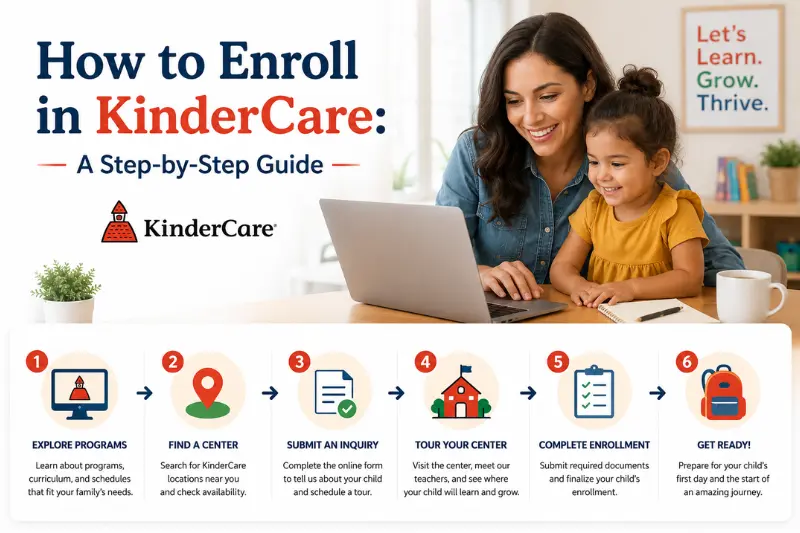
Enrolling in KinderCare is more straightforward than many parents expect. Here’s the process broken down:
Step 1: Find Your Center
Go to kinder care.com and use the location finder to search by zip code or city. You’ll see available centers with ratings, hours, and contact information.
Step 2: Schedule a Tour
KinderCare strongly encourages an in-person or virtual tour before enrollment. During the tour, you’ll meet the director and lead teachers, see the classroom, and get a feel for the center’s culture. This is also the right time to ask about waitlists — popular centers fill quickly.
Step 3: Submit an Inquiry
On the center page, fill in your contact information, your child’s date of birth, and your desired start date. A center representative will contact you with current pricing and availability.
Step 4: Complete the Enrollment Agreement
Once you’ve confirmed the spot, you’ll sign an Enrollment Agreement that outlines tuition, schedule, and policies. Read this carefully — it includes details on drop-off and pickup windows, late fees, and notice periods for withdrawing.
Step 5: Provide Required Documentation
You’ll typically need to submit your child’s immunization records, a health form completed by your child’s doctor, and any relevant allergy or medical information.
Step 6: Set Up the Parent Portal
KinderCare provides a family portal (accessible via my.kinder care.com) where you can pay tuition, view your child’s daily reports, see photos, and communicate with teachers.
Open enrollment at most Kinder Care locations runs year-round, meaning there is no fixed enrollment window the way there is with some public preschool programs. That said, infant and toddler spots fill the fastest, so if you’re expecting or planning ahead, it’s worth reaching out 3–6 months in advance.
KinderCare Daily Schedule for Infants: What a Typical Day Looks Like
One of the most common concerns parents have when enrolling an infant is simply: What is happening while I’m at work?
KinderCare infant rooms follow a responsive care model, meaning the schedule is built around each baby’s individual cues rather than a rigid group timetable. Here’s a representative example of what a KinderCare daily schedule for infants might look like:
| Time | Activity |
|---|---|
| 6:30 – 8:00 AM | Arrival, morning greetings, individual play |
| 8:00 – 9:00 AM | Morning feeding (bottle or breakfast, depending on age) |
| 9:00 – 10:00 AM | Tummy time, sensory exploration, teacher-led interaction |
| 10:00 – 11:30 AM | Morning nap (based on individual sleep cues) |
| 11:30 AM – 12:30 PM | Lunchtime feeding, diaper changes |
| 12:30 – 2:30 PM | Quiet play, reading, music time |
| 2:30 – 4:00 PM | Afternoon nap |
| 4:00 – 5:00 PM | Outdoor time (weather permitting) or indoor play |
| 5:00 – 6:00 PM | Wind-down, pickup, parent communication |
Throughout the day, KinderCare teachers log each infant’s feedings, diaper changes, sleep times, and activities through the family portal. Parents can check in during the day without calling, which most families find reassuring.
Infant-to-teacher ratios at KinderCare typically follow a 1:3 or 1:4 guideline, depending on state requirements. Some states mandate even lower ratios for infants under 12 months. Ask your specific center about their policy.
KinderCare vs. Other Daycare Centers: How It Stacks Up
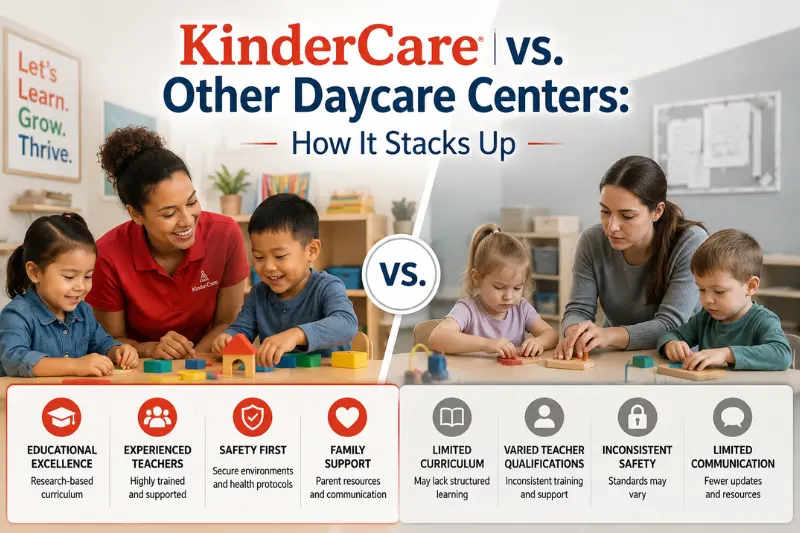
Choosing childcare is personal, and KinderCare isn’t the right fit for every family. Here’s an honest comparison with the most common alternatives parents consider.
KinderCare vs. Local Independent Daycares
Independent daycare centers often have smaller class sizes and a more intimate, family-like environment. They may be more flexible with scheduling and communication. However, they vary enormously in quality, may lack formal accreditation, and may not offer the same structured curriculum. KinderCare provides more consistency through its national standards — but a great independent center with experienced, long-tenured teachers can absolutely outperform a large chain.
KinderCare vs. Home Daycare (Family Childcare Homes)
Licensed family daycares operate out of a private home, typically caring for 4–8 children. They’re usually less expensive than Kinder Care, more flexible, and often better suited for very young infants who need extra individual attention. The trade-off is fewer enrichment resources and less structured programming.
KinderCare vs. Head Start
Head Start is a federally funded program for low-income families with children ages 3–5. It’s free and offers strong early education, nutrition, and family support services. If your family qualifies, Head Start is worth pursuing before paying full Kinder Care tuition. The limitation is availability — slots are limited and there can be waitlists.
KinderCare vs. Church-Based Preschools
Many churches run affordable preschool programs. They’re often part-time (2–3 days per week, half days), which doesn’t work if you need full-day care. Quality varies, and some integrate religious instruction. If part-time early education is what you need, these are often the most affordable option.
One of the most common questions parents ask before enrolling is how KinderCare stacks up against the competition. Tuition, curriculum philosophy, teacher quality, and accreditation all look different when you put them side by side with local private centers, Montessori programs, and other national chains. If you’re still weighing your options, our detailed guide on KinderCare vs. Other Daycare Centers breaks down every key factor — including the questions most comparison articles miss — so you can make a confident decision for your family.
KinderCare vs. Montessori Preschool: Which Philosophy Is Right for Your Child?
This is one of the most common comparisons parents make — and it deserves a real answer, not just a generic “both are great” response.
- KinderCare’s approach is teacher-directed within a structured curriculum. Teachers plan activities, introduce concepts, and guide children through learning objectives. The classroom environment is warm and playful, but the learning has a defined direction. Progress is tracked against developmental benchmarks.
- Montessori’s approach is child-directed. Children choose their own work from a carefully prepared environment, moving at their own pace and following their interests. The teacher acts as a guide rather than a direct instructor. There are no grades and minimal external rewards. The emphasis is on intrinsic motivation and independence.
Key differences at a glance:
| Factor | KinderCare | Montessori |
|---|---|---|
| Learning style | Teacher-directed | Child-directed |
| Classroom structure | Age-grouped, scheduled | Mixed-age, open-choice |
| Curriculum | Standardized (World of Wonder) | Prepared environment, child-led |
| Assessment | Developmental milestone tracking | Observational, no traditional grades |
| Cost | Moderate to high | Often comparable or higher |
| Availability | 2,600+ US locations | Varies widely by city |
Which is better? It depends on the child. Children who thrive with routine and benefit from direct instruction often do well at KinderCare. Children who are highly self-motivated, need more freedom of movement, or struggle in highly structured settings often flourish in Montessori. If possible, visit both before deciding — and watch how your child reacts to each environment.
One practical note: authentic Montessori schools are accredited by either the American Montessori Society (AMS) or Association Montessori Internationale (AMI). Many schools use the name “Montessori” loosely without these credentials. Verify accreditation if that philosophy matters to you.
KinderCare Near Me: Finding Open Enrollment in Your Area (USA)
If you’re searching for a KinderCare near you with open enrollment, here’s the most efficient approach:

Using the KinderCare website
Go to kindercare.com/our-centers/results and enter your zip code. The map view shows all centers within a selected radius. Each listing indicates current availability and allows you to schedule a tour directly.
Calling ahead
Online availability information isn’t always real-time. A quick phone call to your top two or three centers will confirm whether they currently have openings in your child’s age group.
Tips for finding open spots:
- Infant and toddler rooms fill the fastest — contact centers at least 3–6 months ahead if possible
- Center availability shifts regularly as families move, change schedules, or children age up to the next classroom
- If a center is full, ask to be put on the waitlist — openings come up more often than you’d expect
- Some centers have more flexibility for part-time slots even when full-time spots are taken
For employer-sponsored KinderCare
If your employer partners with KinderCare Learning Companies, check your HR benefits portal. You may have priority enrollment access or reserved slots at nearby centers.
Affordable KinderCare Alternatives for Budget-Conscious Families
KinderCare is not cheap. If the tuition costs are out of reach, here are legitimate, quality alternatives worth considering:
1. Head Start and Early Head Start
Free, federally funded. Designed for families earning below 100% of the federal poverty level. Early Head Start covers infants and toddlers; Head Start covers ages 3–5. Find your local program at eclkc.ohs.acf.hhs.gov.
2. State-Funded Pre-K Programs
Most states offer free or subsidized pre-K for four-year-olds, and several now include three-year-olds. Eligibility criteria and quality vary significantly by state.
3. Child Care Subsidy Programs (CCDF)
The Child Care and Development Fund provides vouchers on a sliding-scale basis to working families who meet income requirements. These vouchers can be used at licensed providers including KinderCare. Apply through your state’s childcare agency.
4. YMCA Childcare
The YMCA operates early childhood programs and before/after school care in many communities. Financial assistance is available on a needs basis, and the programs are generally well-regarded.
5. Co-op Preschools
Parent-cooperative preschools are run by families who take turns assisting in the classroom. Tuition is significantly lower because parent labor offsets staffing costs. A great option if your schedule allows it.
6. Licensed Home Daycares
Licensed family childcare homes are regulated by your state and often cost 20–40% less than center-based care. Look for providers with Child Development Associate (CDA) credentials or higher.
7. Bright Horizons
A direct KinderCare competitor with a similar employer-sponsored model. Pricing is comparable but employer partnerships may vary — worth checking if your company uses Bright Horizons instead.
Is KinderCare a Good Daycare? An Honest Assessment
The honest answer is: it depends on the individual center.
KinderCare as a national brand has strong fundamentals — NAEYC accreditation at many locations, a research-backed curriculum, health and safety standards, and regulatory oversight. Parent reviews at highly rated centers consistently highlight dedicated teachers, clear communication, and happy children.
What KinderCare tends to do well:
- Structured, age-appropriate curriculum
- Consistent safety and security protocols across locations
- Professional development for teachers
- Digital parent communication through the portal
- Nutrition program that meets USDA guidelines
Where experiences can vary:
- Individual center quality depends heavily on the director and lead teachers
- Teacher turnover is a known challenge in the childcare industry nationally, and KinderCare is not immune
- Some locations have received regulatory complaints or inspection deficiencies — all public record through your state’s licensing agency
- Large centers can feel less personal than smaller alternatives
What parents consistently say matters most
When you find a KinderCare center with a stable, experienced director and low teacher turnover, the experience tends to be excellent. When there’s frequent staff turnover or inconsistent management, quality suffers noticeably.
- Our recommendation: Before enrolling, visit the specific center at least once — ideally during mid-morning activity hours rather than just during a scheduled tour. Ask how long the current lead teachers have been at the center. Talk to other parents if you can. State licensing inspection reports are publicly available and worth reviewing.
KinderCare Hours and Drop-Off Policy: What Parents Need to Know
Most KinderCare centers operate Monday through Friday, with hours typically ranging from 6:30 AM to 6:00 PM. Some locations open as early as 6:00 AM or close as late as 6:30 PM. Weekend care is generally not available at standard KinderCare centers.
Drop-off policy
KinderCare uses a secure entry system at all centers. Parents must check in at a front desk or use a keypad entry. Valid photo ID is required for any adult picking up a child who is not the primary parent on file — even if staff knows the person.
- Authorized pickup individuals must be listed in advance on your enrollment paperwork
- Late pickup fees are standard and can be significant (often $1–2 per minute after closing)
- Many centers have a soft drop-off window — arriving more than 30 minutes after scheduled open or more than 30 minutes after group activities begin may disrupt your child’s transition into the classroom
Sick child policy
Children with fever (usually defined as 100°F or higher), vomiting, diarrhea, or certain contagious conditions may not attend. KinderCare will call you to pick up a sick child, and most centers require 24 hours symptom-free before return. Know your backup plan for sick days.
Holiday and closure schedule
KinderCare centers observe major federal holidays and typically close or operate on reduced schedules. Annual center-specific closure schedules are provided during enrollment.
KinderCare Food Program for Toddlers: Nutrition and Meals
KinderCare participates in the USDA Child and Adult Care Food Program (CACFP), which sets nutritional standards for meals and snacks served to children in licensed care settings. This means the food your toddler receives at KinderCare must meet federally established nutritional requirements — it’s not just whatever is convenient to prepare.
What a typical day’s menu might include for toddlers:
- Morning snack: Whole grain crackers with cheese, or fruit and yogurt
- Lunch: Turkey and vegetable wrap or pasta with meat sauce, milk, and a vegetable side
- Afternoon snack: Applesauce or banana with whole grain graham crackers
Menus are posted in the center and available through the parent portal. KinderCare’s “KinderCare Cooks” program publishes recipes and nutrition tips on their website, reflecting a genuine effort to make food part of the educational experience.
Allergies and dietary restrictions
KinderCare accommodates documented food allergies and dietary restrictions. You must provide written documentation and a healthcare provider’s note for severe allergies. Staff are trained in allergy protocols and epinephrine administration, though policies vary by state regarding whether epi-pens can be administered by staff.
What competitors often miss about this
Not all daycare centers participate in CACFP — participation requires adherence to nutrition standards and record-keeping that some smaller providers skip. If nutrition quality is a priority for your family, it’s worth asking any childcare provider directly whether they participate in the program.
Kinder Care Safety and Child Supervision: Policies and Standards
Safety is the non-negotiable foundation of any childcare decision. Here’s what KinderCare has in place:
Physical security:
- Keypad-secured entry at all center doors
- ID verification for all adult pickups
- Security cameras at entrances and common areas at many locations
- Visitor check-in log required
Staff background checks:
All KinderCare employees undergo comprehensive background checks, including criminal history screening, sex offender registry checks, and reference verification. This is required at both the company level and through state licensing agencies.
Health and safety protocols:
- Monthly fire and evacuation drills
- Lockdown and emergency shelter drills
- CPR and pediatric first aid certification required for all teachers
- Written emergency plans for each center
Supervision ratios:
KinderCare maintains staff-to-child ratios that meet or exceed state licensing requirements. In most states this means:
- Infants: 1:3 or 1:4
- Toddlers: 1:4 or 1:5
- Preschool: 1:8 to 1:10
- School-age: 1:10 to 1:14
State licensing records:
KinderCare centers are inspected by state childcare licensing agencies at least annually. Inspection reports and any deficiency records are publicly available through your state’s childcare licensing database. It is absolutely worth looking up the specific center you’re considering — not to expect perfection, but to understand how they respond to and resolve any findings.
Kinder Care Jobs and Kinder Care Careers: Working at KinderCare
KinderCare is one of the largest private employers of early childhood educators in the United States. If you’re considering a career in childcare, or looking to work in a professional early education environment, here’s what you need to know.
Types of positions available:
- Early Childhood Teacher — Lead teacher roles for specific age groups (infant, toddler, preschool, school-age). Most require a CDA, associate’s degree, or bachelor’s degree in early childhood education or a related field.
- Assistant Teacher / Teacher’s Aide — Entry-level roles, often available to those working toward their CDA credential.
- Center Director — Manages the overall operation of a single location. Typically requires a degree plus management experience.
- Corporate and Support Roles — KinderCare Learning Companies also employs staff in finance, HR, technology, real estate, marketing, and curriculum development at their Lake Oswego, Oregon headquarters.
Benefits KinderCare offers to employees:
- Tuition assistance for early childhood education coursework
- Free or discounted childcare at KinderCare centers
- Medical, dental, and vision insurance for eligible employees
- 401(k) retirement plan
- Paid professional development
What the reviews say:
Employee reviews on Indeed (6,180+ reviews) paint a mixed picture. At well-managed centers with strong directors, employees describe KinderCare as a genuinely rewarding place to work. At others, turnover is high and management support is inconsistent. Pay remains a challenge across the early childcare industry nationally — KinderCare positions are not high-paying relative to the skill and responsibility involved, though the company has made incremental increases in recent years.
How to apply:
Visit kcecareers.com — KinderCare’s dedicated careers website. You can search by position type, location, or upload your resume for personalized job matching. The site also allows you to join a talent network so you receive alerts when relevant roles open.
KinderCare Portal: Using the Parent and Family App
The KinderCare family portal is available at my.kindercare.com and through the KinderCare mobile app. Once enrolled, you’ll receive login credentials to access your child’s account.
What you can do through the portal:
- Pay tuition — set up autopay or make one-time payments
- View daily reports — sleep times, feedings, diaper changes (for infants and toddlers), activities, and notes from teachers
- See photos and videos — many teachers share moments from the day
- Access monthly statements — useful for FSA reimbursement and tax purposes (KinderCare provides an annual year-end statement with your total spending for the Dependent Care Tax Credit)
- Message your child’s teacher — send notes, ask questions, share important information
- Update authorized pickup contacts — any changes to who can pick up your child should be done through the portal and confirmed with the center directly
- View center closure notices — holiday schedules and emergency closures are communicated through the portal
The portal is one of KinderCare’s most consistently praised features by parents. The visibility into the daily routine — especially for infants and toddlers who can’t tell you what happened at school — provides real peace of mind for working parents.
KinderCare FAQs (Short Answers)
What is KinderCare?
KinderCare is a childcare and early education provider in the U.S. that offers learning programs for infants, toddlers, preschool, and school-age children.
What ages does KinderCare accept?
It usually serves children from infancy up to around 12 years old, depending on the center.
How do I enroll my child?
You find a nearby center, contact them, take a tour, and then complete the enrollment form with the center.
How much does it cost?
The cost is not fixed. It depends on the location, child’s age, and schedule, so each center gives its own pricing.
Does KinderCare offer financial help?
Some families may qualify for assistance programs, employer benefits, or government childcare support.
What do children learn there?
They follow an early learning curriculum focused on reading, math basics, creativity, social skills, and school readiness.
Is KinderCare safe?
Yes, centers follow safety rules like secure entry systems, trained staff, supervision, and health protocols.
Can parents visit before enrolling?
Yes, parents are encouraged to tour the center before making a decision.
Does KinderCare provide food?
Many centers offer snacks and meals, but it depends on the location and parents should confirm locally.
What should my child bring?
Usually extra clothes, comfort items, and any required personal or medical items.
Is there a parent app?
Yes, parents can use an app to get updates, photos, and communication from teachers.
Do I pay if my child is absent?
In most cases, yes, because you are paying for the reserved spot, not daily attendance.
How do payments work?
Payments are usually made online through card or bank transfer with automatic payment options.
Is it good for kindergarten preparation?
Yes, the program is designed to prepare children for school with early learning and social skills.
Are all centers the same?
They follow the same general system, but experience can vary depending on the location and staff.
Final Thoughts: Making the Right Childcare Decision for Your Family
KinderCare is a serious, professionally operated early education provider with a genuine curriculum, real safety infrastructure, and strong national accountability standards. For many American families, it provides reliable, quality care that bridges the gap between home and school in a meaningful way. That said, no national chain — including Kinder Care — guarantees a uniformly excellent experience at every location. The quality of your child’s experience will depend significantly on the specific center, the director’s leadership, and the stability of the teaching staff.
The best thing you can do as a parent is visit the specific center in person, ask hard questions, check state licensing records, and trust your instincts about the environment. A center where teachers greet children by name, where the director knows every family, and where the rooms feel warm and purposeful — that’s the sign of a quality program regardless of what brand is on the sign. Use this guide to go in prepared. You now have the questions to ask, the costs to expect, the policies to understand, and the alternatives to consider. The right childcare decision is the one that works for your child, your schedule, and your budget — and you’re better equipped to make it now.