
You want to start or advance a career in security. You have a busy schedule. You do not want to sit in a classroom for weeks.
Good news: a quality security online course can get you certified, licensed, and job-ready — often in a matter of days — without ever leaving your home.
But not all security courses are the same. Some prepare you for a guard card or state license. Others lead to globally recognized cybersecurity certifications. Choosing the wrong one wastes time and money.
This guide explains everything your competitors’ pages skip: the difference between course types, what each state actually requires, how much things cost, what happens after you pass, and which red flags to avoid when choosing a provider.
What Is a Security Online Course?
A security online course is a state-approved or nationally recognized training program you complete over the internet, at your own pace, on any device. It covers the skills, laws, and procedures you need to work in the security industry.
Security training broadly falls into two categories:
- Physical security training — prepares you to become a licensed security guard or officer (unarmed or armed), a personal protection specialist, or a campus safety officer.
- Cybersecurity training — prepares you for roles like cybersecurity analyst, network security engineer, or IT risk assessor.
Some professionals pursue both. A corporate security manager, for example, often needs knowledge of both physical access control and digital threat management.
Key insight competitors miss: The line between physical and cyber security is shrinking. Businesses now expect security professionals to understand surveillance systems, access control software, and basic network hygiene — not just patrol duties or firewalls alone.
Who Should Take a Security Online Course?
You are a good candidate if you:
- Want to become a licensed security officer or guard in your state
- Are looking to enter the cybersecurity industry without a college degree
- Already work in security and need a renewal or additional certification
- Are a veteran or first responder transitioning to a civilian security role
- Want a side career or supplemental income in event security, campus security, or private protection
- Work in IT and want to formalize your security knowledge
Security is one of the fastest-growing career fields in the U.S. The Bureau of Labor Statistics projects steady demand for both security guards and information security analysts through 2032. Online courses are the fastest, most affordable entry point.
Two Major Types of Security Online Courses
1. Physical Security Guard Training (State-Licensed Courses)
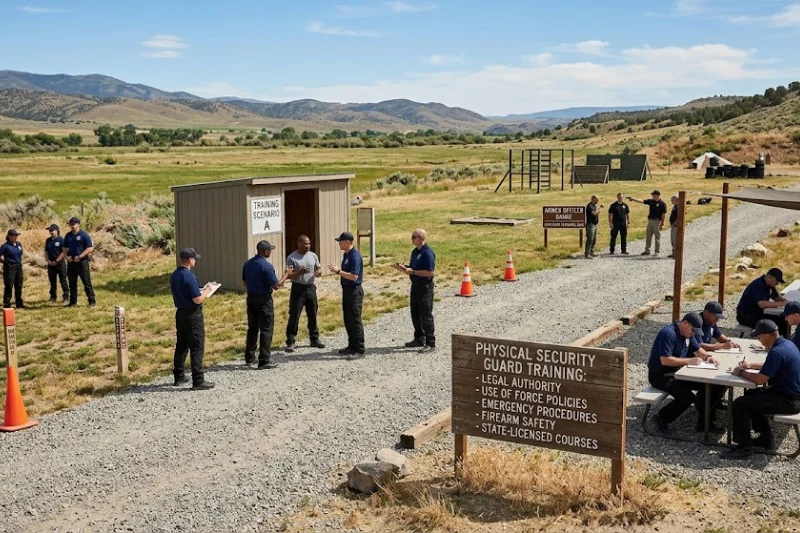
These courses are approved by your state’s licensing body — such as a Department of Public Safety (DPS), Department of Commerce, or equivalent agency. Completing one is legally required before you can apply for your guard card or security officer license.
What physical security courses typically cover:
- Legal authority and limitations of a security officer
- Use of force policies and de-escalation techniques
- Emergency procedures and first aid basics
- Report writing and documentation
- Communication and professionalism
- Property laws and trespass regulations
- Firearm safety (for armed officer tracks only)
Licensing levels vary by state. Here is a plain-English breakdown of how it works in four major states:
| State | Unarmed License | Armed License | Approving Body | Course Length |
|---|---|---|---|---|
| Texas | Level 2 | Level 3 / Level 4 | TX Dept. of Public Safety (PSB) | Varies by level |
| Florida | Class D | Class G | FL Dept. of Agriculture | 40 hrs (D) / includes firearm |
| Illinois | Unarmed Officer | N/A (separate) | IDFPR | 20 hours |
| Tennessee | Unarmed License | Separate process | TN Dept. of Commerce & Insurance | 4 hours |
What most competitor sites do not tell you: Your certificate from an online course is NOT your license. After completing your course and passing the exam, you still need to submit a state application, provide fingerprints, pass a background check, and pay state fees. Budget an extra $50–$150 for the state application process, depending on your state.
2. Cybersecurity Certifications

Cybersecurity courses do not require state approval, but they lead to credentials that employers worldwide recognize. These range from free foundational programs to premium expert-level certifications.
Entry-level cybersecurity courses (no experience needed):
- Google Cybersecurity Certificate — delivered via Coursera, focuses on practical skills and AI-powered security tools; no prior experience required
- ISC2 Certified in Cybersecurity (CC) — entry-level, ANAB-accredited, globally respected; now paid after the free 1MCC program concluded in May 2026
- CompTIA Security+ — one of the most employer-requested entry certifications; widely accepted by government and defense contractors
Intermediate to advanced certifications (experience required):
- CISSP (ISC2) — the gold standard; requires 5 years of experience but is the most recognized credential in enterprise security
- CEH (Certified Ethical Hacker) — focuses on offensive security and penetration testing
- CISM / CRISC — management-focused certifications for security leaders
How to Choose the Right Security Online Course
Before you enroll, answer these five questions:
1. What is your end goal — a job or a license?
If you need a guard card to get hired this month, choose a state-approved physical security course. If you want an IT security career over the next year, start with an entry-level cybersecurity certification.
2. Is the course approved by your state?
This matters only for physical security licensing. Always verify approval directly on your state agency’s website before paying. An unapproved course cannot be used to apply for a license — no exceptions.
3. What does the course actually include?
Look for providers that give you: a structured curriculum, an included final exam, a downloadable or emailed certificate within 24 hours, and step-by-step guidance on submitting your state application. Some schools stop at the certificate and leave you to figure out the rest alone.
4. What is the real total cost?
Course fees are only part of the picture. Add the state application fee, fingerprinting fee (usually $35–$75), and any required passport-style photo. Some states also charge annual renewal fees. Compare the total cost of getting licensed, not just the course price.
5. Does the provider offer any post-graduation support?
Job placement assistance, alumni networks, and ongoing Q&A access are rare in this industry — but they exist. Providers that offer them are worth paying slightly more for, especially if you are entering the field for the first time.
What Competitors Do Not Tell You: The Hidden Steps After Your Course
Most security training websites focus on the course and the exam. Very few walk you through what comes next. Here is the complete post-course checklist for physical security licensing:
After You Pass Your Online Exam
- Download your Training Certificate — typically emailed within 24 hours of passing. Save multiple copies.
- Create your state portal account — in Texas, this is the DPS Private Security Bureau portal; in Tennessee, it is the CORE portal; in Illinois, it is IDFPR’s online system.
- Complete your state application — fill in personal information exactly as it appears on your government-issued ID. Mismatches cause delays.
- Schedule fingerprinting — most states use a third-party provider like IdentoGO or a local law enforcement agency. Book early; slots fill up.
- Submit your passport-style photo — most state portals require an upload, not a physical print.
- Pay the state licensing fee — ranges from $25 to $100+ depending on the state and license level.
- Wait for approval — processing times vary from one week to six weeks. Follow up if you have not heard back within the stated window.
Pro tip: Do not quit your current job or accept a security position until your license is in hand. Working as a security officer without a valid state license is illegal in most states and can disqualify you from future licensing.
Security Online Course Costs: A Realistic Breakdown
Competitors typically advertise the course price alone. Here is what you actually spend:
Physical Security Guard Training (example: Texas Level 2)
| Expense | Typical Cost |
|---|---|
| Online course fee | $30 – $100 |
| State application fee | $25 – $75 |
| Fingerprinting | $35 – $75 |
| Background check | Included or $10 – $30 |
| Photo (if not digital) | $10 – $20 |
| Total estimated cost | $100 – $300 |
Cybersecurity Certification (example: CompTIA Security+)
| Expense | Typical Cost |
|---|---|
| Study course (online) | $0 – $300 |
| Exam voucher | $392 (2026 standard price) |
| Practice tests | $30 – $80 |
| Total estimated cost | $422 – $772 |
Money-saving tip: Many community colleges, workforce development programs, and employer tuition reimbursement plans cover some or all security training costs. Check with your local workforce board or employer HR department before paying out of pocket.
Career Paths After a Security Online Course
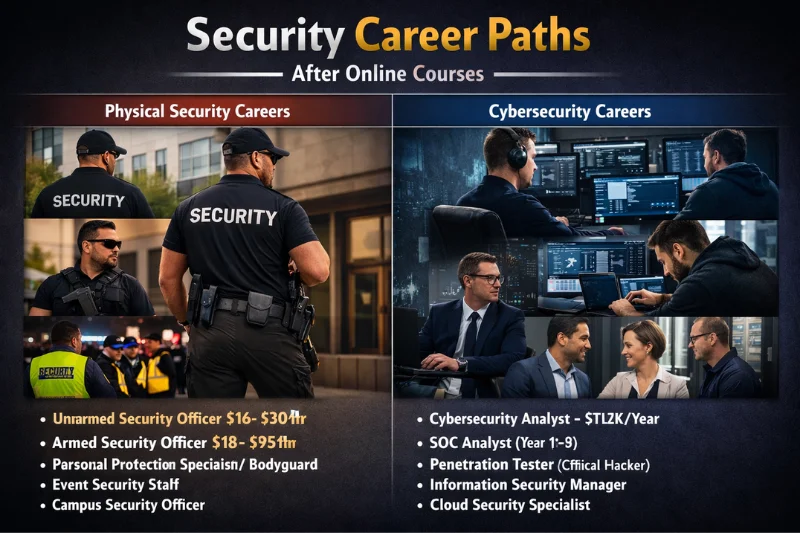
Completing a security online course opens more doors than most people expect. Here is what you can realistically pursue:
After Physical Security Training
- Unarmed Security Officer — entry-level; median pay $16–$20/hour in most states
- Armed Security Officer — requires additional training and licensing; pays $18–$28/hour
- Personal Protection Specialist / Bodyguard — Level 4 in Texas; requires advanced certification; pay varies significantly
- Event Security Staff — flexible, often per-event; good for part-time income
- Campus Security Officer — steady hours, lower stress, often benefits-eligible
- Loss Prevention Specialist — retail-focused; some require separate certification
After Cybersecurity Certification
- Cybersecurity Analyst — median salary ~$112,000/year (BLS, 2024)
- SOC Analyst (Tier 1–3) — monitors networks and responds to threats; strong entry path
- Penetration Tester — ethical hacking; requires more experience and CEH/OSCP
- Information Security Manager — leadership role; CISM credential preferred
- Cloud Security Specialist — one of the fastest-growing roles; AWS and Azure security skills in high demand
Top Features to Look for in a Security Online Course Provider
Use this checklist when comparing providers:
- State-approved / DPS or equivalent licensing body recognition
- Self-paced access — complete on your schedule, not theirs
- Mobile-friendly platform — work from your phone or tablet
- Certificate delivered within 24 hours of passing
- Exam included in the course price (not sold separately)
- Step-by-step state application guidance included
- Accessible customer support (phone, chat, or email)
- Clear refund or retake policy
- Transparent total pricing — no hidden fees
- Job placement assistance or employer network (bonus)
Red Flags to Avoid When Choosing a Security Online Course
- No mention of state approval — if the site does not name the approving state agency, assume it is not approved
- Suspiciously cheap pricing — courses under $20 for required training are often not state-compliant
- No exam included — some providers charge extra for the final exam; confirm this upfront
- Vague curriculum — the course outline should specifically match your state’s required topics
- No contact information — a phone number or live chat is non-negotiable for a provider you are paying
- Grammatical errors and unprofessional content — poor quality course materials often indicate a poorly managed school
Frequently Asked Questions About Security Online Courses
How long does a security online course take?
It depends on the type and state. Tennessee requires 4 hours for an unarmed license. Illinois requires 20 hours. Texas Level 2 courses vary. Cybersecurity certificate programs typically take 3–6 months to complete at a few hours per week.
Can I take a security course online in any state?
You can take the course from anywhere with an internet connection, but the course itself must be approved for the specific state where you plan to work. A Florida-approved course cannot be used to get a Texas license.
Do I need any prior experience or education?
For physical security licensing, most states only require you to be 18 or older, a U.S. citizen or legal resident, and pass a background check. No prior experience is needed. For cybersecurity, entry-level programs also require no prior experience.
How soon can I start working after completing my online course?
You cannot legally work as a licensed security officer until your state application is approved and your license or guard card is issued. The state review process takes one to six weeks depending on your state. For cybersecurity jobs, you can apply as soon as you earn your certification.
Is an online security course as respected as in-person training?
Yes — as long as the provider is state-approved or the certification is nationally accredited. Employers care about your license or credential, not whether your classroom had four walls.
What is the difference between a security guard and a security officer?
The terms are used interchangeably in most states. Some employers use “officer” to indicate a higher-trained or armed role, but there is no universal distinction. Your state license determines what you are legally allowed to do.
Can I get both physical security and cybersecurity training?
Absolutely — and doing so makes you a more valuable candidate for corporate security, healthcare security, and government roles that require both physical and digital threat awareness.
Conclusion: Choose the Course That Matches Your Goal
A security online course is one of the fastest, most affordable ways to build a legitimate career in one of the world’s most in-demand industries.
The key is choosing the right type:
- Need a guard card or state license? Choose a state-approved physical security training course that covers your specific licensing level and includes clear post-course application guidance.
- Want to enter cybersecurity? Start with an entry-level certification like Google’s Cybersecurity Certificate or ISC2’s CC, then build toward CompTIA Security+ or CISSP as your experience grows.
- Want the most career flexibility? Consider a provider that bridges both worlds.
Whichever path you choose, make sure the provider is transparent about state approval, total costs, exam policies, and what happens after you pass. The certificate is just the beginning — what matters is what you do with it.