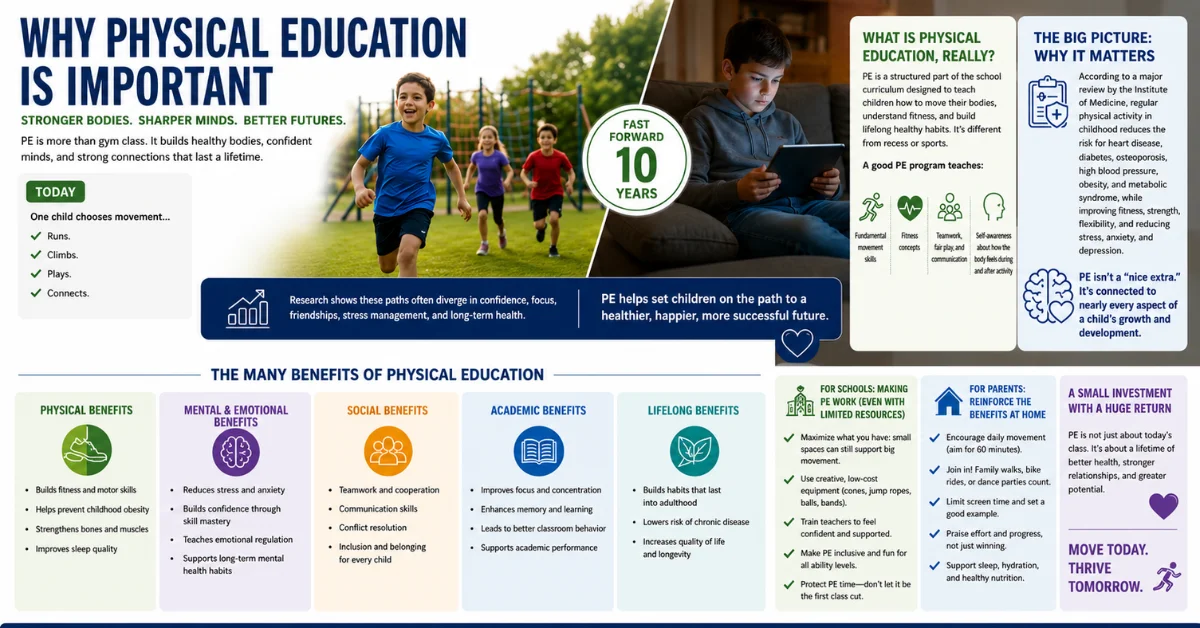
Why Physical Education Is Important because it establishes the foundational motor skills, neurological pathways, and social-emotional resilience required for lifelong physical and mental well-being. Far beyond basic fitness, structured PE enhances cognitive performance by boosting brain oxygenation, reduces early-life stress markers, and builds peer cooperation skills during key developmental windows.
Two children start their school journey on the exact same morning. One spends recess navigating climbing frames, running, and playing tag. The other sits quietly on a bench, absorbed in a tablet screen.
Fast forward ten years. Longitudinal public health studies show their trajectories diverge significantly — extending past physical fitness to influence focus, emotional stability, academic test outcomes, and stress response mechanisms.
Physical education is not just a filler activity in the school schedule. It is a critical developmental intervention where physical movement, emotional regulation, and cognitive growth intersect.
What Defines Physical Education in Modern Curricula?
Physical education is a structured, standard-aligned component of the academic curriculum designed to teach physical literacy, body awareness, and long-term health management.
It differs fundamentally from unstructured recess or competitive youth sports. Recess allows free play, and sports focus on specific game outcomes. PE focuses on teaching children how to move effectively and why active living matters.
A balanced physical education framework instills key foundational competencies:
- Fundamental Movement Skills: Mastering locomotion, dynamic balance, and hand-eye coordination.
- Fitness Literacy: Understanding muscular endurance, cardiovascular exertion, and flexibility mechanics.
- Social Competencies: Developing spatial awareness, active communication, and ethical sportsmanship through structured team building activities for physical education.
- Internal Feedback: Learning to monitor heart rates, exertion levels, and post-exercise recovery.
Core Health Mechanisms: How PE Builds Biological Resilience
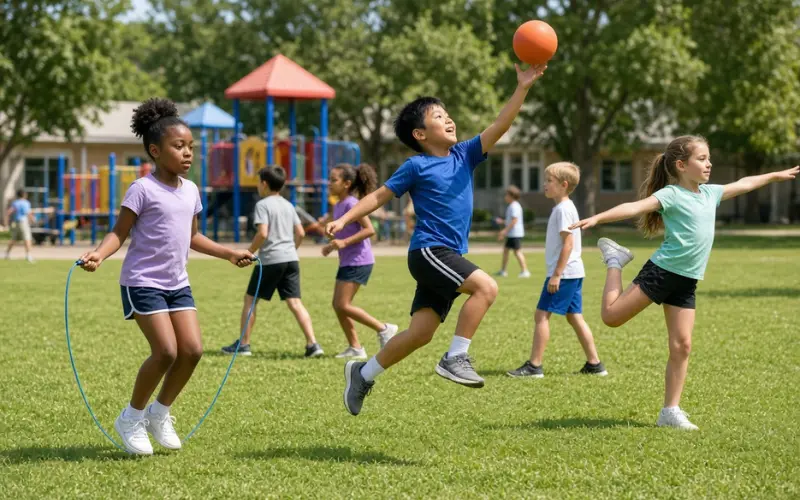
Regular, structured physical activity during developmental years acts as a preventive health shield. Exploring the core physical education objectives helps educators design programs that target these biological markers effectively.
The Institute of Medicine notes that structured physical movement in childhood directly mitigates risk factors for metabolic syndrome, pediatric hypertension, type 2 diabetes, and early-stage bone density loss.
| Health Domain | Physical Outcome | Long-Term Biological Benefit |
| Cardiovascular System | Heightened VO2 max & systemic oxygen distribution | Lower resting heart rate; reduced cardiovascular disease risks |
| Skeletal Structure | Mechanical tension applied to osteoblasts | Maximum peak bone mass accumulation during growth spurts |
| Neurological System | Endorphin release & cortisol clearance | Improved mood stabilization; decreased physiological stress |
Motor Skill Development
Fundamental movements — such as leaping, catching, and pivoting — do not develop through age alone. They require guided practice. Early movement routines often build upon foundational fine motor activities for toddlers, providing systematic instruction that prevents coordination deficits as children grow.
Childhood Obesity Mitigation
Daily movement built directly into the school timetable builds consistent energy expenditure. Establishing physical habits early trains the body’s metabolic baseline, lower long-term adult obesity rates.
Cognitive and Academic Performance Links
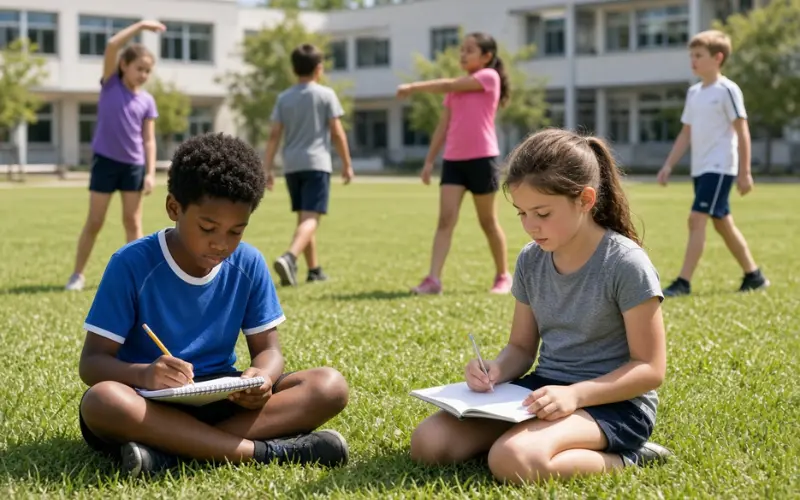
A common misconception is that physical education subtracts from academic focus. Neuroimaging and educational research confirm the opposite: movement directly enhances cognitive processing, making the debate around the pros and cons of physical education far clearer for school boards.
Elevated Brain-Derived Neurotrophic Factor (BDNF)
Exercise stimulates the synthesis of BDNF, a key protein that promotes neuroplasticity, memory formation, and synaptic growth.
Enhanced Classroom Concentration
Increased oxygen delivery to the prefrontal cortex immediately following physical exertion helps students return to academic tasks with sharper focus, improved impulse control, and sustained attention span.
Academic Discipline Transfer
The mechanics of physical progression — setting measurable fitness targets, practicing repeatedly, and handling small setbacks — translate into improved study discipline and persistence in academic environments. These focus-building traits are particularly beneficial for students learning how to study with ADHD and anxiety
Social and Emotional Development Milestones
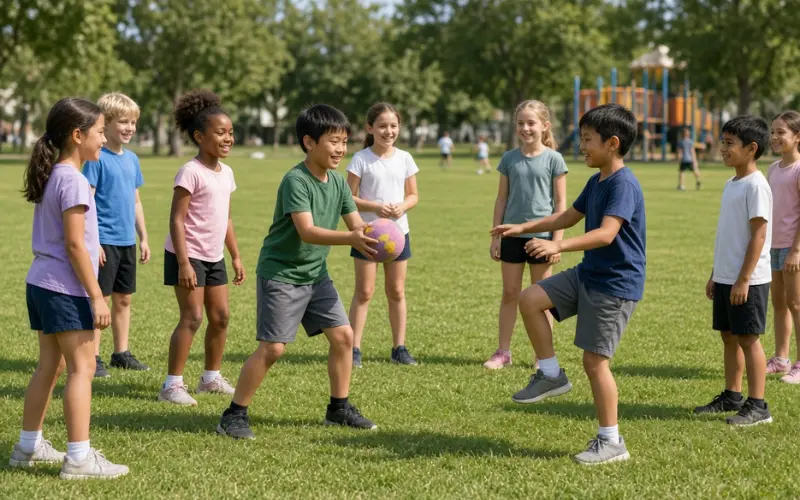
Physical education provides a unique setting where social interactions occur in real time, offering immediate feedback on personal behavior and team dynamics.
Early Childhood (Ages 3–5)
Focuses on basic spatial navigation, self-regulation, simple balance tasks, and listening to directional cues without performance pressure. These early habits set the stage for why educators emphasize early movement within a broader early childhood education training guide
Elementary Years (Ages 6–11)
Combines basic motor patterns into structured cooperative games, teaching turn-taking, peer feedback, and simple emotional check-ins.
Middle & High School (Ages 12–18)
Transitions into lifelong fitness autonomy, stress release mechanisms, individual workout planning, and collaborative team strategies tailored for physical education in middle school
The Proficiency Barrier: Why Early Interventions Matter
Developmental researchers highlight a critical concept known as the Proficiency Barrier.
Children who achieve basic competence in fundamental movement patterns early in life cross this barrier comfortably. They transition naturally into recreational activities, team sports, and outdoor play because movement feels rewarding and safe.
Conversely, children who miss out on early motor instruction struggle with coordination. As social awareness increases in middle childhood, they often avoid physical activities to prevent peer embarrassment.
This avoidance limits their opportunities for practice, widening the skill gap over time and contributing to a sedentary lifestyle in adulthood. Understanding these core growth developmental needs forms the foundation of a clear physical education philosophy
Action Plan: Supporting Physical Literacy at Home and School
Overcoming resource constraints requires practical, consistent strategies across both school and home environments.
Practical Strategies for Resource-Limited Schools
- Micro-Movement Breaks: Integrate 5-to-10-minute structured movement routines inside academic classrooms between lectures.
- Low-Equipment Games: Prioritize agility drills, relay runs, and balance challenges that use simple markers or body weight.
- Shared Space Utilization: Adapt hallways, outdoor paths, and multipurpose rooms when gymnasiums are unavailable.
Parent Implementation Guide
- Focus on Movement Consistency: Walk or cycle for short neighborhood errands instead of driving short distances.
- Normalize Effort over Perfection: Praise persistence, skill improvement, and participation rather than competitive scores.
- Incorporate Backyard Skill Play: Set up basic obstacle courses or play catch to build hand-eye coordination without athletic pressure.
FAQ’s on Why Physical Education Is Important
How does physical education directly impact daily academic focus?
Physical exertion increases cerebral blood flow and triggers the release of neurotransmitters like dopamine and norepinephrine. This immediate physiological boost improves executive function, memory retrieval, and impulse control, helping students focus better during subsequent academic lessons.
Why is physical education critical in early childhood development?
The early childhood window (ages 3–8) is when neural pathways responsible for basic motor coordination form most rapidly. Early PE establishes fundamental locomotion, balance, and spatial awareness skills, ensuring children do not fall behind the motor proficiency barrier.
How can schools maintain quality PE programs with small budgets?
Quality physical education relies on movement mechanics rather than expensive machinery. Schools can deliver effective programs by utilizing open outdoor areas, incorporating bodyweight movement routines, and training general classroom teachers to run structured movement breaks.
References & Sources
- Institute of Medicine. (2013). Educating the Student Body: Taking Physical Activity and Physical Education to School. Washington, DC: The National Academies Press.
- Centers for Disease Control and Prevention (CDC). (2022). The Association Between School-Based Physical Activity, Including Physical Education, and Academic Performance. U.S. Department of Health and Human Services.
- World Health Organization (WHO). (2020). WHO Guidelines on Physical Activity and Sedentary Behaviour. Geneva: World Health Organization.