
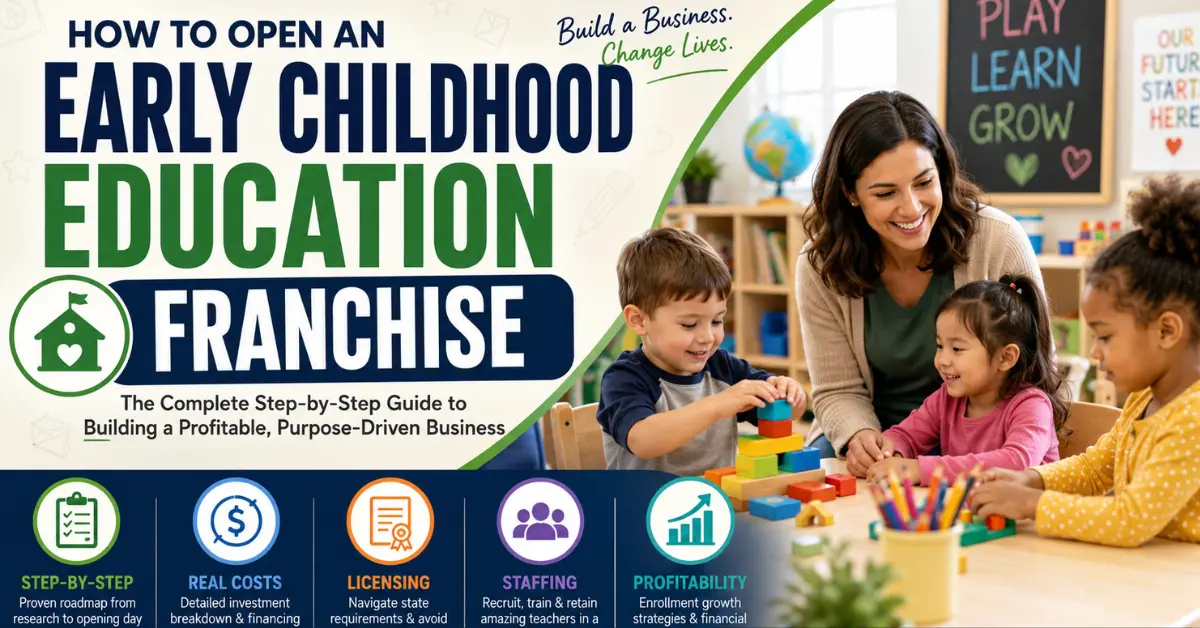
So you want to open an early childhood education franchise. Smart move — and a meaningful one.
The early childhood education franchise industry is one of the most in-demand, recession-resistant business sectors in the United States. Working families need reliable, high-quality childcare. Supply cannot keep up with demand. And franchises built around early learning are consistently among the top-ranked opportunities in the entire franchise world.
But opening an early childhood education franchise is also one of the most complex business ventures you will take on. There are state licensing requirements, staffing shortages, 6–18 month enrollment ramp-up periods, and six-figure startup costs that most guides gloss over.
This guide does not gloss over anything. Whether you are an educator exploring business ownership or an entrepreneur who wants to invest in early childhood education, you will find everything you need here — including what your competitors’ articles will not tell you.
What Is an Early Childhood Education Franchise?
An early childhood education franchise is a licensed childcare or preschool business that operates under a parent brand’s proven curriculum, systems, and business model. Instead of starting an independent daycare from scratch, you pay a franchise fee for the right to use an established brand and receive full training and operational support.
Common types of early childhood education franchises include:
- Full-day daycare centers serving infants through pre-K
- Preschool and kindergarten-readiness programs
- Montessori or Reggio Emilia-inspired early education centers
- STEM-focused early childhood learning programs
- After-school enrichment and tutoring franchises
Why open an early childhood education franchise instead of going independent?
- A proven curriculum is already built for you
- Brand recognition builds parent trust faster
- Corporate support guides you through state childcare licensing
- Training prepares you and your staff before day one
- You join a network of fellow owners who have already solved your problems
Opening this type of franchise gives you the mission of independent childcare ownership with a proven roadmap already in place. That combination is why this sector continues to attract thousands of new investors every year.
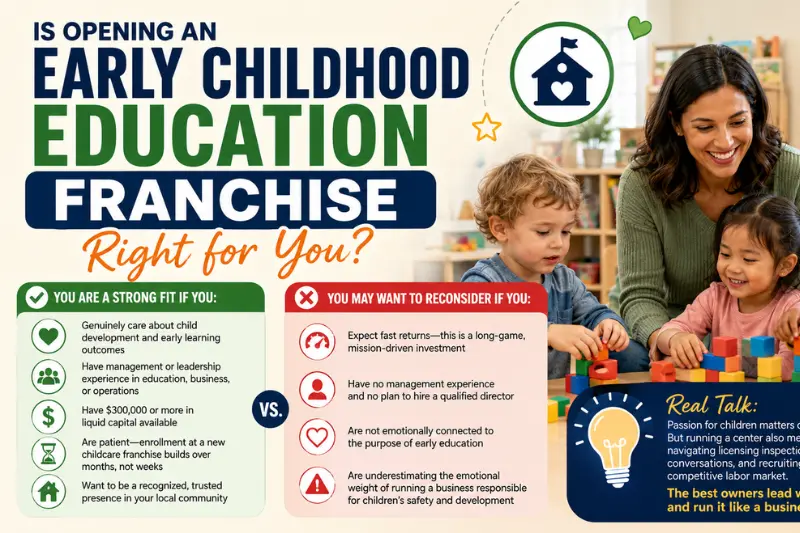
Is Opening an Early Childhood Education Franchise Right for You?
Before you pick a brand or write a check, honestly assess whether this type of franchise fits your life, your finances, and your goals.
You are a strong fit for an early childhood education franchise if you:
- Genuinely care about child development and early learning outcomes
- Have management or leadership experience in education, business, or operations
- Have $300,000 or more in liquid capital available
- Are patient — enrollment at a new childcare franchise builds over months, not weeks
- Want to be a recognized, trusted presence in your local community
You may want to reconsider if you:
- Expect fast returns — this is a long-game, mission-driven investment
- Have no management experience and no plan to hire a qualified director
- Are not emotionally connected to the purpose of early education
- Are underestimating the emotional weight of running a business responsible for children’s safety and development
Real talk: Passion for children matters deeply in this business. But running one of these centers also means managing payroll, navigating licensing inspections, handling difficult parent conversations, and recruiting teachers in a competitive labor market. The best owners in this sector lead with heart and run it like a business.
Step 1: Research the Early Childhood Education Franchise Market
Before you compare specific brands, understand the industry you are entering.
The U.S. childcare and early education market is worth over $60 billion — and growing. The structural demand is massive:
- Over 20.4 million children under age 5 need care
- 64% of mothers with children under age 6 are in the workforce
- Quality childcare shortages exist in most U.S. metro and suburban markets
- The early childhood education franchise sector is largely recession-resistant — parents cannot simply stop needing childcare when the economy dips
- Well-operated centers in this sector typically generate EBITDA margins of 15–30% at full enrollment
Research your specific local market before choosing a franchise brand:
- Are local childcare centers running waitlists? That signals unmet demand.
- Which age groups are most underserved — infant care, toddlers, or pre-K?
- What is the median household income in your target area? Higher-income markets support premium tuition models.
- Are there major employers, hospitals, or universities nearby? Dual-income households are your core customer base.
This local market data will tell you which type of program — and which tuition price point — is the right fit for your area.
Step 2: Compare Early Childhood Education Franchise Brands
Not all early education franchise systems are created equal. Spend real time comparing at least 3–5 brands before you commit to any opportunity.
What to Evaluate When Comparing Franchise Opportunities:
- Curriculum quality — Is it research-based? Updated regularly? Delivered consistently across locations?
- Brand reputation — Do local parents already recognize and trust the name?
- Franchisee satisfaction — Speak directly with current franchise owners, not just the corporate team
- Post-opening support — What does the franchisor actually do for you after you open?
- Territory protection — Will they place a competing franchise location within your market?
- Financial performance data (Item 19) — Does the FDD include actual revenue figures from operating franchisees?
Always request and read the Franchise Disclosure Document (FDD)
Every franchisor is legally required to provide you with an FDD at least 14 days before you sign any agreement or pay any fee. This document covers:
- The franchisor’s history, background, and litigation record
- All fees: franchise fee, royalties, marketing fund contributions, and technology fees
- Total estimated investment range for your franchise
- Your territorial rights and renewal terms
- A full contact list of current and former franchisees — call them directly
Critical tip: Hire a franchise attorney to review the FDD before signing anything. The $1,500–$3,000 cost is one of the best investments you will make before opening your center.
Step 3: Understand the Full Cost of Opening an Early Childhood Education Franchise
This is where most articles get vague or only show you one brand’s numbers. Here is an honest, market-wide cost breakdown for opening a childcare franchise.
Investment Ranges by Center Size
| Cost Category | Smaller Center (50–75 Kids) | Larger Center (100–150 Kids) |
|---|---|---|
| Franchise Fee | $40,000 – $75,000 | $50,000 – $75,000 |
| Real Estate / Build-Out | $150,000 – $400,000 | $300,000 – $750,000 |
| Furniture & Equipment | $75,000 – $150,000 | $125,000 – $250,000 |
| Licensing & Insurance | $15,000 – $30,000 | $20,000 – $40,000 |
| Marketing & Technology | $15,000 – $30,000 | $20,000 – $40,000 |
| Working Capital (6 months) | $50,000 – $100,000 | $75,000 – $150,000 |
| Total Estimate | $345,000 – $770,000 | $590,000 – $1.3M |
Premium brands can range significantly higher — up to $8.5M+ for build-to-own locations.
Ongoing fees after opening your center:
- Royalties: 6–8% of gross tuition revenue (most franchise systems average 6–7%)
- Marketing fund: 1–2% of gross revenue
- Technology platform fees: $200–$500/month
- Annual conference and ongoing training costs
How to finance your center:
- SBA 7(a) loans — the most common financing option for preschool franchise investments
- SBA 504 loans — ideal for real estate-heavy childcare franchise builds
- Franchisor-preferred lenders — many franchise brands have relationships with approved national lenders
- ROBS (Rollover for Business Startups) — use retirement funds without early withdrawal penalties
- HELOCs — home equity as supplemental capital for smaller funding gaps
What competitors do not tell you: Opening a childcare franchise requires budgeting for a 6–18 month enrollment ramp-up. During that period, state licensing requires you to maintain full staffing ratios even at partial enrollment. You are paying full labor costs while revenue is still building. Working capital is not optional — it is what keeps your franchise alive during the growth phase.
Step 4: Navigate State Licensing for Your Early Childhood Education Franchise
State licensing is the most underestimated — and most critical — step in opening a preschool franchise. Every state has different requirements, and failing to plan for them can delay your opening by months.
What state childcare licensing for a childcare franchise typically covers:
- Staff-to-child ratios by age group (e.g., 1:4 for infants, 1:10 for preschoolers — varies by state)
- Minimum square footage per child for both indoor classrooms and outdoor play areas
- Health and sanitation standards for food handling, diapering, and facility hygiene
- Background checks for all employees — fingerprinting, state abuse registry, and criminal history screening
- Teacher qualification requirements — some states require CDA credentials or early childhood education college degrees
- Emergency preparedness and evacuation plans filed with the licensing agency
- Nutrition standards if your center serves meals through the USDA food program
Licensing timeline reality check:
Most states take 60 to 120 days to process a childcare license after your facility passes inspection. Some states take even longer. You cannot open, enroll children, or collect a single dollar in tuition without your childcare license in hand.
Steps to get your center licensed:
- Contact your state’s childcare licensing agency before you sign any lease
- Download your state’s full childcare facility licensing checklist
- Design your facility to meet all requirements from day one — retrofits are expensive
- Submit your licensing application as early as legally possible
- Schedule and pass all required inspections: fire, health, and building
- Ensure all staff complete required pre-service training before inspection day
Pro tip: Your center corporate team should guide you through this entire process. If a franchisor cannot provide state-specific licensing support, that is a serious red flag.
Step 5: Choose the Right Location for Your Early Childhood Education Franchise
Location is one of the most consequential decisions you will make for your franchise. A strong curriculum in the wrong building, on the wrong street, in the wrong neighborhood, will struggle to fill enrollment — regardless of brand name.
What makes a strong location for an early childhood education franchise:
- High visibility from a main road — parents discover your center during their daily commute
- Safe, easy drop-off access — wide parking areas, no dangerous intersections, clear sight lines
- Proximity to residential neighborhoods with young families
- Near major employers or commuter corridors where dual-income families live or work
- Low existing competition — fewer than 3–4 licensed childcare centers within a 2–3 mile radius
- Zoning pre-approved for childcare use — verify this before signing any lease
Facility requirements for most ECE franchises:
- 9,000 to 14,000 square feet of interior space (varies by brand and state requirements)
- Age-appropriate bathrooms (toddler-height fixtures, dedicated infant changing areas)
- Commercial kitchen or food prep area if your center serves meals
- Secure, keypad-controlled entry and exit systems
- Dedicated outdoor play space meeting your state’s safety surface and equipment standards
- Adequate natural light in all classrooms
What competitors do not tell you: Zoning approval for a childcare center sometimes requires a public hearing — and neighbors occasionally push back due to traffic concerns. Start the zoning process the moment you identify a potential site. This step alone can add 30–90 days to your center opening timeline.
Step 6: Build Your Teaching Team
Your teachers are the living product of your franchise. No curriculum, no brand name, and no beautiful building matters more than the educators caring for children every single day.
Staff you need before opening your center:
- Center Director — required by most state licensing agencies; must meet specific educational and experience standards
- Lead Teachers for each age-group classroom
- Assistant Teachers to meet state staff-to-child ratio requirements
- Administrative and enrollment staff to handle tours, registration, and billing
- Cook or nutrition staff if your center serves meals
How to recruit teachers for your franchise:
Early childhood education has a persistent national staffing shortage. Average ECE teacher salaries run $30,000–$40,000 annually — significantly below K–12 education — making recruitment and retention an ongoing challenge for every franchise operator.
What actually works in competitive ECE labor markets:
- Partner with local community college early childhood education programs for recruiting new graduates
- Pay $1–$2 per hour above the local market rate — it dramatically reduces annual turnover
- Offer paid professional development and support toward CDA credentialing
- Create a clear advancement pathway: assistant teacher → lead teacher → director
- Build a workplace culture people talk about — word travels fast in educator communities
The honest number: Annual teacher turnover in childcare averages 30% nationally. Every teacher departure costs your center $3,000–$5,000 in recruiting, onboarding, and lost consistency for children in care. Teacher retention is not just the compassionate choice — it is one of the highest-ROI investments in your entire childcare franchise operation.
Step 7: Complete Franchisor Training Before You Open
Before you open, your franchisor will require you — and typically your director and lead teachers — to complete a structured training program.
What training at an early childhood education franchise typically covers:
- The brand’s educational philosophy and core curriculum implementation
- Classroom management and child development best practices
- Enrollment processes and parent communication systems
- Financial management and tuition billing
- Marketing, center tour procedures, and lead conversion strategies
- State regulatory compliance and required documentation
- Technology platforms: childcare management software and parent-facing communication apps
Common training formats in early education franchise systems:
- In-person at headquarters — 1–3 weeks at corporate offices or a working model school
- On-site pre-opening coaching — corporate trainers come directly to your facility before opening
- Online learning portals — ongoing professional development modules available anytime
- Annual conferences — peer-to-peer learning across the entire franchise network
Ask this before you sign: “What does ongoing support look like 12 months after I open?” The best early education franchise systems assign dedicated franchise business consultants who visit your center regularly, review performance metrics, and coach you through operational challenges. Weaker systems go quiet once you are open.
Step 8: Market Your Early Childhood Education Franchise Before Opening Day
The goal is to open with a waitlist already forming — not to start marketing after your doors are open.
Pre-opening marketing strategies for your franchise:
- Host community open house events — give local families a preview of the facility while it is still under construction
- Partner with OB-GYN offices, pediatricians, and maternity boutiques — expectant and new parents are your most urgently motivated prospects
- Join local Facebook parenting groups — be authentically helpful, not promotional
- Set up your Google Business Profile immediately — this is how parents search for childcare in their neighborhood
- Run geo-targeted Facebook and Instagram ads to parents with young children within a 5-mile radius
- Install a “Coming Soon” sign with a QR code at your location from the first day of construction
- Offer early enrollment incentives — a discounted registration fee for the first 20 families who commit
Realistic enrollment timeline for a new franchise location:
- Months 1–3: 20–40% of licensed capacity
- Months 6–9: 50–70% with consistent marketing
- Months 12–18: 80–100% enrollment (full or near-full capacity)
Build your financial model around the ramp-up curve — not the best-case scenario.
Step 9: Open and Run Your Early Childhood Education Franchise Day to Day
Opening day is exciting. But daily operational discipline is what builds the lasting reputation of your franchise.
Daily operations checklist for your franchise:
- Safe morning check-in and end-of-day pickup verification procedures
- Continuous staff-to-child ratio compliance throughout the day
- Daily classroom schedules aligned to the franchise curriculum
- Health screenings and illness protocols (critical for licensing compliance and parent trust)
- Parent communication via app platforms — Brightwheel and Procare are industry standards
- Proper incident documentation and required regulatory reporting
- Regular classroom walkthroughs by the center director
Word-of-mouth is your most powerful growth tool
Parents who trust your center become your best marketers. When one parent tells another, “Get on their waitlist now,” that single referral drives enrollment more effectively than any paid advertising campaign. Build that trust through:
- Transparent communication — both the good news and the hard conversations
- Celebrating children’s developmental milestones with families
- Maintaining clean, safe, joyful classroom environments every single day
- Teachers who know every child’s name, personality, and developmental progress
Step 10: Plan for Long-Term Profitability of Your Early Childhood Education Franchise
Most owners reach stable profitability at 18–30 months post-opening, assuming consistent enrollment growth. Here is how to track and accelerate that timeline.
Financial benchmarks to monitor in your franchise:
- Enrollment rate: Target 85%+ of licensed capacity by month 18
- Staff cost ratio: Keep this at 50–60% of gross tuition revenue
- EBITDA margin: Healthy franchise centers target 15–25% EBITDA at full enrollment
- Monthly churn rate: Track every family departure and document the reason
Multi-Unit Growth: Expanding Beyond Your First Location
Many successful franchise owners in this space open a second location after 2–3 years of stable operations. Most franchise systems in this sector offer reduced franchise fees for additional units. Operating multiple additional franchise locations creates operational efficiencies, stronger local brand recognition, and greater enterprise value over time.
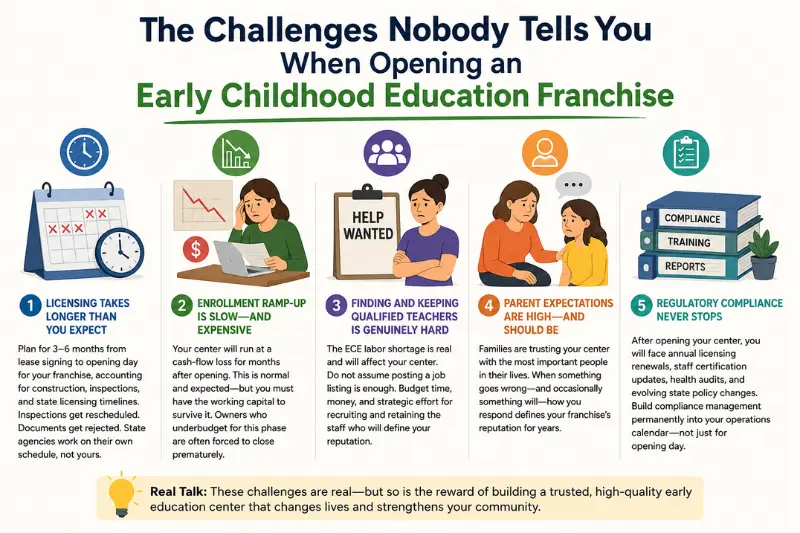
The Challenges Nobody Tells You When Opening an Early Childhood Education Franchise
Every competitor article leads with the opportunity. Here are the real challenges you need to plan for.
1. Licensing takes longer than you expect
Plan for 3–6 months from lease signing to opening day for your franchise, accounting for construction, inspections, and state licensing timelines. Inspections get rescheduled. Documents get rejected. State agencies work on their own schedule, not yours.
2. Enrollment ramp-up is slow — and expensive
Your center will run at a cash-flow loss for months after opening. This is normal and expected — but you must have the working capital to survive it. Owners who underbudget for this phase are often forced to close prematurely.
3. Finding and keeping qualified teachers is genuinely hard
The ECE labor shortage is real and will affect your center. Do not assume posting a job listing is enough. Budget time, money, and strategic effort for recruiting and retaining the staff who will define your reputation.
4. Parent expectations are high — and should be
Families are trusting your center with the most important people in their lives. When something goes wrong — and occasionally something will — how you respond defines your franchise’s reputation for years.
5. Regulatory compliance never stops
After opening your center, you will face annual licensing renewals, staff certification updates, health audits, and evolving state policy changes. Build compliance management permanently into your operations calendar — not just for opening day.
Frequently Asked Questions About Opening an Early Childhood Education Franchise
Do I need an education background to open an early childhood education franchise? No — most franchise systems accept business-minded owners who hire a qualified director. You must pass background checks, and your center director typically must meet state-specific educational and experience requirements.
How much liquid capital do I need to open an early childhood education franchise? Most reputable ECE franchise brands require a minimum of $150,000–$300,000 in liquid assets, with total net worth of $500,000 or more. Premium ECE franchise brands require significantly higher net worth.
Can I own multiple early childhood education franchise locations? Yes. Most franchise systems in this sector actively encourage multi-unit ownership after you have successfully operated your first location for 1–2 years, often with reduced fees for additional territory agreements.
How long does the full process take from first call to opening day? Typically 12 to 24 months from initial inquiry to opening your center — factoring in franchisee approval, site selection, lease negotiation, build-out, state licensing, staff hiring, and training.
When will my early childhood education franchise become profitable? Most owners achieve stable profitability at 18–30 months post-opening. Key variables include enrollment rate, local tuition pricing, staffing costs, and facility overhead.
Final Thoughts: Taking the Next Step to Open an Early Childhood Education Franchise
Opening an early childhood education franchise is not a passive investment. It is a hands-on, community-rooted business that demands your leadership, your discipline, and genuine care for the children and families you serve.
The franchise owners who thrive long-term are the ones who walk into every challenge prepared. They hire excellent teachers and pay them fairly. They understand their state licensing requirements before they sign a lease. They build their enrollment waitlist before they open their doors. They measure financial metrics and developmental outcomes equally.
If that sounds like you, this sector offers one of the most meaningful and financially rewarding businesses you can build.
Your next steps toward opening an early childhood education franchise:
- Research 3–5 ECE franchise brands and request their Franchise Disclosure Documents (FDDs)
- Retain a franchise attorney before signing any agreement
- Contact your state’s childcare licensing agency to understand local requirements upfront
- Speak with at least 5 current franchise owners across different brands
- Build your complete financial model — including the enrollment ramp-up period — before committing
The families in your community are actively searching for the quality, trust, and mission that a well-run early childhood education franchise provides. With the right preparation, that franchise can be yours.