Dizziness and balance disorders prompt millions of primary care visits every year, making inner ear and balance assessment a core clinical skill. For physical therapists managing vertigo, instability, or post-concussion symptoms, completing dedicated vestibular physical therapy continuing education
is not just an optional resume booster. It represents the vital bridge between guessing through a complex dizziness case and accurately targeting the affected canal before initiating treatment.
This guide outlines what advanced vestibular continuing education covers, evaluates hybrid versus traditional learning formats, breaks down cost structures, and explains how to build a progressive clinical skill set rather than collecting disconnected certificates.
Why Is Vestibular Physical Therapy Continuing Education?
Dizziness accounts for nearly 15% to 20% of adult medical consultations annually. Despite how frequently patients present with balance impairment, entry-level Doctor of Physical Therapy (DPT) programs usually provide only foundational exposure to vestibulo-ocular reflexes and positional testing.
Without targeted post-professional education, clinicians often face common diagnostic and treatment hurdles:
- Misinterpreting Complex Nystagmus: Misidentifying horizontal or anterior canal pathology as standard posterior canal BPPV.
- Over-reliance on Generic Protocol: Prescribing basic balance drills when specialized canalith repositioning or VOR gaze-stabilization exercises are clinically indicated.
- Extended Care Duration: Prolonging episodes of care due to difficulties distinguishing peripheral inner ear issues (like vestibular neuritis) from central nervous system conditions (like vestibular migraine or cerebellar stroke).
Clinicians who complete structured, competency-verified vestibular training achieve faster patient recovery, frequently resolving benign paroxysmal positional vertigo within one to three focused visits.
What Does Vestibular PT Continuing Education Actually Cover?
Comprehensive post-professional courses train clinicians to evaluate the delicate balance mechanisms connecting the inner ear, brainstem, and visual system. A high-quality curriculum moves well beyond introductory lectures to cover:
Applied Neuroanatomy & Oculomotor Diagnostics
- System Physiology:Deep dive into the semicircular canals, otolith organs (utricle and saccule), and vestibulo-ocular reflex (VOR) pathways.
- Eye Movement Analysis: Evaluating smooth pursuit, saccadic movement, VOR suppression, and spontaneous versus gaze-evoked nystagmus using infrared video goggles or VNG.
Differential Diagnosis & Treatment Protocols
- Positional Testing: Mastering the Dix-Hallpike maneuver, side-lying tests, and horizontal roll tests to identify exact pathology.
- Particle Repositioning:Executing the Epley, Semont, Gufoni, and BBQ roll maneuvers with correct timing and angle precision.
- Complex Pathologies: Differential screening for Persistent Postural-Perceptual Dizziness (PPPD), cervicogenic dizziness, bilateral vestibulopathy, and post-concussion vestibular deficits.
Comparing Course Formats: Hybrid vs. In-Person vs. Fully Online
Selecting the right continuing education format directly impacts clinical skill retention, work schedules, and educational budgets.
1. Hybrid Courses (Online Didactics + Live Lab)
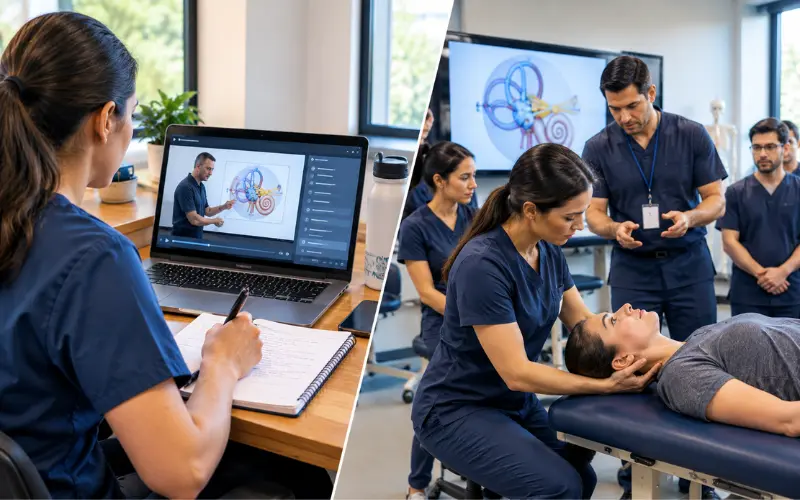
The hybrid model splits theoretical knowledge from manual psychomotor practice. Clinicians complete self-paced digital modules on neuroanatomy and pathophysics before attending a focused, 1-day live practical lab. This format minimizes time away from the clinic while ensuring hands-on technique verification.
2. Traditional In-Person Workshops
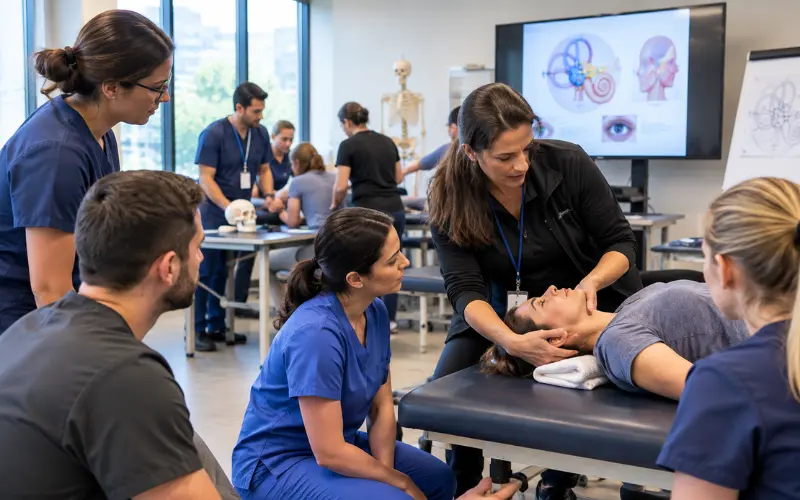
These 2-to-3-day weekend seminars offer continuous face-to-face instruction and peer-to-peer lab work. While excellent for direct mentor feedback, they require higher travel expenses and full weekend availability.
3. Fully Online / On-Demand CEU Courses
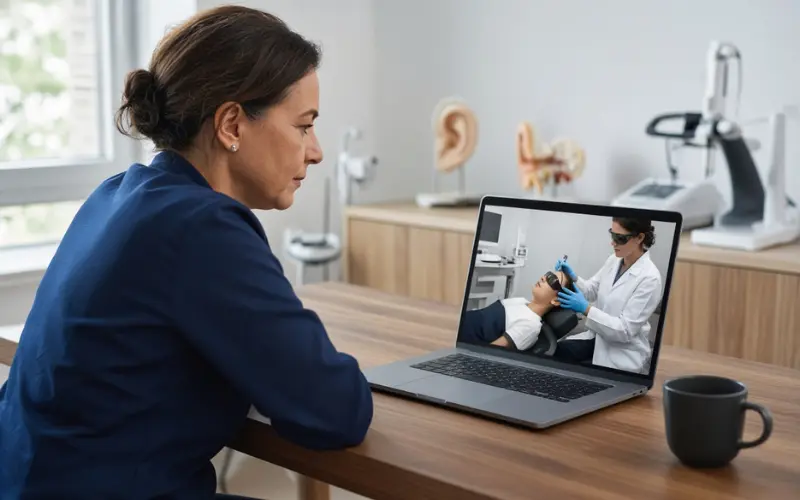
100% digital courses provide maximum flexibility for general license renewal. However, because vestibular testing relies on precise manual handling and visual nystagmus observation, pure video modules work best as introductory refreshers rather than primary skill builders.
Educational Formats Comparison
| Feature / Metric | Hybrid Model (Recommended) | Traditional In-Person | Fully Online / On-Demand |
| Skill Verification | High (Dedicated Live Lab) | High (Full Weekend Lab) | Low (Theoretical Only) |
| Schedule Flexibility | High (Self-Paced Theory) | Low (Fixed Weekend Dates) | Maximum (100% At-Own-Pace) |
| Travel & Hotel Costs | Moderate (1 Day Travel) | High (2–3 Days Travel) | None |
| Diagnostic Proficiency | High | High | Low to Moderate |
| Best Suited For | Full-Time PTs & Clinic Staff | Hands-On Visual Learners | General CEU Renewal Hours |
Credentialing: Course Certificates vs. Competency Certification
A major point of confusion for clinicians is the difference between earning contact hours and earning a recognized competency credential:
- CEU Credit Hours: Standard continuing education units that satisfy state licensing board renewal criteria. Completing a course awards contact hours but does not evaluate hands-on physical skill.
- Competency Certification: Advanced programs requiring clinicians to demonstrate clinical reasoning and psychomotor skills through written and practical examination under expert observation.
Physical therapists planning to build a specialized vestibular practice or market services to referring physicians should target competency-based programs with practical skill testing.
Building a Progressive Vestibular Career Path
Instead of viewing continuing education as a single weekend event, successful clinicians build an ongoing professional development strategy:
- Foundational Phase (0–1 Year Experience): Complete introductory coursework focused on anatomy, basic BPPV maneuvers, and standard balance assessment.
- Competency Phase (1–3 Years Experience): Enroll in a hybrid or in-person competency program featuring formal written and practical examination.
- Advanced Specialization (3+ Years Experience): Pursue advanced training in complex central disorders, pediatric vestibular care, concussion rehabilitation, or wound care continuing education for physical therapist integration for multidisciplinary settings.
Cost Expectations for Vestibular CEU Programs
Pricing varies depending on course depth, faculty credentials, and hands-on lab access:
- Self-Paced Online Courses: $200 – $450 (Focused mainly on CEU accumulation)
- Weekend In-Person or Hybrid Courses: $450 – $800 (Includes manual materials and live lab instruction)
- Advanced Competency Certification Programs: $1,500 – $2,200 (Includes extensive digital modules, multi-day skill labs, and practical examinations)
Frequently Asked Questions
Is a hybrid vestibular continuing education course sufficient for managing complex cases?
Yes, hybrid courses pair thorough digital instruction on diagnostic theory with focused live practical labs. This combination gives clinicians both the theoretical reasoning and tactile testing precision required to manage complex vestibular conditions safely.
What is the primary difference between a CEU certificate and a competency credential?
A CEU certificate confirms attendance and completion of designated hours for state license renewal. A competency credential requires passing practical skills and written examinations to verify hands-on clinical capability.
Can Physical Therapy Assistants (PTAs) take advanced vestibular continuing education?
Yes, PTAs can complete vestibular continuing education to deliver treatment interventions, perform gaze-stabilization drills, and execute repositioning maneuvers under a plan of care established by a Physical Therapist. Diagnostic testing and initial evaluation remain within the scope of the licensed PT.
References and Sources
- Wikipedia:Benign paroxysmal positional vertigo (BPPV)
- Wikipedia:Vestibular Rehabilitation Therapy (VRT)
- American Physical Therapy Association (APTA): Academy of Neurologic Physical Therapy Guidelines.
- Clinical Practice Guideline: Benign Paroxysmal Positional Vertigo (Otolaryngology–Head and Neck Surgery).