
Introduction: What Does Classroom Success Really Mean?
Ask ten teachers what “classroom success” means and you’ll get ten different answers.
Some will say test scores. Others will talk about attendance, participation, or a student who finally believes in themselves. The truth is — classroom success is all of these things, and more.
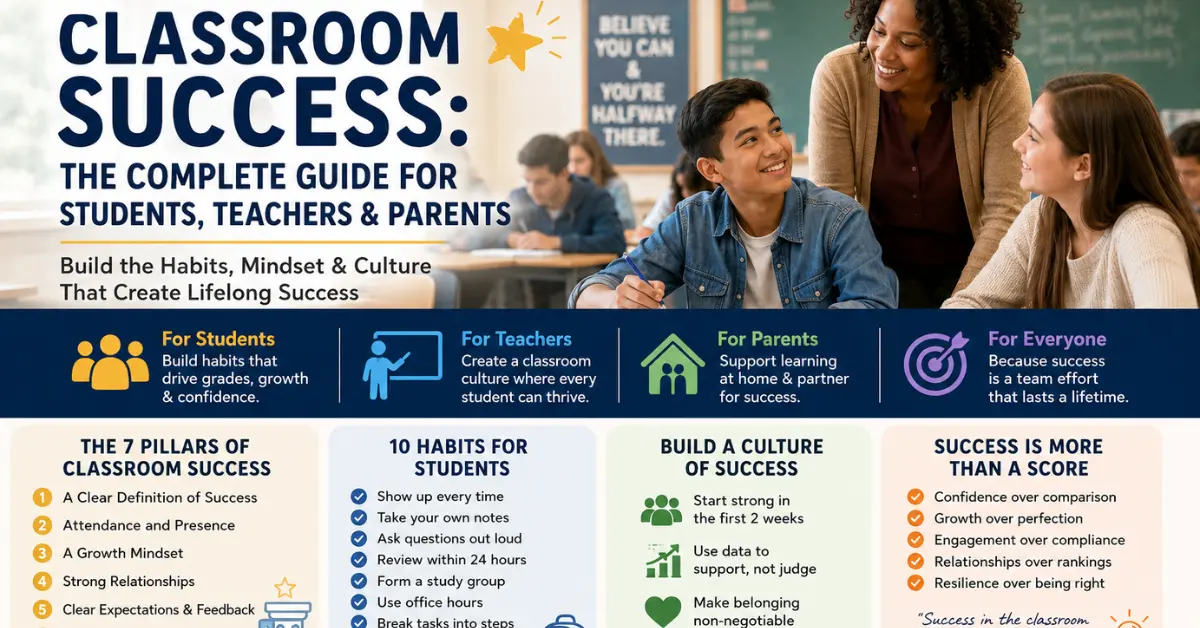
Success in the classroom isn’t a single moment. It’s a daily habit, a shared culture, and a system built by students, teachers, and parents working together. Whether you’re a student trying to improve your grades, a teacher shaping the next generation, or a parent supporting learning at home — this guide covers what truly drives classroom success and how to achieve it.
Why Classroom Success Matters Beyond Grades
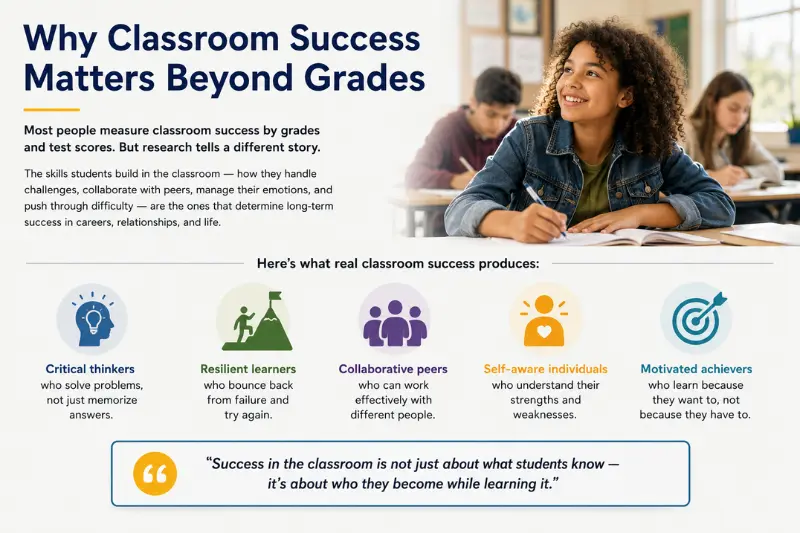
Most people measure classroom success by grades and test scores. But research tells a different story.
The skills students build in the classroom — how they handle challenges, collaborate with peers, manage their emotions, and push through difficulty — are the ones that determine long-term success in careers, relationships, and life.
Here’s what real classroom success produces:
- Critical thinkers who solve problems, not just memorize answers
- Resilient learners who bounce back from failure and try again
- Collaborative peers who can work effectively with different people
- Self-aware individuals who understand their strengths and weaknesses
- Motivated achievers who learn because they want to, not because they have to
“Success in the classroom is not just about what students know — it’s about who they become while learning it.”
Suggested Guide
Academic Papers on Developing ESL Reading Skills: A Complete Easy Guide
The 7 Pillars of Classroom Success
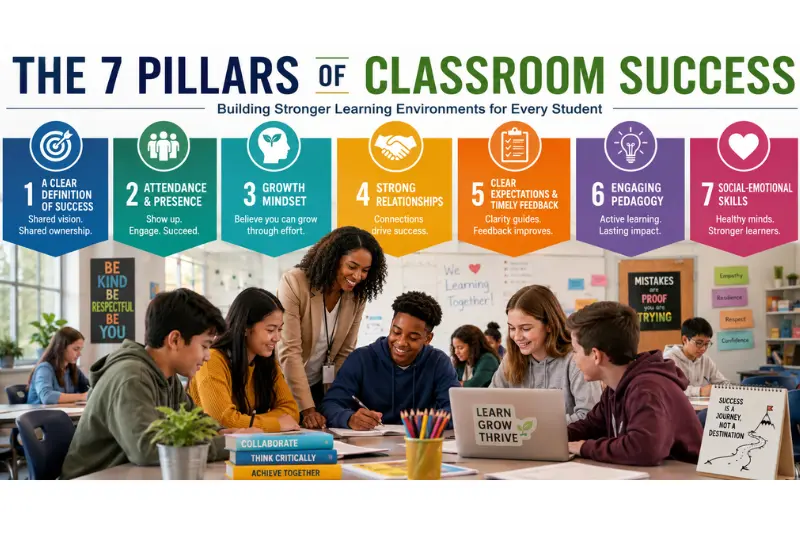
1. A Clear Definition of Success (For Everyone in the Room)
Before a classroom can succeed, everyone needs to agree on what success looks like.
Teachers should define it with their students, not for them. This creates shared ownership. When students help shape the vision of success, they’re more committed to reaching it.
How to build a shared definition:
- Have students write their personal definition of success on day one
- Create a class “success board” that evolves throughout the year
- Revisit the definition after every major project or milestone
2. Attendance and Presence — The Foundation
You can’t succeed in a classroom you’re not in.
Attendance is the single most controllable factor in academic performance. Missing class doesn’t just mean missing notes — it means missing discussion, context, questions, and the kind of in-the-moment learning that no textbook can replicate.
Why showing up matters:
- Lectures add context and examples beyond the textbook
- Class participation builds critical thinking in real time
- Taking your own notes strengthens memory and understanding far more than borrowing someone else’s
- Relationships with professors and peers — built through consistent presence — can shape your entire academic journey
Pro tip for students: Treat going to class as non-negotiable — like a job shift. The decision should already be made before your alarm goes off.
3. A Growth Mindset — The Engine of Progress
Students who believe their abilities can grow through effort outperform those who believe intelligence is fixed. This is the growth mindset, developed by psychologist Carol Dweck — and it’s one of the most powerful predictors of classroom success.
Signs of a growth mindset in action:
- Saying “I can’t do this yet” instead of “I can’t do this”
- Viewing mistakes as data, not failure
- Asking for help without shame
- Celebrating effort, not just results
How teachers can build it:
- Praise the process, not just the grade
- Share stories of famous failures who became great
- Design assignments that reward revision and reflection
- Model your own learning — let students see you struggle and problem-solve
4. Strong Relationships — The Hidden Superpower
The quality of relationships in a classroom directly impacts learning outcomes. Not soft, feel-good outcomes — measurable academic ones.
Research shows that students who feel connected to their teacher and peers are:
- More likely to attend class consistently
- More engaged in learning activities
- Less likely to be suspended or drop out
- Better able to regulate stress and emotions during exams
Four key relationships that drive classroom success:
- Teacher ↔ Student — Trust, respect, and high expectations
- Student ↔ Student — Peer support, study groups, collaborative learning
- Teacher ↔ Parent/Caregiver — Communication and shared goals
- Teacher ↔ Teacher — Shared strategies and team teaching
One of the most underrated moves a teacher can make? Learning every student’s name by the second day of school — and using it often.
5. Clear Expectations and Timely Feedback
Students can’t hit a target they can’t see.
One of the biggest barriers to classroom success is vague expectations. When students don’t know exactly what’s expected — and don’t receive timely, specific feedback — they can’t improve.
What clear expectations look like:
- Assignment instructions broken into specific steps
- Rubrics shared before work begins, not after
- Example work shown at different quality levels
- Deadlines explained with reasons, not just dates
What effective feedback looks like:
- Specific: “Your argument in paragraph 2 needs evidence” not “Needs work”
- Timely: Returned before the lesson moves on
- Actionable: Tells the student what to do next, not just what went wrong
- Encouraging: Recognizes what’s working alongside what isn’t
6. Engaging Pedagogy — Making Learning Come Alive
The most common reason students disengage? Passive learning.
Lectures alone don’t produce classroom success. Students learn best when they’re doing something — discussing, creating, debating, building, teaching others.
High-engagement strategies that work:
- Think-Pair-Share — Students think independently, discuss with a partner, then share with the class
- Project-Based Learning (PBL) — Students solve real-world problems over time
- Exit Tickets — A quick question at the end of class that shows what students understood (and didn’t)
- Collaborative Small Groups — Structured group tasks that give every student a role
- Student Choice — Letting students choose how they demonstrate learning increases investment dramatically
7. Social-Emotional Skills — The Invisible Curriculum
Here’s what most classroom success guides miss entirely: emotions matter.
A student who is anxious, hungry, lonely, or dealing with trauma at home cannot fully learn — no matter how good the lesson is. Social-emotional learning (SEL) addresses this directly.
Core SEL skills that boost classroom success:
- Self-regulation — Managing emotions and impulses in challenging moments
- Empathy — Understanding others’ perspectives, reducing conflict
- Problem-solving — Working through interpersonal and academic challenges
- Resilience — Recovering from setbacks and continuing to try
- Confidence — Believing you belong in the room and have something to contribute
Schools that invest in SEL programs see measurable results: fewer disciplinary issues, higher attendance, and improved academic performance.
For Students: 10 Practical Habits That Drive Classroom Success
- Show up — every time. Presence is the price of entry.
- Sit where you can see and hear clearly. Environment shapes attention.
- Write your own notes. The act of writing is the learning.
- Ask questions out loud. If you’re confused, others are too.
- Review notes within 24 hours. Memory fades fast — don’t let it.
- Form a study group. Teaching someone else is the best way to learn.
- Use office hours. Most students never go — which means those who do stand out.
- Break big tasks into small steps. Overwhelm is the enemy of starting.
- Celebrate small wins. Progress compounds when you notice it.
- Ask for help early — not at the last minute. Support is there; you have to use it.
For Teachers: Building a Classroom Culture of Success
A successful classroom doesn’t happen by accident. It’s designed, day by day, decision by decision.
Start Strong — The First Two Weeks Are Everything
The culture you establish in the opening weeks will define your entire year. Students are watching to see if you mean what you say, if you’re consistent, and if this space is safe.
First-week priorities:
- Set clear, specific expectations — co-create them with students when possible
- Learn every name fast
- Give students an early “win” — a challenge they can succeed at
- Create a classroom identity (team name, motto, shared goal)
- Show students you see them as whole people, not just learners
Use Data to Support, Not Judge
Real-time data — attendance patterns, assignment completion rates, assessment results — can identify students who need support before they fall behind. The goal isn’t surveillance; it’s early intervention.
Check in with students who are slipping before it becomes a crisis.
Make Belonging Non-Negotiable
Every student must feel that they belong in your classroom. Not because it’s a nice thing to say — but because belonging is a prerequisite for learning.
Students who feel unseen, unwelcome, or like they don’t fit will mentally check out, even when they’re physically present.
For Parents: How to Support Classroom Success at Home
Classroom success doesn’t end when the school bell rings. Parents play a powerful role in reinforcing what students learn.
At-home habits that make a difference:
- Ask specific questions after school: “What was the most interesting thing you learned today?” not “How was school?”
- Create a consistent homework routine — same time, same place, minimal distractions
- Show genuine interest in what they’re studying, even if it’s unfamiliar to you
- Normalize struggle — let your child know it’s okay to find things hard
- Stay in contact with teachers, especially if something at home might affect focus or mood
- Celebrate effort first, grades second
The Student Perspective: What Learners Say They Actually Need
This section is missing from almost every competitor article — but it matters most.
When students are asked what helps them succeed in the classroom, their answers are consistent:
- “I need to feel like I matter to my teacher.” Not just as a student, but as a person.
- “I need to understand why we’re learning this.” Purpose drives engagement.
- “I need to be allowed to make mistakes without embarrassment.” Safety comes before risk-taking.
- “I need things to move at a pace I can follow.” Not too fast, not too slow.
- “I need breaks and movement.” Brains don’t run on passive sitting.
Designing classrooms around these needs isn’t soft — it’s smart.
Common Myths About Classroom Success (Debunked)
| Myth | The Truth |
|---|---|
| “Good grades = classroom success” | Grades measure one dimension. Skills, mindset, and habits matter equally. |
| “Smart students succeed; others struggle” | Intelligence is not fixed. Effort and environment shape outcomes far more. |
| “Quiet classrooms are learning classrooms” | Discussion, debate, and noise are often signs of deep learning. |
| “Struggling students just don’t care” | Disengagement is almost always a symptom of an unmet need. |
| “Success is an individual achievement” | It’s a community effort — teachers, peers, and families all contribute. |
Measuring Classroom Success: Beyond the Test Score
How do you know if your classroom is succeeding? Look beyond grades and consider:
- Student confidence — Are they willing to try hard things?
- Classroom climate — Do students feel safe to speak up and make mistakes?
- Growth over time — Are students improving from their own starting point, not just compared to others?
- Engagement indicators — Are students asking questions, participating, and connecting ideas?
- Post-class retention — Can students recall and use what they learned weeks later?
- Self-advocacy — Are students seeking help, asking for clarification, and managing their own learning?
Frequently Asked Questions About Classroom Success
Q1: What is classroom success, and how is it defined?
Classroom success means more than earning good grades. It’s the combination of academic achievement, personal growth, strong habits, and social-emotional development that prepares students for life beyond school. A truly successful classroom is one where students feel safe, engaged, challenged, and supported — and where progress is measured for every individual, not just the top performers.
Q2: What are the most important factors that contribute to classroom success?
Several factors work together to drive classroom success:
- Consistent attendance — you can’t learn what you miss
- A growth mindset — believing effort leads to improvement
- Strong teacher-student relationships — trust enables learning
- Clear expectations and timely feedback — students need to know what’s expected and how they’re doing
- Social-emotional skills — self-regulation, resilience, and empathy all support academic performance
- Parental involvement — home support reinforces classroom learning
No single factor works alone. Classroom success is the result of all these elements working in sync.
Q3: How can a student improve their performance in the classroom?
Students can take several practical steps to improve:
- Show up consistently and sit where distractions are minimal
- Write their own notes during class — the act of writing boosts memory
- Review notes within 24 hours before the information fades
- Ask questions early and often — confusion compounds if left unaddressed
- Use office hours, tutoring, or study groups for extra support
- Break large assignments into smaller steps to avoid overwhelm
- Celebrate small wins to stay motivated over time
Improvement doesn’t require being the smartest person in the room — it requires being the most consistent.
Q4: How can teachers create a classroom culture of success?
Teachers build a culture of success through daily, intentional choices:
- Co-creating expectations with students rather than dictating them
- Learning every student’s name quickly and using it often
- Giving specific, actionable feedback — not just grades
- Designing lessons that actively involve students, not just lecture at them
- Identifying struggling students early and intervening before problems compound
- Making every student feel like they belong in the room
The first two weeks of school are the most important. The culture set early tends to stick all year.
Q5: What role do parents play in their child’s classroom success?
Parents are one of the most powerful influences on classroom success — even from home. Key ways parents can help:
- Ask specific questions about school rather than just “How was your day?”
- Establish a consistent homework routine with minimal distractions
- Normalize struggle — let your child know it’s okay to find things hard
- Stay in regular contact with teachers, especially when something at home may affect focus
- Show interest in what your child is studying, even if the subject is unfamiliar
- Celebrate effort and progress, not just final grades
When school and home are aligned, students feel supported from every direction.
Q6: Why do some students struggle in the classroom even when they try hard?
Struggling despite effort often points to an unmet need, not a lack of ability. Common causes include:
- Learning differences such as dyslexia, ADHD, or processing challenges that go unidentified
- Emotional or social stress at home or among peers that occupies mental bandwidth
- A mismatch between teaching style and learning style — not every student learns the same way
- Low confidence or fear of failure that prevents students from taking risks or asking for help
- Gaps in foundational knowledge that make new material harder to absorb
The solution is early identification and targeted support — not harder work in the same direction.
Q7: What is the growth mindset and why does it matter for classroom success?
The growth mindset, developed by psychologist Carol Dweck, is the belief that intelligence and ability can be developed through effort, feedback, and persistence. Students with a growth mindset:
- Embrace challenges instead of avoiding them
- View criticism as useful information, not personal attack
- Keep going when things get difficult
- Achieve more over time than students with a fixed mindset
Teachers and parents can nurture a growth mindset by praising effort over results and framing mistakes as part of the learning process.
Q8: How does social-emotional learning (SEL) connect to classroom success?
SEL teaches students the human skills that make academic learning possible — skills like emotional regulation, empathy, resilience, and problem-solving. When students can manage their emotions and relationships, they:
- Focus better during lessons
- Collaborate more effectively on group work
- Handle academic pressure without shutting down
- Build stronger relationships with teachers and peers
Schools that implement structured SEL programs consistently report improvements in attendance, engagement, and academic outcomes — making it one of the highest-return investments a school can make.
Q9: How should classroom success be measured beyond test scores?
Tests capture one snapshot of learning at one moment in time. A fuller picture of classroom success includes:
- Growth from a student’s own starting point — not just comparison to peers
- Confidence and willingness to try challenging tasks
- Ability to retain and apply knowledge weeks after learning it
- Quality of participation and questions asked in class
- Self-advocacy — whether students seek help and manage their own learning
- Classroom climate — whether students feel safe to speak up and make mistakes
The best classrooms track all of these, not just grades.
Q10: What’s the single most important thing a school can do to improve classroom success for all students?
Build a culture where every student feels they belong.
Belonging is the prerequisite for everything else. A student who feels unseen, unwelcome, or like they don’t fit will disengage — no matter how good the teacher or the lesson is. When students feel genuinely connected to their classroom community, they attend more, participate more, and persevere through difficulty far more effectively.
This starts with relationships: teacher to student, student to student, and school to family. Everything else — data, curriculum, feedback systems — works better when it’s built on a foundation of belonging.
Final Thoughts: Success Is a Culture, Not a Score
Classroom success isn’t something that happens to a student — it’s something built together.
It requires teachers who show up with intention, students who engage with effort, parents who reinforce learning at home, and school communities that prioritize belonging and growth alongside grades.
It’s messy. It’s non-linear. Some days it looks like a student who asked their first question in months. Some days it looks like a classroom that didn’t fall apart when the lesson plan did.
But when it works — when all the pieces align — the classroom becomes one of the most powerful places on earth.
That’s what classroom success looks like.