
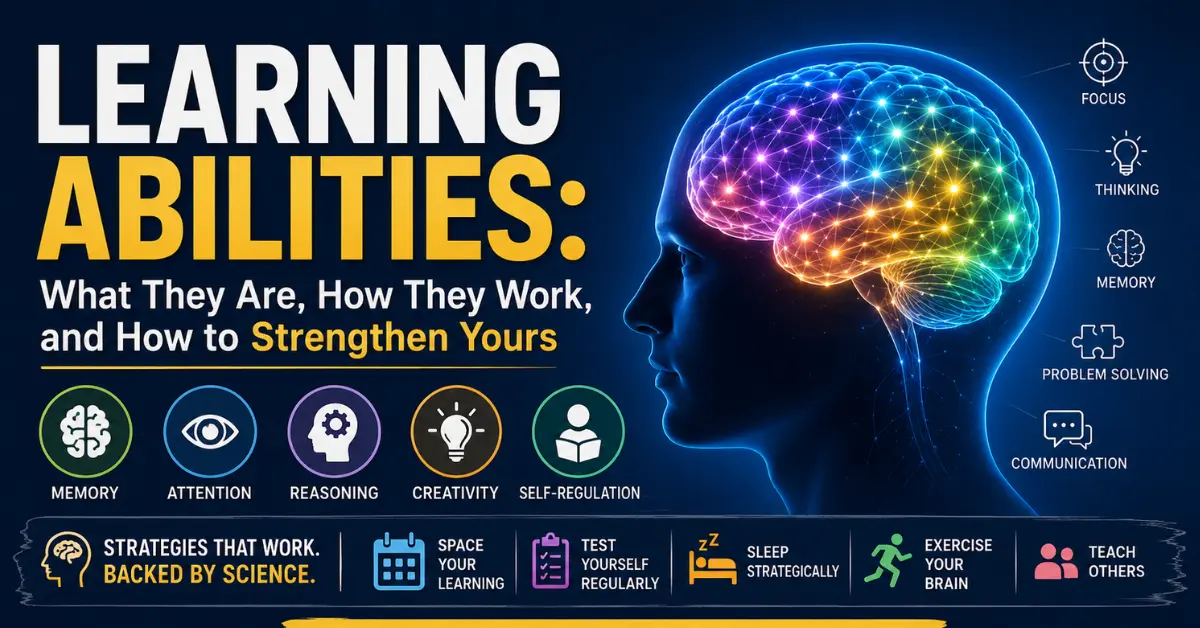
Here’s something most people don’t realize: learning is a skill. And like any skill, you can build it, train it, and improve it — no matter how old you are or how you did in school.
Your learning abilities are the mental tools you use every single day. They help you absorb new information, solve problems, adapt to change, and grow. But most people never intentionally develop them. They go through school, get a job, and assume their ability to learn is just fixed — something they either have or don’t.
Science says otherwise.
This guide breaks down what learning abilities actually are, the neuroscience that powers them, and — most importantly — what you can do right now to sharpen each one.
What Are Learning Abilities?
Learning abilities (also called learning skills or cognitive learning capacities) are the mental processes that allow a person to acquire, retain, understand, and apply new information or skills.
They aren’t the same as intelligence or academic talent. They’re closer to the engine under the hood — the underlying brain functions that make all learning possible.
The Core Learning Abilities
Most experts group learning abilities into these key areas:
- Memory — the ability to store and retrieve information (both short-term and long-term)
- Attention and focus — the ability to concentrate on what matters and filter out distractions
- Processing speed — how quickly the brain takes in and makes sense of information
- Auditory and visual processing — interpreting what you hear and see accurately
- Logic and reasoning — applying rules and patterns to solve problems
- Critical thinking — analyzing information carefully and drawing sound conclusions
- Creative thinking — generating new ideas and approaching problems from fresh angles
- Communication — expressing understanding clearly in spoken and written form
- Self-regulation — managing your own learning process, focus, and emotional responses
These don’t work in isolation. They work together — and strengthening one often boosts the others.
The Neuroscience of Learning Abilities (Made Simple)
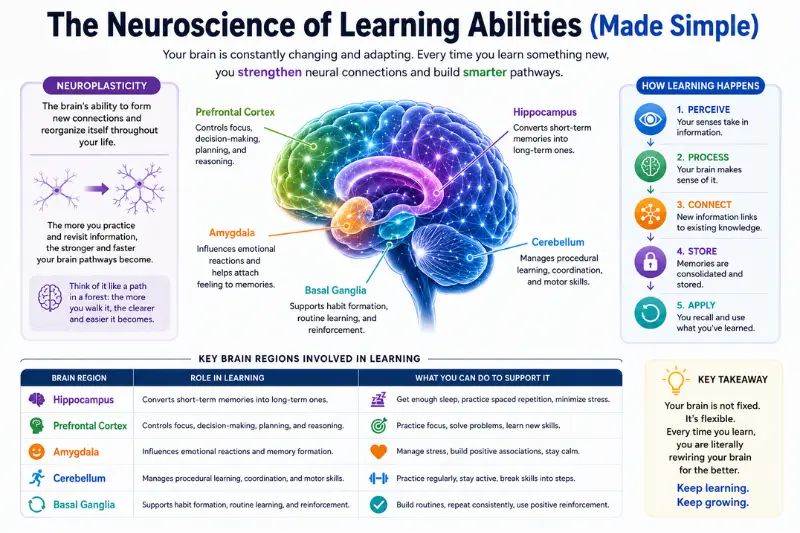
Here’s what your competitors won’t tell you: your brain is physically changing every time you learn something new.
This is called neuroplasticity — the brain’s ability to form new neural connections and reorganize itself throughout your entire life.
When you repeatedly practice a skill or revisit information, the neural pathways involved in that learning become stronger and faster. Think of it like a path through a forest: the more you walk it, the clearer and easier it becomes.
Key brain regions involved in learning:
| Brain Region | Role in Learning |
|---|---|
| Hippocampus | Converts short-term memories into long-term ones |
| Prefrontal Cortex | Controls focus, decision-making, and reasoning |
| Cerebellum | Manages procedural learning and motor skills |
| Amygdala | Influences emotional connections to memories |
| Basal Ganglia | Supports habit formation and routine learning |
Understanding this matters because it means your learning abilities aren’t fixed at birth. They respond to how you use them.
How Learning Abilities Develop Across the Lifespan
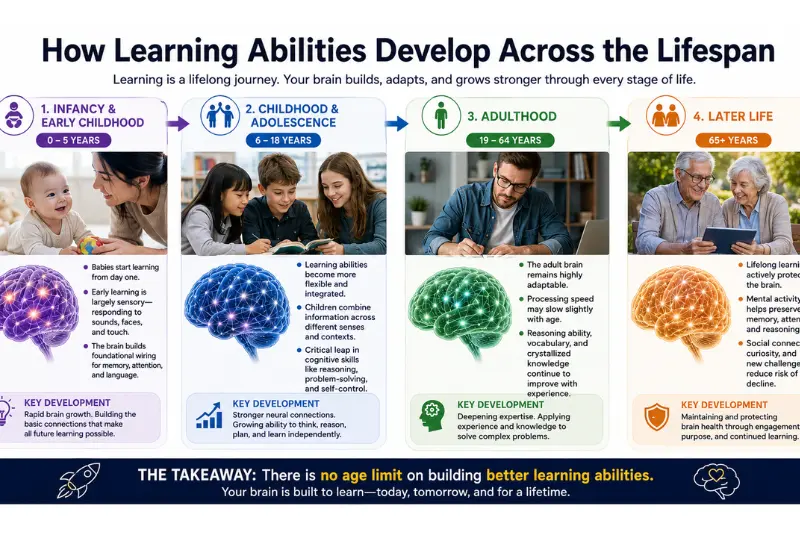
Learning abilities aren’t static. They evolve from the moment you’re born — and they keep developing well into adulthood.
Infancy and early childhood
Babies start learning from day one. Early learning is largely sensory — responding to sounds, faces, and touch. Even at this stage, the brain is building foundational wiring for memory and attention.
Childhood and adolescence
During school years, learning abilities become more flexible and integrated. Children develop the ability to combine information across different senses and contexts — a critical leap in cognitive development.
Adulthood
Here’s the good news adults rarely hear: the adult brain remains highly adaptable. While processing speed may gradually slow with age, reasoning ability, vocabulary, and crystallized knowledge actually tend to improve with experience.
Later life
Lifelong learning actively protects the brain. Research consistently shows that staying mentally active — through reading, problem-solving, learning new skills, or social engagement — helps preserve cognitive function and reduce the risk of decline.
The takeaway: There is no age limit on building better learning abilities.
The 4 C’s of Learning Skills (And What’s Missing From Most Explanations)
You’ve probably heard of the “4 C’s” — critical thinking, creative thinking, communicating, and collaborating. These are the 21st-century skills widely taught in schools.
They’re important. But they’re only part of the picture.
Most articles stop there. Here’s what they leave out:
Metacognition — Thinking About Your Own Thinking
This is arguably the most powerful learning ability of all, and it’s almost never mentioned.
Metacognition means being aware of how you learn — knowing when you understand something, when you’re confused, and how to adjust your approach. Students and professionals with strong metacognitive skills consistently outperform their peers.
How to build it:
- After studying, ask yourself: “What do I actually know vs. what do I just think I know?”
- Keep a learning journal to track what strategies work for you
- Regularly reflect on mistakes — not to feel bad, but to learn from the process
Emotional Regulation
Anxiety, stress, and frustration are learning’s biggest enemies. The brain’s threat response (managed by the amygdala) can actually physically block memory formation and clear thinking.
When you’re stressed, your brain prioritizes survival — not learning. That’s why you go blank during exams, even when you studied well.
Building emotional regulation is a legitimate learning skill:
- Practice brief mindfulness or breathing techniques before study sessions
- Create low-stress learning environments when possible
- Reframe mistakes as information, not failure
Transfer of Learning
This is the ability to apply what you’ve learned in one context to a completely different one — the hallmark of true understanding, not just memorization.
Most people can recall facts. Fewer can transfer them. Building this skill means:
- Deliberately connecting new knowledge to what you already know
- Practicing in varied contexts, not just one setting
- Teaching what you’ve learned to others (the single best transfer exercise)
9 Proven Strategies to Strengthen Your Learning Abilities
These aren’t generic study tips. Each one is backed by neuroscience and cognitive research.
1. Space Your Learning Out
One long study session is far less effective than several shorter ones spread over days. Your brain consolidates memories during rest — especially sleep. Practice spaced repetition for anything you want to retain long-term.
2. Test Yourself — Regularly
Retrieval practice (trying to recall information from memory) is one of the most powerful learning tools known to science. It’s more effective than re-reading notes. Use flashcards, practice problems, or simply close your notes and write out what you remember.
3. Vary Your Study Conditions
Studying in different locations — your desk, a library, a café — actually improves recall. Your brain stores contextual cues alongside memories. Multiple contexts mean more retrieval pathways.
4. Mix Topics in a Single Session
Instead of spending an entire session on one subject, interleave different topics. This is called interleaved practice, and while it feels harder in the moment, it produces stronger long-term retention.
5. Sleep Strategically
Sleep isn’t passive — it’s when your brain does its most important memory consolidation work.
- For factual learning: go to bed early, sleep deeply, review material in the morning
- For creative and motor skills: a slightly later sleep with extra morning rest benefits consolidation
6. Engage All Your Senses
Multisensory learning (seeing, hearing, writing, and doing) activates more brain pathways simultaneously, creating stronger and more flexible memories. Don’t just read — draw diagrams, talk through concepts aloud, or act them out.
7. Teach What You’ve Learned
The “protégé effect” is well-documented: people learn material more deeply when they expect to teach it. You don’t even need an actual student — explaining a concept to yourself out loud works nearly as well.
8. Embrace Productive Struggle
When you’re stuck on something difficult, the instinct is to give up or seek the answer immediately. Resist that impulse. The struggle itself — working through confusion — strengthens neural connections far more than easy success.
9. Protect and Train Your Brain’s Capacity
All the strategies above optimize what your current brain can do. But you can also increase the brain’s underlying capacity:
- Regular aerobic exercise directly grows new neurons in the hippocampus (the memory center)
- Quality sleep (7–9 hours) is non-negotiable for consolidation and cognitive clarity
- Stress management preserves the prefrontal cortex, which powers focused thinking
- Nutrition: omega-3s, antioxidants, and low sugar support brain health
- Social connection engages multiple cognitive systems simultaneously and protects against decline
Learning Abilities and Learning Differences: What You Need to Know
Some people have neurological differences — such as dyslexia, ADHD, or dyscalculia — that affect specific learning abilities. This does not mean those individuals are less intelligent or incapable of learning. It means they learn differently.
Dyslexia
Dyslexia affects the way the brain processes written language — specifically the phonological (sound) processing pathway. People with dyslexia often have strong strengths in visual-spatial thinking, creativity, and big-picture reasoning.
Evidence-based approaches — like Orton-Gillingham and structured literacy — engage multiple sensory pathways (visual, auditory, kinesthetic, tactile) to teach reading more effectively than conventional methods.
ADHD
ADHD affects attention regulation, working memory, and impulse control. People with ADHD are not unable to focus — they focus differently. With the right environment, structure, and strategies, they can be highly effective learners.
The broader point
Learning differences are exactly that — differences in how learning happens, not in whether it can happen. Every brain has its own profile of strengths and challenges.
How to Identify Your Own Learning Ability Profile
Most people have never intentionally assessed their own learning strengths and weaknesses. Doing so is one of the highest-leverage things you can do for your growth.
Ask yourself:
- Memory: Do you forget things quickly after reading them? Do you remember faces but not names, or vice versa?
- Attention: Do you struggle to focus in certain environments? Do you lose track of long explanations?
- Processing speed: Do you need extra time to absorb new concepts before responding?
- Visual vs. auditory processing: Do you learn better from text, or from hearing information spoken?
- Reasoning: Are you stronger at logical, step-by-step analysis or at seeing the bigger picture?
Once you identify your weaker areas, you can target them directly — rather than hoping general studying will fix everything.
Lifelong Learning: Why It Matters More Than Ever
The world is changing faster than at any point in human history. The knowledge and skills that got you here may not be enough to get you where you want to go next.
The people who thrive — in careers, relationships, and life — are those who have made learning itself a habit. Not just learning specific things, but maintaining the underlying ability to learn: the curiosity, the cognitive flexibility, the resilience to tackle the unfamiliar.
Research from the American Psychological Association confirms that lifelong learning strengthens psychological resilience and supports emotional well-being well into old age.
Learning doesn’t have to mean school. It means reading widely, having challenging conversations, picking up new skills, staying curious, and being willing to be a beginner again.
Key Takeaways
- Learning abilities are the underlying cognitive skills that make all learning possible — from memory and attention to reasoning and emotional regulation.
- The brain is neuroplastic — it physically changes and improves with practice at any age.
- Learning abilities develop throughout the lifespan, and it’s never too late to strengthen them.
- The most overlooked abilities are metacognition, emotional regulation, and transfer of learning.
- Proven strategies like spaced repetition, retrieval practice, multisensory learning, and teaching others can significantly improve your learning capacity.
- Learning differences like dyslexia and ADHD reflect different learning profiles — not limited potential.
- Protecting your brain through sleep, exercise, and stress management is foundational to strong learning abilities.
Here are your SEO-optimized FAQs with the keyword “learning abilities” woven in naturally:
Frequently Asked Questions About Learning Abilities
Q1: What are learning abilities, and why do they matter?
Learning abilities are the core cognitive skills your brain uses to absorb, process, retain, and apply new information. They include memory, attention, reasoning, processing speed, and critical thinking. They matter because they affect every area of life — from academic performance and career growth to personal development and mental agility. Strong learning abilities give you a real, lasting advantage in a world that demands constant adaptation.
Q2: Can learning abilities be improved at any age?
Yes — and this is one of the most important things science has confirmed in recent years. Thanks to neuroplasticity, the brain retains the ability to form new connections and strengthen existing ones throughout your entire life. Whether you’re 7 or 70, your learning abilities can grow with the right strategies, consistent practice, and a brain-healthy lifestyle.
Q3: What are the most important learning abilities to develop?
The foundational learning abilities most worth developing are memory, focused attention, processing speed, critical thinking, and creative thinking. Beyond these, three often-overlooked abilities make a huge difference: metacognition (thinking about how you think), emotional regulation (managing stress so your brain can absorb information), and transfer of learning (applying knowledge across different contexts).
Q4: How do learning disabilities affect learning abilities?
Learning disabilities like dyslexia or ADHD affect specific learning abilities — such as phonological processing or attention regulation — but they do not limit a person’s overall intelligence or potential. Many individuals with learning differences have exceptional strengths in other learning abilities, such as visual-spatial thinking, creativity, or big-picture reasoning. With the right support and strategies, strong learning abilities can absolutely be developed.
Q5: What is the fastest way to strengthen my learning abilities?
The most research-backed approach combines several habits: spaced repetition, retrieval practice (self-testing), quality sleep, regular aerobic exercise, and teaching what you learn to others. There is no single overnight fix — but consistently applying even two or three of these methods will produce noticeable improvements in your learning abilities within weeks.
Q6: How does sleep affect learning abilities?
Sleep is one of the most powerful factors in your learning abilities. During deep sleep, your brain consolidates memories — transferring information from short-term to long-term storage. Chronic sleep deprivation significantly weakens attention, memory, and reasoning. Getting 7–9 hours of quality sleep is not optional if you want your learning abilities to perform at their best.
Q7: Are learning abilities the same as intelligence?
No. Intelligence is often thought of as a fixed trait, but learning abilities are dynamic and trainable. You can have high natural intelligence and poor learning habits — or average test scores and outstanding learning abilities built through deliberate practice. Focusing on developing your learning abilities is far more actionable than worrying about intelligence, and the results are measurable.
Final Thoughts
Learning abilities are not a gift reserved for a lucky few. They are skills — built through practice, protected through healthy habits, and strengthened at every stage of life. Whether you’re a student trying to retain more, a professional adapting to a fast-changing industry, or an adult simply wanting to keep your mind sharp, the path forward is the same: understand how your brain learns, then work with it — not against it.
Most people spend years trying to learn more without ever stopping to improve how they learn. That’s the real opportunity. When you invest in your learning abilities — your memory, your focus, your metacognition, your emotional resilience — everything else becomes easier. New skills click faster. Information sticks longer. Challenges feel less overwhelming.
You don’t need to be born brilliant. You just need to start. Because the most important thing about learning abilities is that every single one of them can grow — starting today.