
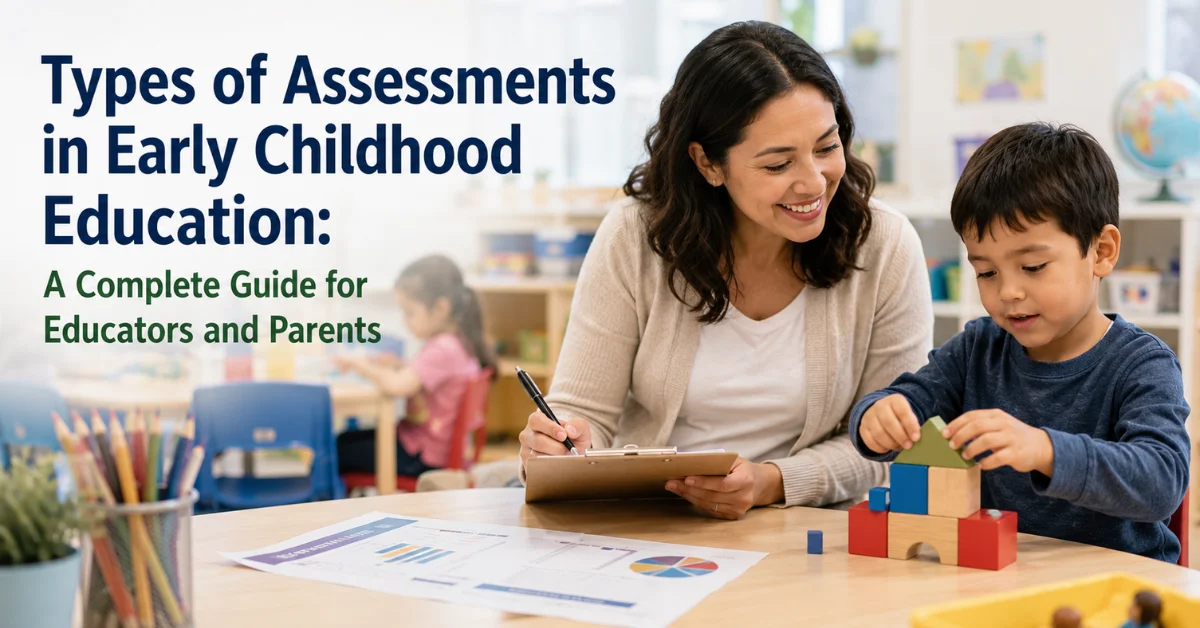
Every child grows at their own pace. One three-year-old might be putting together ten-piece puzzles while another is still mastering five. Neither child is “behind” — they’re simply on their own developmental journey. The job of assessment isn’t to rank children against each other. It’s to help teachers and families understand where a child is right now, so they can support what comes next.
If you’ve ever wondered what “assessment” actually looks like in a preschool classroom, you’re in the right place. This guide breaks down the main types of assessments in early childhood education, explains how they’re used in real classrooms, and shares practical tips that most articles on this topic leave out.
What Is Assessment in Early Childhood Education?
Assessment in early childhood education is the ongoing process of observing, documenting, and evaluating a child’s development across multiple areas — cognitive, language, physical, social, and emotional. Unlike assessments for older students, early childhood assessment rarely involves sitting a child down with a test booklet. Instead, it happens through play, conversation, daily routines, and careful observation.
Think of it less like a test and more like a snapshot album. Each observation, work sample, or checklist adds another photo to the album, and together they tell the story of how a child is growing.
Good assessment helps teachers:
- Plan activities that match each child’s current skills and interests
- Spot early signs that a child might need extra support
- Communicate clearly with families about their child’s progress
- Show whether classroom activities and curriculum are actually working
The Two Big Categories: Formative and Summative Assessment
Almost every type of early childhood assessment falls into one of two categories. Understanding this distinction makes everything else on this list much easier to follow.
Formative Assessment
Formative assessment happens during learning, not after it. It’s the day-to-day noticing that helps a teacher adjust on the fly.
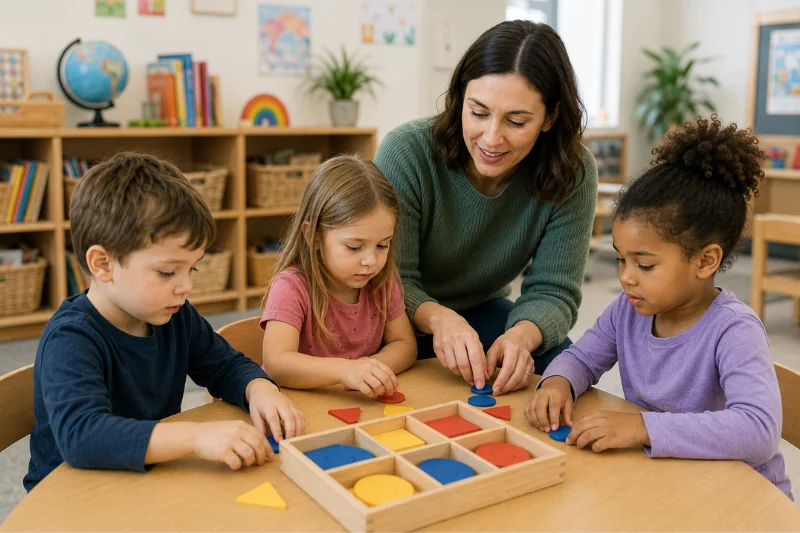
Example: A teacher notices that several children are struggling to sort shapes during a math activity. The next day, she adds a hands-on sorting game with familiar objects to reinforce the concept before moving on.
Formative assessment is:
- Ongoing and informal
- Low-pressure for children
- Used to guide tomorrow’s lesson plan, not just record today’s results
Summative Assessment
Summative assessment happens at a defined point in time — the end of a unit, a semester, or a school year. It summarizes what a child has learned over that period.
Example: At the end of the fall semester, a teacher compiles a progress report showing a child’s growth in letter recognition, counting, and social skills compared to where they started.
Summative assessment is:
- Periodic (usually quarterly, semi-annually, or annually)
- More structured than formative assessment
- Useful for sharing big-picture progress with families and administrators
The key takeaway: these two types work best together. Formative assessment is the everyday compass; summative assessment is the milestone marker that shows how far a child has traveled.
Core Types of Assessment Used in Early Childhood Classrooms
Within formative and summative assessment, several specific methods are used. Here’s what each one looks like in practice.
1. Observational Assessment
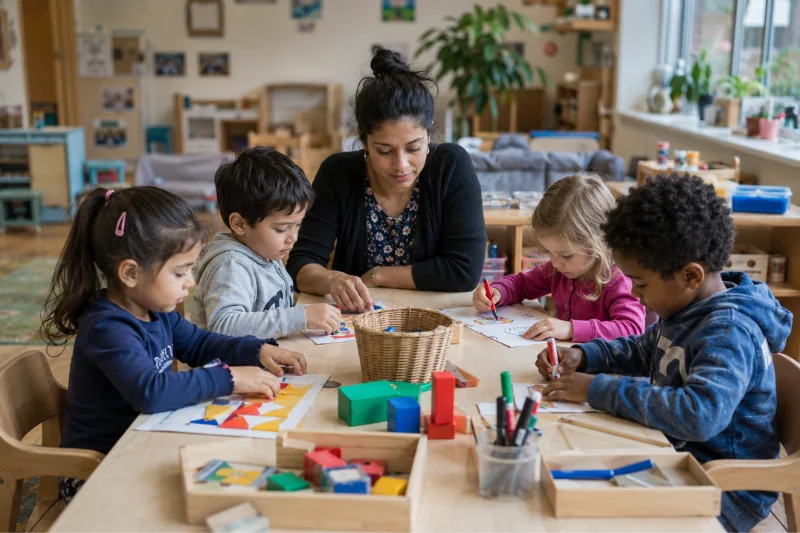
Observational assessment is exactly what it sounds like: a teacher watches children as they play, interact, and go about their day, then records what they see.
How it works:
Teachers might jot down notes during free play, snap a photo of a child building a tower, or use a checklist to track specific skills during circle time.
Why it matters:
This is the most natural form of assessment for young children because it doesn’t interrupt their play or make them feel “tested.” It captures real behavior in real settings.
Common tools:
- Anecdotal records (short written notes about what happened)
- Running records (detailed, real-time accounts of a child’s actions)
- Checklists and rating scales tied to developmental milestones
2. Authentic Assessment
Authentic assessment is closely related to observational assessment, but it’s worth calling out on its own because it’s the gold standard recommended by organizations like NAEYC.
What makes it “authentic”?
It happens during real, everyday activities — not in an artificial testing situation. A child counting snacks at lunch, negotiating turns on the slide, or retelling a story during circle time are all authentic assessment moments.
Why it matters:
Authentic assessment respects how young children actually learn — through play, relationships, and exploration — rather than forcing them into adult-style testing conditions that can cause stress or produce misleading results.
3. Portfolio Assessment
A portfolio is a collected record of a child’s work and progress over time. It might include drawings, writing samples, photos of projects, and teacher notes.
How it works:
Teachers (and often children themselves) select pieces that show growth — for example, comparing a child’s name-writing attempt in September to one from January.
Why it matters:
Portfolios make growth visible in a way that’s meaningful to families and even to children. Kids as young as two and a half can help choose what goes in their portfolio, which builds early self-reflection skills.
Tip:
Digital portfolios (photos and videos stored in an app) have become popular because they’re easy to share with families in real time — something most traditional paper portfolios can’t do.
4. Developmental Screenings
Screenings are brief, standardized tools used to check whether a child’s development is on track in areas like motor skills, language, and social-emotional growth.
How it works:
A tool like the Ages and Stages Questionnaire (ASQ) asks parents and teachers a set of simple questions about what a child can do.
Why it matters:
Screenings are not the same as diagnosis. Their job is to flag when a closer look might be helpful — nothing more, nothing less. If a screening raises a concern, the next step is a referral for a more thorough evaluation, not a label.
5. Direct (Standardized) Assessment
Direct assessment involves structured tasks — administered by a teacher or, sometimes, a computer program — that measure specific skills like letter recognition, counting, or fine motor coordination.
How it works:
A child might be asked to point to the letter “B” among a group of letters, or to count out a specific number of blocks.
Why it matters:
Direct assessment offers a clear, comparable benchmark, which can be useful for identifying specific skill gaps. However, early childhood experts caution against overusing it, since young children can find formal testing stressful and the results may not reflect their true abilities.
6. Play-Based and Game-Based Assessment
This is one of the newer approaches, and it’s still underexplained in most articles on this topic — so let’s break it down properly.
What it is:
Play-based assessment evaluates skills through structured or free play. Game-based assessment takes this a step further, using digital or physical games specifically designed to measure skills like early math, problem-solving, or vocabulary.
How it works:
A child might play a simple matching game on a tablet that’s secretly tracking how quickly and accurately they identify patterns — data the teacher can review later.
Why it matters:
For children who get anxious during traditional assessments, play-based and game-based methods can reveal what a child truly knows in a low-pressure setting. As these tools become more common in classrooms, it’s worth knowing what to look for:
- Does the game align with recognized developmental standards?
- Does it give teachers usable data, or just a “score”?
- Is screen time limited and balanced with hands-on play?
7. Anecdotal Records
Anecdotal records are short, narrative notes capturing a specific moment — what a child did, said, or how they reacted to something.
Example:
“During block time, Maya built a tower with 8 blocks, then said, ‘It’s taller than me!’ and laughed when it wobbled.”
Why it matters:
These small snapshots, collected over time, build a rich picture of a child’s personality, problem-solving style, and social development — details that checklists alone can’t capture.
How Families Fit Into the Assessment Picture
Most articles mention “family involvement” as an afterthought. It deserves more than that.
Families see things teachers never will — how a child behaves at bedtime, what makes them laugh, how they talk about their day. That information is assessment data too.
Practical ways families contribute:
- Questionnaires and surveys about a child’s interests, routines, and behavior at home
- Take-home observation notes where parents jot down what they notice
- Two-way communication apps that let teachers and families share photos and updates in real time
- Family-teacher conferences to discuss portfolios and progress reports together
When families and teachers compare notes, the picture of a child becomes far more complete — and far more accurate.
Assessing Dual-Language Learners and Children With Disabilities
This is an area most competitor articles skip entirely, but it’s one of the most important parts of getting assessment right.
Dual-Language Learners
A child who knows a concept in their home language but not yet in English isn’t “behind” — they simply haven’t had the chance to show what they know in the language being assessed.
Best practices include:
- Assessing children in their home language whenever possible, or using interpreters trained in early childhood assessment
- Looking at what a child can do across both languages combined, not just in English
- Avoiding assessments that weren’t designed or validated for multilingual learners
Children With Disabilities or Developmental Delays
For children with an Individualized Education Program (IEP) or those being evaluated for one, assessment looks a little different.
Key points:
- Assessment should happen in familiar settings with familiar people whenever possible
- Multiple sources of information — teacher observation, family input, and specialist evaluation — should always be used together
- The goal is to identify support needs early, not to label or limit a child
Common Mistakes to Avoid
Even well-meaning programs can fall into a few traps. Here’s what to watch for:
- Over-relying on one method. A single checklist or test score never tells the whole story. Combine multiple types of assessment for a fuller picture.
- Using results for high-stakes decisions. Early childhood assessment should inform teaching — not determine whether a child “passes” or gets held back.
- Skipping the follow-up. A screening or assessment that flags a concern is only useful if someone acts on it.
- Forgetting to close the loop with families. Collecting data is only half the job. Sharing it in a way families understand is what makes it meaningful.
- Letting bias creep in. Every observer brings their own background and assumptions. Regular training and reflection help reduce unconscious bias in how children are observed and scored.
How Often Should Assessments Happen?
There’s no single right answer, but here’s a general rhythm many programs follow:
| Assessment Type | Typical Frequency |
|---|---|
| Observational / anecdotal records | Daily or weekly |
| Portfolio updates | Ongoing, reviewed monthly |
| Developmental screenings | 1–2 times per year (or at enrollment) |
| Summative progress reports | Quarterly or semi-annually |
| Formal evaluations (for IEPs, etc.) | As needed, based on referral |
The goal is a steady rhythm of small, manageable check-ins — not one big stressful event.
Putting It All Together
The best early childhood assessment systems don’t rely on just one tool. They weave together:
- Daily observation to catch the small moments
- Authentic, play-based methods to see real skills in real contexts
- Portfolios to document growth over time
- Screenings to catch potential concerns early
- Family input to fill in the gaps no classroom can see
- Periodic summaries to share the big picture
When these pieces work together, assessment stops feeling like a test and starts feeling like what it really is: a way of truly knowing each child, so every child gets the support they need to thrive.
Frequently Asked Questions
1. What is the purpose of assessment in early childhood education?
The purpose is to understand each child’s development, growth, and learning needs so teachers can plan activities, identify support needs early, and communicate progress with families.
2. What is the most common type of assessment in early childhood education?
Observational assessment is the most common, since it fits naturally into daily routines and lets teachers see real skills in real settings without disrupting play.
3. What’s the difference between formative and summative assessment?
Formative assessment happens during learning to guide day-to-day teaching, while summative assessment happens at the end of a period (like a semester) to summarize overall progress.
4. Is standardized testing appropriate for preschoolers?
Generally, no. Most experts recommend authentic, play-based methods for young children, using standardized screenings only to flag potential concerns—not as the main form of assessment.
5. What’s the difference between a screening and an assessment?
A screening is a quick, one-time check to flag possible developmental concerns. An assessment is an ongoing process used to understand a child’s growth and guide instruction.
6. How often should young children be assessed?
Observations and anecdotal notes should happen daily or weekly, portfolios should be updated monthly, and formal summaries or screenings are typically done a few times a year.
7. What is authentic assessment?
Authentic assessment evaluates children during real, everyday activities—like play, mealtime, or storytelling—rather than through artificial testing situations.
8. How can parents support the assessment process?
Parents can share observations from home, fill out questionnaires, communicate regularly with teachers, and participate in conferences to discuss their child’s progress.
9. How is assessment different for dual-language learners?
Dual-language learners should be assessed in their home language whenever possible, and their skills should be considered across both languages—not just in English.
10. What should happen if an assessment or screening identifies a concern?
The concern should be followed up with further evaluation by qualified professionals and discussed with families—it should never be used to label a child or make high-stakes decisions on its own.
Final thought:
Good assessment isn’t about testing kids—it’s about taking the time to truly understand each child, so you can meet them where they are and help them grow at their own pace. When done right, it builds trust with families, supports teachers, and gives every child the best possible start.