
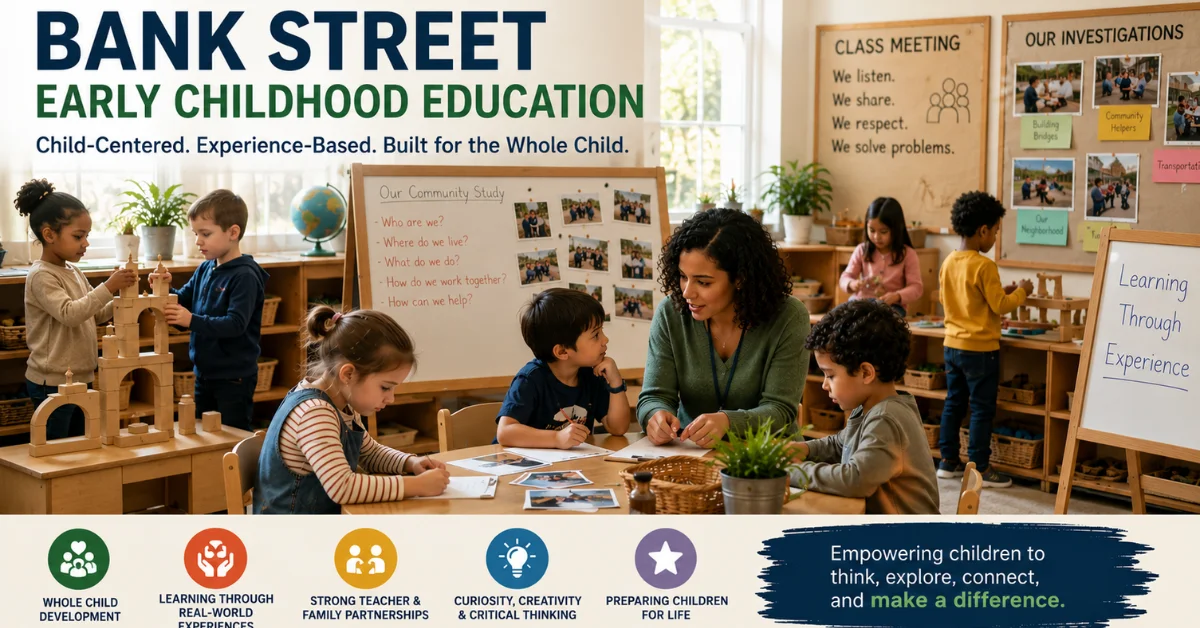
If you’re researching bank street early childhood education, you’ve probably encountered a wide range of opinions about play-based learning, child-centered classrooms, and progressive education. Some parents describe the approach as one of the most effective ways to nurture curiosity, independence, and critical thinking, while others wonder whether a less structured environment can adequately prepare children for future academic demands.
The truth is that bank street early childhood education is far more than simply allowing children to play throughout the day. Developed through decades of research in child development, psychology, and education, the approach is built on the belief that children learn best through meaningful experiences, social interactions, hands-on exploration, and strong relationships with teachers and families. Rather than separating learning into isolated subjects, bank street early childhood education encourages children to investigate real-world topics that naturally integrate reading, writing, math, science, social studies, and creative expression.
What makes bank street early childhood education particularly unique is its focus on the whole child. Academic growth is important, but so are social skills, emotional development, physical well-being, creativity, and problem-solving abilities. Supporters believe that when children feel safe, engaged, and genuinely interested in what they’re learning, deeper understanding follows naturally.
In this guide, you’ll learn the history behind bank street early childhood education, the core principles that define the approach, what classrooms actually look like, how it compares to Montessori and Reggio Emilia, the research supporting its effectiveness, potential drawbacks to consider, and practical questions to ask when evaluating a school that claims to follow the philosophy. Whether you’re a parent, educator, or administrator, understanding bank street early childhood education can help you make more informed decisions about early learning environments.
Where the Bank Street Approach Came From
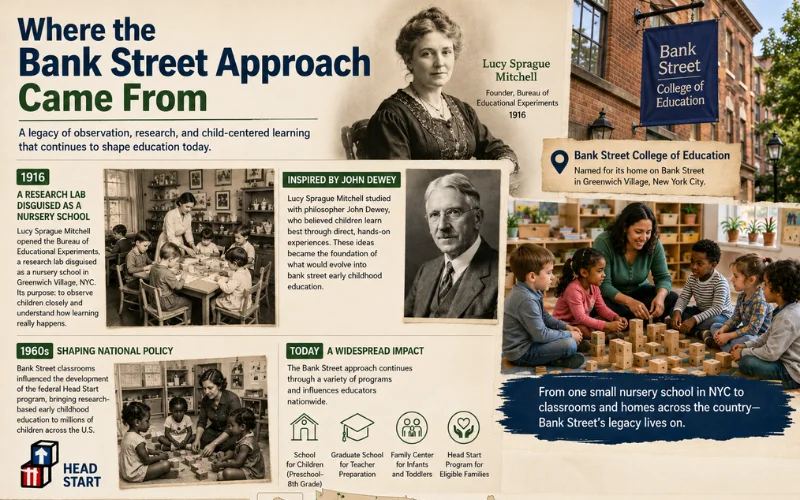
The origins of bank street early childhood education can be traced back to 1916, when educator Lucy Sprague Mitchell opened something unusual for the time: a research lab disguised as a nursery school. She called it the Bureau of Educational Experiments, and its entire purpose was to observe children closely and discover how learning actually happens, rather than relying on assumptions about child development.
Mitchell had studied with philosopher John Dewey, who argued that children learn best through direct, hands-on experiences rather than passive instruction. Those ideas became the foundation of what would later evolve into bank street early childhood education and the institution now known as Bank Street College of Education, named after its location on Bank Street in Greenwich Village.
What’s often left out of shorter explanations is that bank street early childhood education wasn’t simply an alternative teaching method used in a single school. It eventually influenced national education policy. During the 1960s, classrooms using principles associated with bank street early childhood education helped shape the development of the federal Head Start program. Ideas first tested in a small Manhattan nursery school ultimately influenced how millions of young children across the United States were educated.
Today, the institution behind bank street early childhood education operates several programs, including a School for Children, a graduate school for teacher preparation, a Family Center for infants and toddlers, and a Head Start program for eligible families. However, the influence of bank street early childhood education extends far beyond these programs. The philosophy is now practiced in public, charter, private, and home-based educational settings across the country by educators who have either received formal training or incorporated its principles into their teaching practices.
The Real Name: The Developmental-Interaction Approach
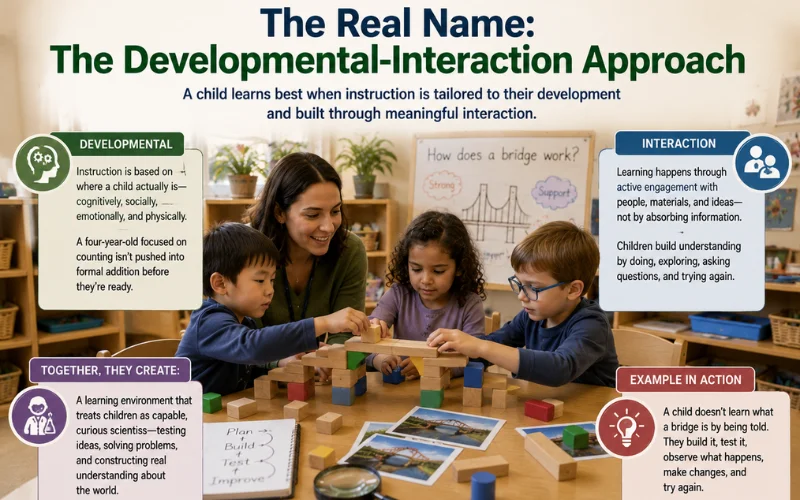
Educators sometimes refer to this as the developmental-interaction approach, and the name is actually a pretty precise description of what’s going on.
“Developmental” means instruction is built around where a child actually is — cognitively, socially, emotionally, and physically — rather than a fixed, one-size-fits-all timeline. A four-year-old who’s deeply focused on counting isn’t pushed into formal addition just because the calendar says it’s time.
“Interaction” means learning happens through a child’s active engagement with people, materials, and ideas — not by absorbing information from the outside in. A child doesn’t learn what a bridge is by being told. They learn it by building one out of blocks, testing whether it holds weight, watching it collapse, and trying again.
Put those together, and you get a method that treats young children less like empty containers waiting to be filled and more like working scientists, testing theories about how their world operates.
The Six Principles That Actually Define a Bank Street Classroom
Most explanations of this approach stop at “it’s play-based and child-centered,” which is true but not especially useful if you’re trying to evaluate a real program. Here’s what’s actually happening underneath that label.
1. Whole-child development, not just academic milestones
A Bank Street classroom tracks a child’s growth across four connected areas at once — social skills, emotional regulation, cognitive thinking, and physical development — because the philosophy holds that these aren’t separate boxes. A child who’s anxious about a friendship will struggle to concentrate on a math problem, so the teacher addresses both, not just the one that shows up on a report card.
2. Social studies as the spine of the curriculum, not a side subject
This is probably the single most distinctive — and most misunderstood — feature of the approach. Instead of teaching reading, math, science, and social studies as separate blocks, Bank Street classrooms organize the entire curriculum around an ongoing investigation of the child’s world: themselves, their family, their classroom, their neighborhood, and eventually their city and the wider world. Reading, writing, counting, and science all get pulled into that investigation rather than taught on their own.
3. Play is treated as serious cognitive work
This isn’t “let the kids have free time before the real learning starts.” In this model, dramatic play, block building, and open-ended exploration are the real learning — they’re how a four- or five-year-old processes complex ideas they can’t yet express in words.
4. Teachers act as observers and documentarians first, instructors second
Rather than standing at the front delivering a lesson, a Bank Street-trained teacher spends a large portion of the day watching, taking anecdotal notes, and building a picture of each child’s interests and struggles. Lesson planning grows out of what the teacher actually sees children doing, not a fixed pacing guide.
5. The classroom functions as a small democracy
Children participate in class meetings, help set classroom norms, and work through conflicts with peers rather than having every rule and consequence dictated from above. This is treated as academic content in its own right — an early, age-appropriate introduction to civic life.
6. Genuine partnership with families and the surrounding community
Because the curriculum is built around the child’s real world, parents, neighbors, and local community members are regularly pulled directly into classroom investigations — not just invited to a holiday performance once a year.
What This Looks Like Day-to-Day, by Age
This is where most articles on this topic stay frustratingly abstract. Here’s what the principles above actually translate into at different ages.
Infants and Toddlers (6 months–3 years)
At this stage, the “curriculum” is almost entirely relational. Caregivers focus on consistent, responsive relationships, predictable routines, and a richly stocked sensory environment — different textures, safe objects to manipulate, mirrors, simple cause-and-effect toys. The goal isn’t early academics; it’s helping a child build a secure foundation of trust, which research in child development consistently links to better learning outcomes years later. Ratios tend to be very low (often one adult to three or four children) precisely because this relational work can’t happen at scale.
Preschool and Pre-K (3–5 years)
This is where the “studies” approach becomes visible. A class typically starts the year with an “all about me” unit — children explore their own identity, family structure, and home life — before gradually widening outward to the classroom community and then the neighborhood.
A concrete example: say a construction crew starts working on a building visible from the classroom window. A traditional program might treat this as a fun distraction. A Bank Street-trained teacher treats it as a gift. Over the following weeks, that single observation might turn into:
- Literacy: new vocabulary (crane, scaffold, foundation, blueprint), a class-made picture dictionary of construction words, dictated stories about what children think is being built
- Math: counting trucks, comparing the heights of buildings using blocks, measuring how tall the crane “really” is using non-standard units like footsteps or hand spans
- Science: simple investigations into how pulleys and levers work, why some materials are stronger than others
- Social studies: interviewing a construction worker if one is willing to talk to the class, exploring what other jobs go into building a building
Art and block building: recreating the construction site in the block area, sketching “blueprints,” building models
Nobody decided in advance that this would be the semester’s topic. It emerged because the children were genuinely curious, and the teacher recognized an opportunity to teach nearly every core skill through it. That responsiveness — building curriculum around real, in-the-moment interest rather than a fixed pacing calendar — is one of the hardest parts of this approach to do well, and it’s a major reason teacher training matters so much (more on that below).
Kindergarten Through Second Grade
The “studies” widen further — neighborhood mapping, local history, how goods and services move through a community, basic civics. Children in this age range often build elaborate, sustained block constructions representing real places they’ve researched: their block, their school, a local market. Literacy and math instruction continue, but they’re frequently anchored to these real investigations rather than taught purely through workbooks.
How Bank Street Compares to Other Well-Known Approaches
This is a question almost every parent eventually asks, and most articles answer it vaguely. Here’s a direct comparison.
| Bank Street | Montessori | Reggio Emilia | Waldorf | |
|---|---|---|---|---|
| Founded | 1916, Lucy Sprague Mitchell (US) | Early 1900s, Maria Montessori (Italy) | 1940s, Loris Malaguzzi (Italy) | 1919, Rudolf Steiner (Germany) |
| Curriculum organized around | Social studies “studies” of the child’s expanding world | Sequenced, self-correcting materials chosen individually by each child | Long-term projects driven by children’s own questions, heavily documented | Imagination, storytelling, rhythm, and seasonal/nature themes |
| Teacher’s role | Observer, documenter, and curriculum designer who builds lessons around what children show interest in | Trained guide who introduces specific materials one-on-one, then steps back | Co-researcher and documentarian alongside children | Storyteller and model; teacher often stays with the same group for multiple years |
| Typical activity | Group investigation (e.g., mapping the neighborhood) blended with block building and dramatic play | Individual work with specific Montessori materials (pink tower, sandpaper letters) | Collaborative, often artistic, long-term projects (the “100 languages of children”) | Free play, handwork, music, and storytelling; academics introduced later than most approaches |
| Group vs. individual emphasis | Strong emphasis on classroom community and group democracy | Strong emphasis on independent, individual work | Strong emphasis on group collaboration and documentation | Strong emphasis on individual development at the child’s own pace |
| View of academics | Integrated into real investigations rather than taught separately | Structured, sequential, and often introduced earlier (e.g., early reading/math materials) | Emergent, project-based, less sequenced | Deliberately delayed; formal reading often not pushed until age 6–7 |
The short version: Montessori is the most individually structured of the four, Waldorf is the most protective of early childhood and slowest to introduce formal academics, Reggio Emilia is the most project- and art-driven, and Bank Street sits in between — child-led like Reggio Emilia, but organized around social studies and group community life in a way the others aren’t.
Why This Approach Holds Up, According to Child Development Research
It’s worth being honest here: not every claim made about “play-based learning” in marketing copy is backed by rigorous evidence, and parents are right to be skeptical of vague references to “brain science.” But several of the core ideas behind this approach do align with well-established findings in child development:
- Secure, responsive relationships in the early years are consistently linked to better self-regulation and learning capacity later on — this is the foundation of attachment research, and it’s exactly what the infant/toddler stage of this approach prioritizes.
- Executive function skills (the ability to plan, switch tasks, and control impulses) develop more reliably through child-directed, open-ended play than through highly structured, adult-directed drills, particularly before age six.
- Children retain and transfer knowledge better when they learn it in a meaningful, real-world context rather than in isolated, abstract drills — which is the entire logic behind organizing math and literacy around real investigations instead of teaching them as standalone subjects.
None of this means every Bank Street-style classroom automatically produces better outcomes than every traditional one. Quality of implementation matters enormously, which brings up the next point.
Where This Approach Can Fall Short
A fair guide doesn’t just sell you on something. A few honest considerations:
- It depends heavily on teacher skill. A well-trained teacher running an emergent, social-studies-driven curriculum is genuinely powerful. A poorly trained one running the same model can produce a classroom that’s pleasant but academically thin — lots of play, not much intentional teaching happening underneath it. The approach has a higher floor for teacher quality than a scripted curriculum does.
- It can feel less “measurable” to anxious parents. If you’re used to seeing weekly spelling tests or a clear reading-level chart, a portfolio of dictated stories and block-building photos can feel vague, even when meaningful learning is happening underneath it.
- It’s not built around standardized test prep. Families specifically targeting competitive, test-heavy K-12 admissions pipelines sometimes find this approach under-emphasizes the narrow academic drilling those processes reward, even though the underlying skills (reasoning, writing, problem-solving) tend to be strong.
- Tuition at flagship programs can be high, and free or low-cost access (like Head Start-affiliated programs) is limited by income eligibility and geography.
How to Vet a Program That Says It Uses This Approach
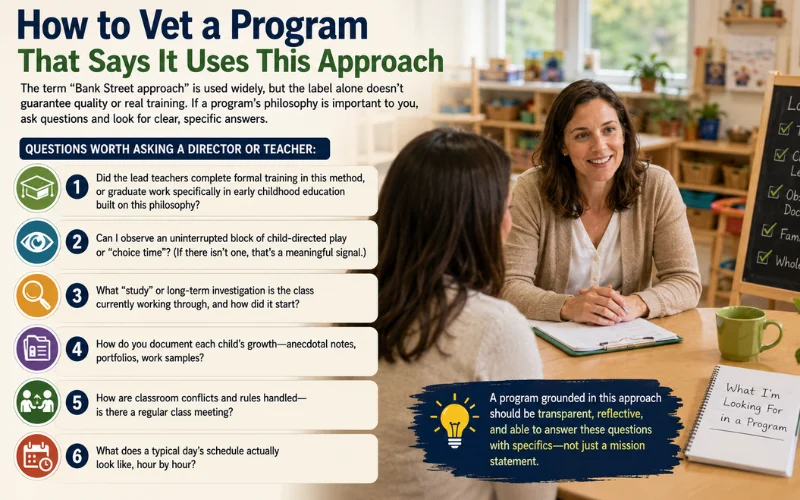
Here’s something most articles on this topic skip entirely, and it’s genuinely useful: the term “Bank Street approach” is used descriptively across the early childhood field, which means it appears on a lot of school websites, curriculum products, and marketing pages that have no formal training connection to the actual institution behind it. That doesn’t automatically make those programs bad — but it does mean the label alone isn’t proof of anything. If a program’s philosophy is what’s drawing you in, it’s worth verifying it directly rather than taking the name at face value.
Questions worth asking a director or teacher:
- Did the lead teachers complete formal training in this method, or graduate work specifically in early childhood education built on this philosophy?
- Can I observe an uninterrupted block of child-directed play or “choice time”? (If there isn’t one, that’s a meaningful signal.)
- What “study” or long-term investigation is the class currently working through, and how did it start?
- How do you document each child’s growth — anecdotal notes, portfolios, work samples?
- How are classroom conflicts and rules handled — is there a regular class meeting?
- What does a typical day’s schedule actually look like, hour by hour?
A program genuinely grounded in this philosophy should be able to answer all six of these with specifics, not just a mission-statement paragraph.
Frequently Asked Questions bank street early childhood education
1. What is bank street early childhood education?
Bank street early childhood education is a child-centered educational approach that emphasizes learning through direct experience, social interaction, play, and meaningful engagement with the world around children.
2. Who created bank street early childhood education?
Bank street early childhood education originated with educator Lucy Sprague Mitchell, whose work eventually led to the creation of Bank Street College of Education in New York City.
3. How is bank street early childhood education different from Montessori?
While both approaches are child-centered, bank street early childhood education focuses heavily on social studies, group investigations, and community learning, whereas Montessori emphasizes individual work with structured learning materials.
4. Is bank street early childhood education play-based?
Yes. Play is considered a critical learning tool in bank street early childhood education, helping children develop academic, social, emotional, and problem-solving skills.
5. What age groups benefit from bank street early childhood education?
Bank street early childhood education is most commonly associated with infants, toddlers, preschoolers, and elementary-age children, although its principles can be applied across various age groups.
6. Does bank street early childhood education teach academics?
Absolutely. Reading, writing, math, science, and social studies are all included in bank street early childhood education, but they are integrated into real-world investigations rather than taught as isolated subjects.
7. Is bank street early childhood education research-based?
Yes. Many principles of bank street early childhood education align with established research in child development, executive function, social-emotional learning, and experiential education.
8. Are teachers specially trained in bank street early childhood education?
Some educators receive formal training through programs influenced by bank street early childhood education, while others learn its methods through broader early childhood education coursework and professional development.
9. What are the benefits of bank street early childhood education?
Benefits often include stronger critical-thinking skills, improved social-emotional development, greater creativity, enhanced collaboration, and deeper engagement in learning.
10. How can parents evaluate a bank street early childhood education program?
Parents should observe classrooms, ask about teacher training, review documentation methods, and learn how the school incorporates child-led investigations into daily learning experiences.
Final Thoughts
Bank Street early childhood education offers a child-centered approach that combines play, exploration, and real-world learning experiences. Rather than focusing only on academics, bank street early childhood education supports children’s cognitive, social, emotional, and physical development as a whole. While the quality of implementation matters, families looking for a nurturing, curiosity-driven learning environment may find bank street early childhood education to be an excellent foundation for lifelong learning.