
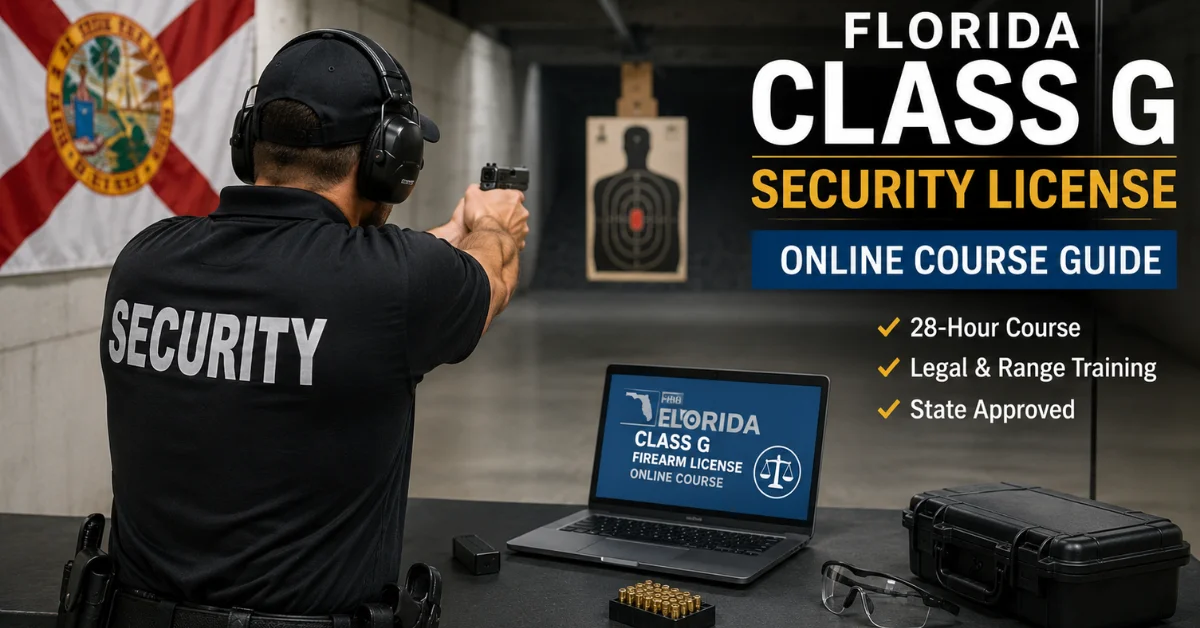
If you are planning to start a career in armed security, the first step you will likely come across is the class g security license online course florida. This course is essential for anyone who wants to legally carry a firearm while working as a security officer in Florida. At first glance, it may seem simple to enroll in an online program and get certified quickly, but the process is actually more structured than most people realize. Florida law requires a combination of online classroom training and in-person firearms qualification, which means you cannot complete the entire course from home.
The class g security license online course florida is designed to provide both theoretical knowledge and practical skills. It covers important topics such as firearm safety, legal use of force, and state regulations, while also requiring hands-on range training with a licensed instructor. Whether you are a beginner entering the security field or an existing Class D officer looking to upgrade your qualifications, understanding how this course works will help you avoid confusion, save time, and choose the right training provider.
This guide walks through exactly what the Class G course covers, what “online” really means for this particular license, what it costs from start to finish, what to bring on range day, and what separates a course that genuinely prepares you for the job from one that just hands you a certificate and sends you on your way.
What the Class G License Actually Is
The Class G Statewide Firearm License is issued by the Florida Department of Agriculture and Consumer Services (FDACS), Division of Licensing, under Chapter 493 of the Florida Statutes. It’s the credential that allows a licensed security officer or private investigator to carry a firearm while on duty. Without it, carrying a gun while working security in Florida — even if you personally own a concealed weapon permit — is illegal. A CCW permit and a Class G license are not interchangeable; one is about your right as a private citizen, the other is about your authority while performing a job.
You cannot apply for a Class G license on its own. Florida requires you to already hold, or be actively pursuing, a qualifying base license first — most commonly the Class D Security Officer license, though Class C or CC private investigator licenses also qualify. Think of Class G as an add-on credential layered on top of your underlying security or investigative license, not a standalone starting point.
Why “Online” Doesn’t Mean What You Think It Means Here
This is the part almost every Google search result glosses over, and it’s the single most important thing to understand before you pay for any course.
Florida Administrative Code 5N-1 sets the Class G curriculum at a minimum of 28 hours, and it splits that time into two legally distinct categories:
The classroom and legal portion (roughly 20 hours) covers Chapters 493, 775, 776, and 790 of the Florida Statutes, civil and criminal liability for using force, firearm mechanics, safe handling, and the legal boundaries around when a security officer can and cannot use a weapon. This portion genuinely can be — and routinely is — delivered online, either through live instructor-led video sessions or self-paced modules with a final written exam.
The firearms qualification portion (8 hours) cannot be delivered online under any circumstances, because it requires live-fire shooting under the direct, in-person supervision of a state-licensed Class “K” firearms instructor. This is non-negotiable. No training provider, regardless of what their homepage says, can legally issue you a Class G certificate without you physically attending a range day and shooting a qualification course.
So when a course is marketed as “online,” what that actually means is: the legal and theoretical portion happens on your laptop, and the shooting portion happens at a real gun range with a real instructor watching you. Any site that implies the entire 28 hours, range time included, can be completed from your couch is either misrepresenting the course or referring to a different, non-qualifying type of firearms training. This is worth confirming directly with a provider before you enroll, because the gap between “hybrid” and “fully online” trips up more applicants than any other part of the process.
What You’ll Actually Learn
The 28-hour curriculum, regardless of which school delivers it, breaks down into a few core blocks:
- Legal aspects of firearm use. This is where most of your classroom time goes. You’ll cover the specific Florida statutes governing the use of force, the difference between civil and criminal liability, and the legal standard for justifiable use of deadly force as a security officer (which is meaningfully different from the standard that applies to an ordinary armed citizen). Get this part wrong on the job and the legal consequences fall on you personally, not just your employer — which is exactly why FDACS weights this so heavily.
- Firearm mechanics and safety. Nomenclature, how your weapon functions, safe carry and storage, loading and unloading procedures, and clearing the most common types of malfunctions. You’re expected to be fluent with this before you ever step onto the range, because range day moves fast and instructors don’t have time to re-teach basics under live-fire conditions.
- Marksmanship fundamentals. Stance, grip, sight alignment, trigger control, and the four-step draw. This is taught conceptually in the classroom portion and then drilled physically on the range.
- The written exam. Most providers require a passing score between 70% and 75% before you’re cleared to move on to range day. A handful of providers test only at the end of the full course; others test daily as you progress through modules.
- Range qualification (live fire). You’ll be required to fire a set number of rounds under direct supervision — this typically totals around 144 rounds across practice and two qualification cycles, though the exact structure varies slightly by provider. You need to hit a minimum proficiency score, generally in the range of 70% accuracy, to pass. If you don’t pass on your first attempt, most schools allow a retake, sometimes for an additional range fee.
What You’ll Need Before You Show Up to the Range
This is something a surprising number of course pages either bury or skip entirely, and it can turn into an expensive surprise on range day if you’re caught off guard.
You will need closed-toe shoes (sneakers or boots — no sandals, no open-toed shoes of any kind), long pants with a sturdy belt (no shorts, no sweatpants), and a crew-neck or collared shirt with no low-cut or sleeveless designs. This isn’t arbitrary — it’s a safety requirement related to hot brass ejection and proper holster fit. If you wear prescription glasses, bring them; you’ll need clear eye protection that fits over them.
You’ll also need to decide in advance whether you’re renting a firearm through the school or bringing your own. If you bring your own semi-automatic pistol, you’ll generally need a minimum of four magazines (or four 6-round speed loaders if you’re qualifying with a revolver) and your own ammunition in an approved caliber — typically 9mm, .40 S&W, .45 ACP, or .380. Reloaded ammunition, frangible rounds (like Glaser or MagSafe), exploding rounds, and armor-piercing rounds are universally prohibited at qualification ranges. No ammunition of any kind is permitted inside the classroom — it’s range-only, and bringing it into a classroom setting can get you removed from the course.
If you’d rather not deal with any of this, most schools offer firearm rental as part of the course price, which typically includes the weapon, ammunition, and hearing/eye protection for the day.
How Much the Whole Process Actually Costs
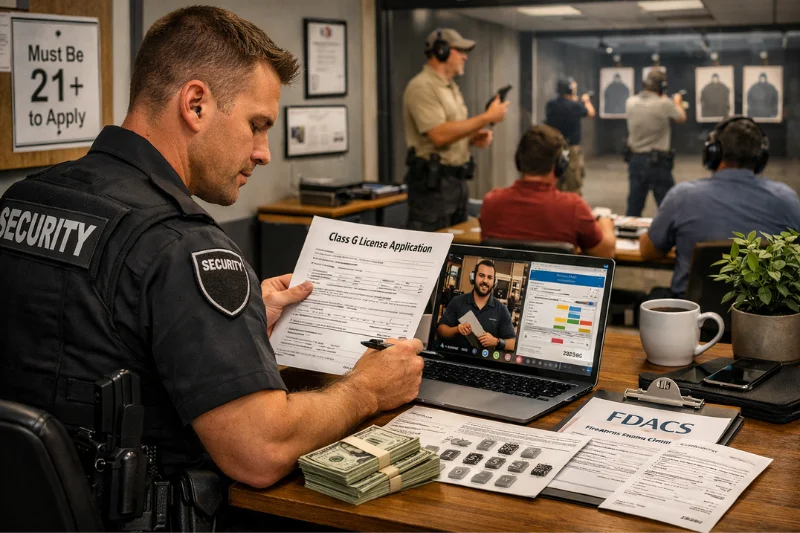
Course pricing varies more than you’d expect for a state-standardized curriculum, and a lot of that variation comes down to what’s bundled into the advertised price versus what gets added on later.
As of 2026, Class G course tuition alone typically runs $150 to $300, depending on the provider, whether a firearm rental is included, and whether the price bundles the range fee or charges it separately (commonly an additional $25–$50 if it’s not included). On top of tuition, you’re looking at:
- FDACS application fee: $112
- Fingerprinting fee: roughly $40–$50 (this is separate from the application fee and paid to your fingerprinting/Livescan provider, not to FDACS directly)
All in, most applicants spend somewhere between $300 and $450 total to go from zero to a submitted Class G application, assuming you already hold your Class D license. If you’re starting completely from scratch — meaning you need both the Class D unarmed license and the Class G armed license — budget closer to $500–$800 once you factor in the 40-hour Class D course as well.
One detail worth knowing: you must be at least 21 years old to apply for Class G, even though the Class D license only requires you to be 18. This trips up a fair number of younger applicants who complete their Class D at 18 or 19 and then have to wait before they’re eligible to pursue Class G.
How Long the Whole Process Takes
Most online/hybrid Class G courses are structured to run over two to three consecutive days for the classroom portion, with the range day scheduled separately — sometimes the same week, sometimes on a fixed recurring schedule (several providers run range days only on specific weekends each month). Self-paced programs let you stretch the classroom hours over a longer window, often with a completion deadline somewhere between 30 and 45 days from enrollment.
After you finish training and pass both the written exam and the range qualification, your school issues a certificate of completion. From there, FDACS application processing for Class G typically takes two to four weeks, somewhat longer than the Class D timeline, since Class G applications get an additional layer of review.
Eligibility Requirements at a Glance
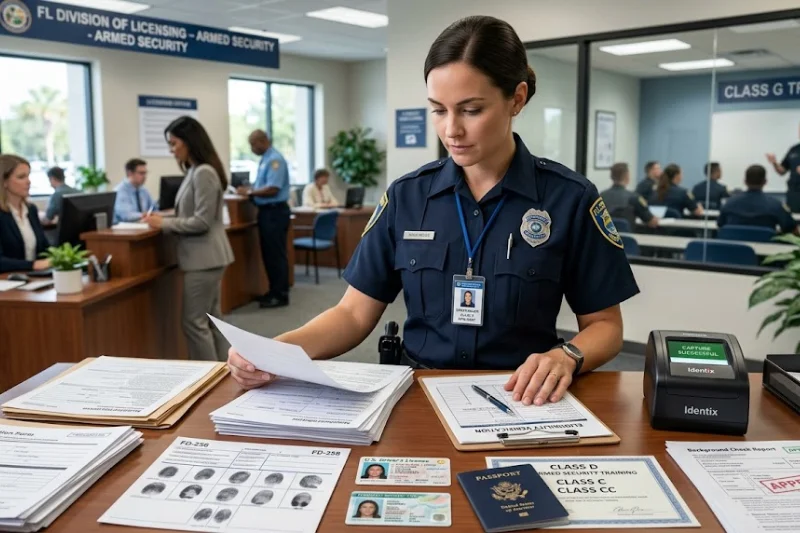
Before you spend money on a course, confirm you actually meet these baseline requirements:
- At least 21 years old
- U.S. citizen or legal permanent resident
- Hold (or be actively completing) a qualifying base license — Class D, C, or CC
- No disqualifying criminal history. Florida takes felony convictions seriously: a felony conviction generally results in denial unless your civil rights have been restored and at least 10 years have passed since the end of your sentence, and for Class G specifically, your right to possess a firearm must also have been separately restored
- No history of involuntary mental health commitment or adjudicated incompetence
- Pass a fingerprint-based state and federal background check
If you have any criminal history at all, even something that feels minor or long in the past, it’s worth checking your specific situation against FDACS guidance before enrolling in a course — there’s no refund for tuition if your application is later denied on background grounds.
What Happens After You’re Licensed
Getting your class g security license online course florida is the beginning, not the end, of your obligations. Florida requires Class G holders to complete four hours of firearms requalification training annually to keep the license active, and the full license itself must be renewed every two years. Missing your annual requalification window is one of the most common — and most avoidable — reasons armed officers end up working without a valid credential. Set a calendar reminder the day you get licensed; don’t rely on your employer or training school to track this for you.
It’s also worth knowing that your Class G license only authorizes you to carry the specific type and caliber of firearm you qualified with. If you switch to a different weapon platform later — say you qualified with a 9mm semi-automatic and your new employer issues a .40 caliber duty weapon — you need to requalify on that specific firearm before carrying it on duty.
How to Choose a Course That’s Actually Worth Your Money
Given that every provider teaches the same state-mandated curriculum, the differences that actually matter come down to a handful of practical factors:
Transparency about the hybrid structure
A provider that clearly explains the 20-hours-online-plus-8-hours-range split, tells you exactly where and when the range day happens, and discloses the instructor’s Class K license number is being straight with you. Vague promises of “fully online” training are a warning sign.
What’s actually included in the advertised price
Does the quoted price include the range fee, firearm rental, ammunition, targets, and eye/ear protection — or are those add-ons you’ll discover later? Get this in writing before you pay.
Schedule flexibility
Some programs run fixed cohorts only a few times a year. Others offer rolling enrollment with multiple range dates each month. If your work schedule is unpredictable, ask specifically how missed sessions or range days get rescheduled, and whether there’s a fee for doing so.
Instructor credentials you can verify
Ask for your instructor’s Class K firearms instructor license number and the school’s DS (training facility) license number, then check both against the FDACS license lookup tool before you enroll. A legitimate school will give you this information without hesitation.
What happens if you don’t pass
Ask in advance about retake policies for both the written exam and the live-fire qualification. Some schools include one retake at no extra cost; others charge a fresh range fee for every attempt.
Frequently Asked Questions class g security license online course florida
1. Can I complete the Class G security license course entirely online in Florida?
No. While the classroom portion may be completed online, Florida law requires the 8-hour live-fire firearms qualification to be completed in person under the supervision of a licensed Class K instructor.
2. How long is the Florida Class G security license course?
The state-mandated course consists of 28 hours of training, including approximately 20 hours of classroom instruction and 8 hours of live firearms training at an approved shooting range.
3. How much does a Class G security license online course cost?
Most Florida providers charge between $150 and $300 for the course. Additional costs may include fingerprinting, the FDACS application fee, ammunition, firearm rental, and range fees if they are not included.
4. Do I need my own firearm to take the Class G course?
No. Many training schools offer firearm rentals, ammunition, eye protection, and hearing protection for students who do not own a handgun.
5. What is the minimum age to apply for a Class G license in Florida?
You must be at least 21 years old to qualify for a Florida Class G Statewide Firearm License, even though you can obtain a Class D Security Officer License at age 18.
6. Is the Class G license required for armed security jobs in Florida?
Yes. Anyone working as an armed security officer in Florida must hold a valid Class G Statewide Firearm License in addition to an eligible security or private investigator license.
7. What documents should I bring on the day of my firearms qualification?
Bring a valid photo ID, appropriate range attire (closed-toe shoes and long pants), any required paperwork from your training provider, and your firearm and ammunition if you’re not using the school’s rental equipment.
8. How long does it take to receive a Class G license after applying?
After successfully completing the course and submitting your application, the Florida Department of Agriculture and Consumer Services typically processes Class G licenses within 2 to 4 weeks, depending on application volume.
9. Can I take the Class G course if my Class D license is still being processed?
Many training providers allow you to complete the Class G training while your Class D application is pending. However, your Class G license generally won’t be issued until you meet all eligibility requirements for the qualifying base license.
10. How can I choose the best Class G security license online course in Florida?
Look for a state-licensed training provider that clearly explains the online and in-person requirements, includes transparent pricing, offers flexible scheduling, has experienced Class K instructors, and provides support throughout the licensing process.
Final Thoughts
Finding the right Class G security license online course in Florida is about more than simply choosing the cheapest option—it’s about selecting a state-approved program that prepares you for both the licensing process and the responsibilities of working as an armed security professional. While the classroom portion can often be completed from the comfort of your home, remember that Florida law requires hands-on firearms training and live qualification before you can earn your license.
Before enrolling, compare providers carefully, verify that they are licensed by the state, and make sure you understand exactly what’s included in the course fee. A transparent training school will clearly explain the online coursework, range requirements, scheduling, and any additional costs upfront.
By choosing a reputable provider and completing all required training, you’ll be well on your way to earning your Florida Class G license and opening the door to higher-paying armed security opportunities. Take the time to invest in quality training now—it can make a significant difference in both your confidence and your long-term career success.