
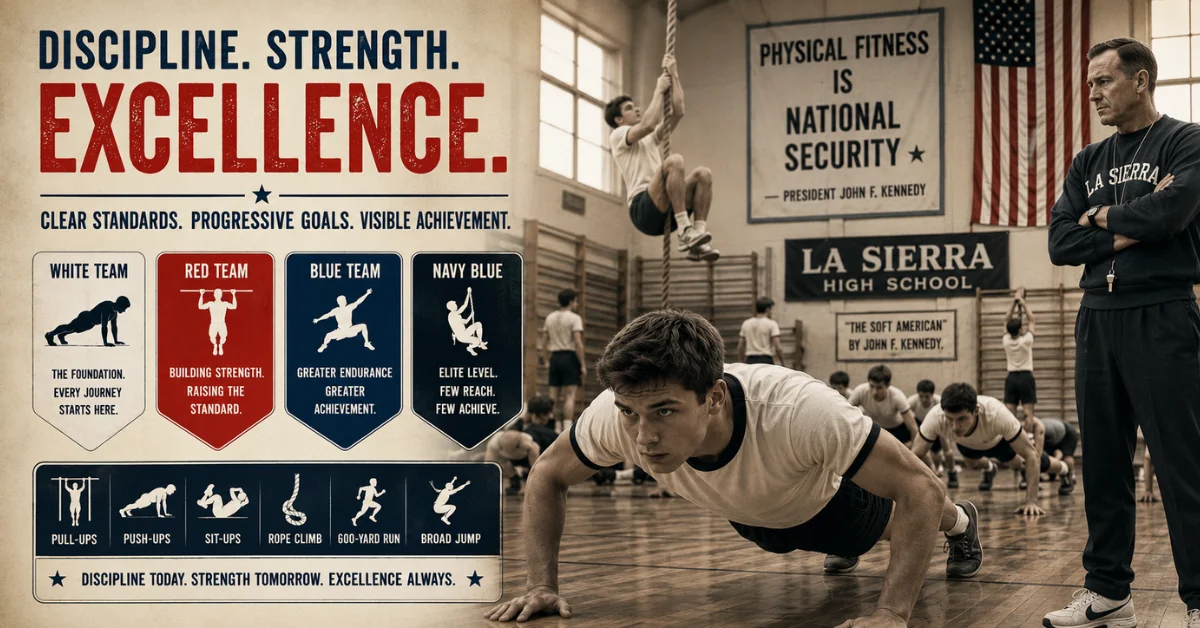
The La Sierra Physical Education Program is widely regarded as one of the most influential school fitness systems ever created. Developed by PE teacher Stan LeProtti in the early 1960s, it emphasized discipline, bodyweight training, and measurable fitness standards at a level rarely seen in schools today. This guide explores the history of the La Sierra Physical Education Program, its famous color-coded achievement levels, why it was so effective, and how you can apply its training principles to your own fitness journey.
What Was the La Sierra Physical Education Program?
The La Sierra Physical Education Program was a structured, progressive physical fitness curriculum developed in the late 1950s and refined through the 1960s under the leadership of PE teacher and coach Stan LeProtti. It operated on a color-coded belt system — similar to martial arts — where students advanced from White through Red, Blue, and ultimately to the elite Navy Blue level by demonstrating mastery of a standardized battery of bodyweight exercises.
The La Sierra Physical Education Program gained national attention when President John F. Kennedy, alarmed by a series of studies showing American youth were falling behind their European counterparts in physical fitness, began publicly championing it as a model for the entire country. Kennedy referenced the program in speeches, and a short documentary film about it was shown to schools across the United States.
What made the La Sierra Physical Education Program remarkable wasn’t just the difficulty. It was the system: clear standards, progressive goals, visible achievement, and a culture where physical excellence was a source of genuine pride.
The Cold War Context That Made It Happen
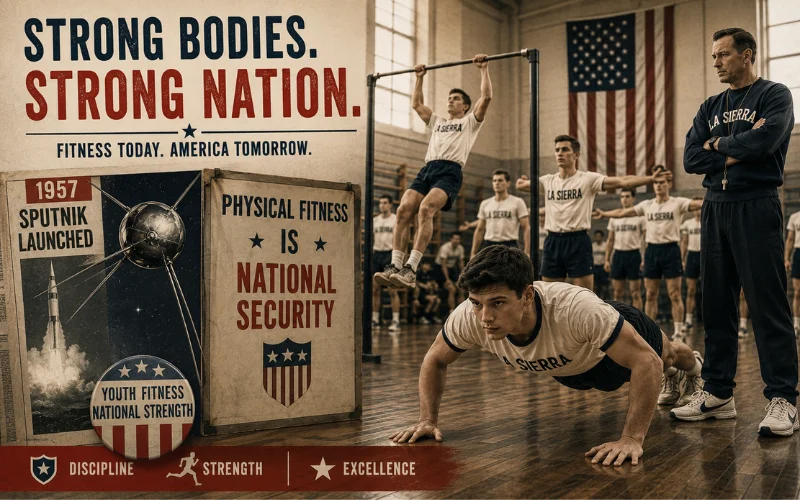
To understand La Sierra, you have to understand the anxiety running through America in the late 1950s.
In 1957, the Soviet Union launched Sputnik. Two years earlier, in 1955, a study published in the journal Research Quarterly found that 57.9% of American children failed a minimum fitness test — compared to just 8.7% of European children who took the same test. The study caused a minor national panic.
President Eisenhower responded by forming the President’s Council on Youth Fitness in 1956. Kennedy doubled down on this when he took office in 1961, writing a passionate essay called “The Soft American” in Sports Illustrated, arguing that the physical decline of American youth was a genuine national security threat.
It was into this environment that the La Sierra program arrived. LeProtti had developed something that worked, and it worked visibly — the film footage of students performing precision group calisthenics, climbing ropes, executing muscle-ups, and moving their bodies with athletic ease was a direct rebuttal to the narrative of softness.
The program wasn’t just exercise. It was a statement.
Stan LeProtti: The Man Behind the Program
Stan LeProtti was not a celebrity fitness guru. He was a PE teacher who believed, with absolute conviction, that every student was capable of far more than they thought — and that a structured environment with high standards was the vehicle to get them there.
His approach had several core principles that distinguished it from typical school PE:
Standards over participation
Most school PE programs of the era simply required students to show up and try. LeProtti required students to meet specific, measurable benchmarks before advancing. There were no participation trophies.
Pride, not punishment
The color system turned fitness achievement into something students wanted. Moving from White to Red to Blue was an accomplishment you wore — literally, in the form of colored gym clothes. Peers knew where you stood.
Mastery before advancement
Students repeated tests until they passed. There was no social promotion. A senior who still wore White was unusual and noticeable — a powerful motivator in a social environment.
Daily deliberate practice
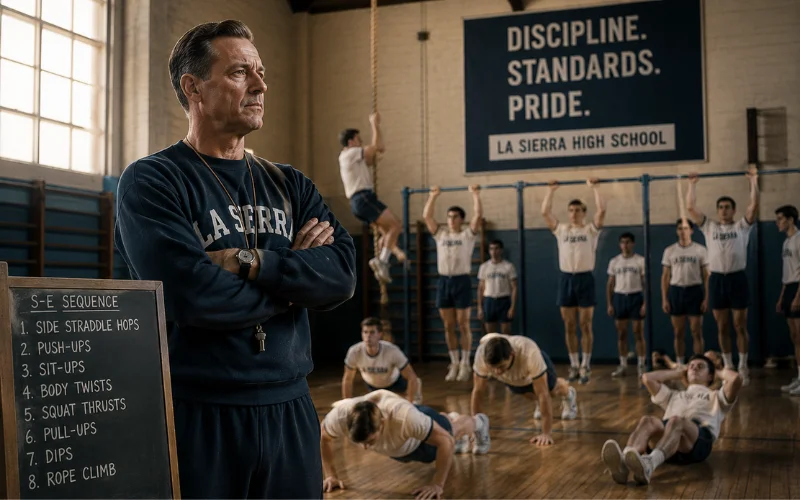
The program’s foundation was a daily warm-up routine called the S-E (Strength-Endurance) sequence — performed every single class, every single day. The routine’s consistency was part of its power.
These are not radical ideas. But in a world of school fitness programs focused on team sports, dodgeball, and free-play periods, they were revolutionary.
The Daily S-E Warm-Up Routine
Every La Sierra class began with the same Strength-Endurance sequence. This wasn’t optional and wasn’t varied. It was performed daily, executed in unison, often to music, and was the bedrock of the entire program’s physical development.
The routine consisted of the following exercises performed in sequence:
- Side-straddle hops (jumping jacks) — 50 reps
- Push-ups — 20 reps
- Sit-ups (full range) — 20 reps
- Body twists — 20 reps (10 each side)
- Squat thrusts (burpees without the jump) — 10 reps
- Pull-ups — maximum effort
- Dips — maximum effort
- Rope climb or peg board — as prescribed
The sequence was performed with minimal rest between exercises. The emphasis was on controlled movement — full range of motion on every rep, no half-reps counted. Teachers observed and corrected form actively.
For a modern training adaptation, you can replicate this routine exactly. The equipment substitutions are discussed in detail further below.
The Full Color-Coded Standards
This is the section that stops people cold when they first encounter it.
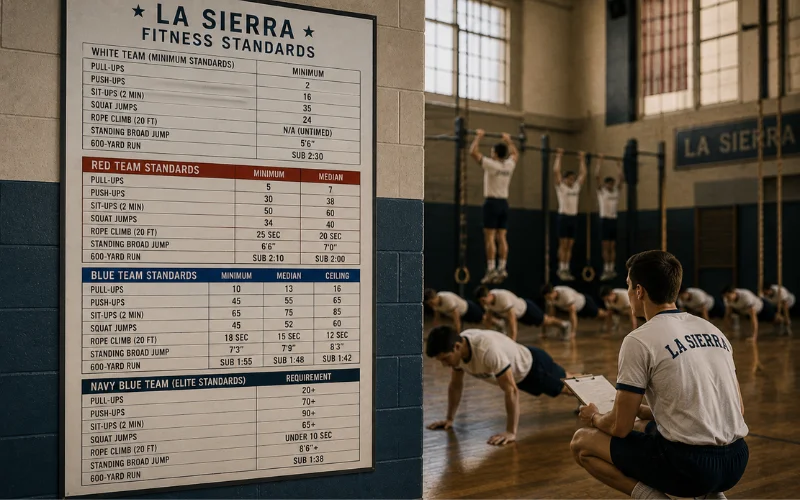
The La Sierra program used five color levels. Students were assessed on a battery of exercises and had to meet the minimum for each exercise within a category to earn that color. Partial passes didn’t count — you either hit every benchmark or you stayed where you were.
The exercises tested were:
- Pull-ups
- Push-ups
- Sit-ups (in 2 minutes)
- Squat jumps
- Rope climb (20 feet)
- Standing broad jump
- 600-yard run
White Team (Minimum Standards)
These were the entry-level benchmarks — what every student was expected to achieve within the first months of enrollment.
| Exercise | Minimum |
|---|---|
| Pull-ups | 2 |
| Push-ups | 16 |
| Sit-ups (2 min) | 35 |
| Squat jumps | 24 |
| Rope climb (20 ft) | N/A (untimed) |
| Standing broad jump | 5’6″ |
| 600-yard run | Sub 2:30 |
Red Team Standards
| Exercise | Minimum | Median |
|---|---|---|
| Pull-ups | 5 | 7 |
| Push-ups | 30 | 38 |
| Sit-ups (2 min) | 50 | 60 |
| Squat jumps | 34 | 40 |
| Rope climb (20 ft) | 25 sec | 20 sec |
| Standing broad jump | 6’6″ | 7’0″ |
| 600-yard run | Sub 2:10 | Sub 2:00 |
Blue Team Standards
| Exercise | Minimum | Median | Ceiling |
|---|---|---|---|
| Pull-ups | 10 | 13 | 16 |
| Push-ups | 45 | 55 | 65 |
| Sit-ups (2 min) | 65 | 75 | 85 |
| Squat jumps | 45 | 52 | 60 |
| Rope climb (20 ft) | 18 sec | 15 sec | 12 sec |
| Standing broad jump | 7’3″ | 7’9″ | 8’3″ |
| 600-yard run | Sub 1:55 | Sub 1:48 | Sub 1:42 |
Navy Blue Team (Elite Standards)
The Navy Blue level was achieved by a very small percentage of students — perhaps 5–10% in any given year. These were exceptional athletes by any standard.
| Exercise | Requirement |
|---|---|
| Pull-ups | 20+ |
| Push-ups | 70+ |
| Sit-ups (2 min) | 90+ |
| Squat jumps | 65+ |
| Rope climb (20 ft) | Under 10 sec |
| Standing broad jump | 8’6″+ |
| 600-yard run | Sub 1:38 |
Take a moment to sit with those numbers. Twenty pull-ups and seventy consecutive push-ups — achieved by a high school student training on nothing but bodyweight, five days a week, in a normal school setting. No protein supplements. No periodization software. No personal trainers.
The elite Navy Blue students in LeProtti’s program would be competitive at adult fitness events today.
Where Are You Right Now? How to Self-Assess
Before you start training toward any of these standards, get an honest baseline. Testing yourself today also gives you a reference point to measure progress against.
Test protocol
Rest for at least one day before testing. Perform each test fresh — don’t do pull-ups right after push-ups for maximum accuracy. Use strict form throughout: pull-ups start from a dead hang with full arm extension, push-ups maintain a rigid plank from knees to neck, sit-ups go from flat back to elbows touching knees.
Run through each exercise once, record your score, and compare to the table above.
Where most untrained adults land
Research on adult fitness consistently shows that the average adult male today struggles to perform more than 3–4 pull-ups and 25–30 push-ups with strict form. If that describes you, you’re at or below the White Team minimums — the absolute starting point for 1960s high school freshmen.
That’s not a criticism. It’s useful information. It tells you exactly where to begin.
Why the Program Worked: The Science Behind the System
The La Sierra program wasn’t designed with modern exercise science in mind, but it accidentally encoded several principles that exercise scientists now know produce results.
Frequency over intensity
Research consistently shows that frequent exposure to a movement pattern is one of the most reliable ways to improve at it. Doing 20 pull-ups five days a week produces better results than doing 100 pull-ups once a week. LeProtti’s students trained every school day — that’s 180+ sessions per year.
Grease the groove
Pavel Tsatsouline popularized this concept decades after La Sierra — the idea that performing submaximal reps of a movement pattern frequently builds neural efficiency. The S-E routine was essentially structured grease-the-groove training applied to an entire school.
Progressive standards with visible milestones
Self-determination theory in psychology identifies three core human motivational needs: autonomy, competence, and relatedness. The color system addressed all three. Students chose to push harder (autonomy), saw clear evidence of improvement (competence), and belonged to a group defined by shared standards (relatedness).
Compound, functional movements only
There are no bicep curls in the La Sierra curriculum. Every exercise involves multiple muscle groups, requires full-body tension, or develops a functional athletic capacity. The program was inadvertently training patterns rather than muscles — a principle modern functional fitness and movement coaches champion.
Daily consistency without overtraining
Because the S-E routine was submaximal for most students on most days, it avoided the accumulative fatigue that destroys motivation and causes injury in more intense programs. Students could recover and return the next day. Compounded over years, this consistency produced extraordinary results.
The Mental Dimension: What Nobody Else Talks About
- Read the accounts of La Sierra alumni — and there are many, scattered through fitness blogs, Reddit threads, and documentary comments — and a pattern emerges that goes beyond fitness.
- They don’t primarily talk about how strong they got. They talk about what it did to their relationship with difficulty.
- One alumnus writing on Ross Training’s blog described it this way: the program taught him that discomfort was temporary and that almost every limit he thought he had was negotiated, not fixed. Another described using the Navy Blue rope climb standard as a mental reference point forty years later when facing challenges in his career.
- LeProtti understood something that modern fitness culture occasionally rediscovers and then forgets again: physical training done with standards and structure is character education. The body is the entry point. What you’re really developing is a person who has proven to themselves — not just been told — that they can do hard things.
- This is the dimension the history articles miss. The La Sierra program wasn’t remarkable because it produced fit teenagers. It was remarkable because it produced adults who carried a different self-concept for the rest of their lives.
- If you take the program seriously as an adult, this is worth holding in mind. You’re not just chasing a pull-up number. You’re establishing a new relationship with your own capacity.
Modern Equipment Substitutions
One of the most common questions about adapting the La Sierra program is how to replace the equipment that existed in a 1960s school gym but doesn’t exist in most homes, apartment complexes, or commercial gyms today.
Rope climb (20 feet)
This is the hardest substitution. Your best options, in order of preference: (1) an outdoor pull-up bar with a climbing rope attached — ropes can be purchased cheaply and hung from most outdoor structures; (2) a rock climbing gym membership, where you can practice rope technique on an auto-belay or with a partner; (3) if no rope is available, substitute towel pull-ups (drape two towels over a bar and grip one in each hand) — this develops the grip strength and upper-body pulling pattern most transferable to rope climbing.
Pegboard
Substitute with a straight bar muscle-up progression. The pegboard primarily develops shoulder girdle strength, horizontal pushing/pulling coordination, and grip endurance — all of which are trained through muscle-up work. A doorframe pull-up bar is sufficient.
Standing broad jump
No substitution needed. Any floor surface works. Mark your starting line with tape and measure from there.
600-yard run
Any standard track, park path, or sidewalk works. 600 yards is approximately 550 meters — one and a half laps of a standard 400-meter track, or roughly two-thirds of a mile.
Pull-up bar
Doorframe pull-up bars ($20–40) are widely available and hold the weight of any adult. Alternatively, use playground equipment — most parks with a children’s area have adequate bars.
The 12-Week La Sierra Training Program
This is the section that doesn’t exist anywhere else.
The following is a structured 12-week program for adults who want to work toward the Red Team standards — a realistic, meaningful goal for most healthy adults starting from below the White Team minimums. After completing this block, continue with a second 12-week block targeting Blue Team standards.
Program Structure
Train 5 days per week (Monday through Friday), rest Saturday and Sunday. Each session includes the S-E warm-up routine followed by skill work on lagging exercises.
Session length: 35–50 minutes
Equipment needed: Pull-up bar, floor space, timer
Weeks 1–3: Foundation (White Team Base)
Daily S-E Warm-Up (perform every session)
- 30 jumping jacks
- 10 push-ups
- 15 sit-ups
- 10 body twists each side
- 5 squat thrusts
- Pull-up max effort (1 set — record number)
Skill Work (after warm-up)
- Pull-up negatives: 3 sets of 5 (jump to top position, lower for 5 seconds)
- Push-up progressions: 3 sets — aim for 1–2 more reps than your baseline each week
- Sit-up volume: 3 sets × 12–15
- 600-yard run at conversational pace: 1–2 times per week
Weekly test: Every Friday, test yourself on the full White Team battery. Track every number.
Weeks 4–6: Volume Build
Daily S-E Warm-Up (increased)
- 40 jumping jacks
- 15 push-ups
- 20 sit-ups
- 12 body twists each side
- 8 squat thrusts
- Pull-up max effort (2 sets — rest 90 seconds between)
Skill Work
- Pull-ups: 5 sets of max-minus-1 (stop one rep before failure to maintain quality)
- Push-ups: 5 sets — add 2–3 reps per week
- Sit-ups: 4 sets × 20, increasing pace
- 600-yard run: 2 timed efforts per week, aiming to lower your time by 3–5 seconds
Weeks 7–9: Intensity Phase
Daily S-E Warm-Up (full standard)
- 50 jumping jacks
- 20 push-ups
- 20 sit-ups
- 15 body twists each side
- 10 squat thrusts
- Pull-up max effort (2–3 sets)
Skill Work
- Pull-up ladders: 1, 2, 3, 2, 1 — rest 60 seconds between rungs; add a rung each week
- Push-up challenge sets: 1 × max, rest 2 minutes, 1 × max
- Timed sit-up test: 2 full 2-minute max-effort sets, rest 3 minutes between
- 600-yard run: 3 timed efforts per week; push the pace on the final effort
Weeks 10–12: Test Preparation
Reduce skill work volume by 30%. Maintain the S-E warm-up. Focus shifts to practicing the test exercises exactly as they’ll be tested — same form, same count method, same rest intervals.
- Full battery test: Perform on Week 10 Day 1, Week 11 Day 1, and Week 12 Day 5 (your final assessment). Compare all three.
- Rest: Take one full rest day before each test day.
Red-to-Blue Block (Weeks 13–24)
Once you’ve hit Red Team minimums, the second 12-week block follows the same structure but with higher volume targets:
- Pull-up work targets: 8, 10, 12+ reps per set
- Push-up work targets: 45–55 per set
- Sit-up targets: 65+ in 2 minutes
- Run target: Sub-1:55 for 600 yards
By Week 24, Blue Team minimums are achievable for most consistent trainees.
Adapting the Program for Women and Beginners
The original La Sierra program was designed in the 1960s for adolescent males, and its benchmarks reflect that context. This doesn’t mean the program’s principles don’t apply universally — they absolutely do — but some thoughtful adaptation makes it more useful.
For women
The same structure, the same daily S-E routine, the same color progression philosophy. The benchmark numbers shift to reflect typical female strength baselines. Modified benchmarks: White Team pull-ups → 1 (assisted); Red Team → 3–5; Blue Team → 8–10. Push-up and sit-up benchmarks remain close to the originals, as upper body pushing and core strength scales similarly. The 600-yard run standards would increase by approximately 15–20 seconds per level for an honest age- and sex-appropriate challenge.
For people starting below the White Team minimums
You’re not starting at White Team. You’re starting at zero, and that’s a completely legitimate place to be. Your first four weeks should focus exclusively on movement quality — not rep counts. One good pull-up beats five bad ones. Master the movement pattern before you load it with volume.
For pull-ups specifically: start with dead hangs (building grip strength and shoulder stability), progress to scapular pull-ups (learn to engage the lats before bending the elbow), then to band-assisted pull-ups or ring rows, then to negatives, then to full pull-ups. This progression typically takes 6–10 weeks for someone who starts with zero pull-ups.
For older adults
The La Sierra principles are highly compatible with training past 40 and 50. The bodyweight-only format is joint-friendly compared to heavy barbell lifting. Reduce daily frequency to three days per week, extend the 12-week blocks to 16 weeks, and prioritize recovery. The standards you’re aiming for can be modified — what matters is that your personal benchmark exists, is measurable, and is progressively increasing.
What Happened to the La Sierra Program?
By the late 1960s, the program’s prominence had begun to fade. Several factors contributed.
The cultural upheaval of the late 1960s pushed back against the program’s disciplinary structure. A new educational philosophy emphasizing student autonomy and de-emphasizing competition and explicit standards made programs like La Sierra politically uncomfortable in many districts.
Funding cuts in the 1970s hit school physical education across the country. When PE classes were reduced in length and frequency, programs like La Sierra — designed around daily practice — became structurally impossible to implement.
LeProtti continued coaching and advocating for the program for decades, but it never regained its national prominence. He passed away in 2015 without seeing the viral rediscovery that was coming.
In 2012, fitness communities online began sharing footage of the program again. By 2015, the video had circulated widely enough to generate considerable discussion about what had been lost. La Sierra University’s current Health and Exercise Science department — the institutional heir to the school where the program was born — offers exercise science and health science degrees but has largely moved away from the program’s legacy in its curriculum.
The 1966 La Sierra PE Student Handbook, a primary source document of the program’s standards and philosophy, is available in digitized form online and is worth reading for anyone who wants to understand the program’s original intent in its own words.
The Real Lesson the La Sierra Program Offers Today
- The fitness industry is not short on programs. There are thousands of them, covering every modality, demographic, and goal imaginable. What the La Sierra program offers that almost none of them do is conceptual simplicity married to genuine rigor.
- It is not complicated. It is not novel. It does not require specialized equipment, a gym membership, or any understanding of periodization theory. It requires showing up every day, doing a routine you could write on a notecard, and being honest about whether you can meet a clear standard.
- The reason the La Sierra program produces results is not mysterious. Daily practice of fundamental bodyweight movements, progressive standards, and a structure that makes improvement visible and meaningful — these are not secret ingredients. They are the fundamentals of physical development, applied consistently.
- What the program demands is not sophistication. It demands consistency. And consistency, as LeProtti understood and as most people in the modern fitness world quietly know, is the variable that separates people who become physically capable from people who merely intend to.
- If you do nothing else with this article, do the S-E warm-up every weekday for the next month. Twenty minutes a day. No special equipment. Record your numbers once a week.
- In thirty days, come back and compare your numbers to where you started. The program will have made its argument for itself.
Frequently Asked Questions La Sierra Physical Education Program
1. How long did students stay at the White Team level?
Most students in the La Sierra Physical Education Program progressed from White Team to Red Team within one to two semesters of consistent daily practice. Students who entered the program with above-average fitness sometimes advanced within the first few weeks.
2. Did girls participate in the La Sierra Physical Education Program?
The documented La Sierra Physical Education Program was designed for boys. Girls’ physical education classes at La Sierra High School followed different standards and structures that were not as extensively documented or filmed.
3. Is the original footage from the La Sierra Physical Education Program available to watch?
Yes. A short documentary-style film showcasing the La Sierra Physical Education Program is available on YouTube and remains one of the best ways to see the program in action.
4. Could an adult starting from scratch realistically reach Blue Team standards?
Yes. With consistent training over 18 to 24 months, many healthy adults can achieve the Blue Team benchmarks established by the La Sierra Physical Education Program.
5. Was the La Sierra Physical Education Program ever officially adopted by other schools?
Partially. Following national attention from President Kennedy and the President’s Council on Youth Fitness, several schools adopted elements of the La Sierra Physical Education Program, although it was never implemented nationwide.
6. What’s the best single exercise to prioritize if I can only do one?
Pull-ups are arguably the most important exercise in the La Sierra Physical Education Program because they develop upper-body strength, grip endurance, and overall athletic capability.
7. Why was the La Sierra Physical Education Program so effective?
The La Sierra Physical Education Program emphasized daily practice, measurable standards, progressive goals, and personal accountability, creating an environment where students consistently improved.
8. What were the different color levels in the La Sierra Physical Education Program?
The La Sierra Physical Education Program used a color-coded progression system that included White, Red, Blue, and Navy Blue levels, each with increasingly difficult fitness requirements.
9. Can the La Sierra Physical Education Program be adapted for modern fitness training?
Yes. Many coaches and fitness enthusiasts use the principles of the La Sierra Physical Education Program to create bodyweight-based training routines focused on strength, endurance, and discipline.
10. What is the biggest lesson from the La Sierra Physical Education Program?
The lasting lesson of the La Sierra Physical Education Program is that consistent effort, clear standards, and gradual progression can produce extraordinary long-term fitness results.
Final Thought
The La Sierra Physical Education Program remains one of the most influential school fitness systems ever created. Its emphasis on daily practice, measurable standards, and progressive improvement continues to inspire educators, coaches, and athletes decades later. Whether you’re a student, parent, coach, or fitness enthusiast, the La Sierra Physical Education Program demonstrates how consistent effort, discipline, and clearly defined goals can lead to exceptional physical and mental development.