
If you’ve spent any time searching for remote RN jobs, you’ve probably noticed the same problem twice over: the big job boards bury a handful of genuine remote RN jobs under hundreds of hybrid, travel, or flat-out unrelated listings, and the blog posts about remote nursing tend to repeat the same five tips without telling you anything you couldn’t have guessed yourself.
This guide is different. It’s built from actual job postings, current Bureau of Labor Statistics data, licensing rules that trip up otherwise-qualified nurses, and the scam patterns that specifically target people searching for remote RN jobs. By the end, you’ll know exactly which remote RN jobs are legitimate, what they pay, what you need to qualify, and how to tell a genuine opportunity from a waste of your time.
Remote RN jobs are real, and the market for them is growing, but they’re concentrated in a specific set of roles — telehealth and triage nursing, utilization review, case management, clinical documentation, and several other specialties covered below. Most remote RN jobs pay between $60,000 and $110,000 a year, require at least two years of recent clinical experience, and require an active, unrestricted RN license (often a compact multistate license). Bedside, OR, ICU, and ER nursing cannot be done remotely, full stop — if a posting claims otherwise, treat it as a red flag.
Are Remote RN Jobs Actually Real?
Yes — remote RN jobs are absolutely real, but it’s worth understanding the actual size of the opportunity before you build your job search around them. The hype around remote RN jobs and “work from home nursing” has gotten ahead of the reality in some corners of the internet.
According to the U.S. Bureau of Labor Statistics, registered nursing employment is projected to grow about 5% , with roughly 189,100 RN job openings expected each year nationally. The median RN salary nationwide was $93,600 . Remote RN jobs are a real and expanding segment of the nursing workforce, driven primarily by the growth of telehealth, value-based care contracts that require utilization review and case management, and health insurers expanding their remote clinical staff. However, remote RN jobs still represent a minority of all nursing positions rather than the majority.
That distinction matters for how you search. The vast majority of nursing jobs are still bedside, in-person roles. Remote RN jobs offer a legitimate and viable career path, but they exist within specific specialties such as utilization management, case management, telehealth, documentation review, patient education, and several other categories discussed below. If you understand where remote RN jobs are commonly found, you’ll spend far less time scrolling through listings that were never intended to be remote in the first place.
The 12 Types of Remote RN Jobs That Actually Exist
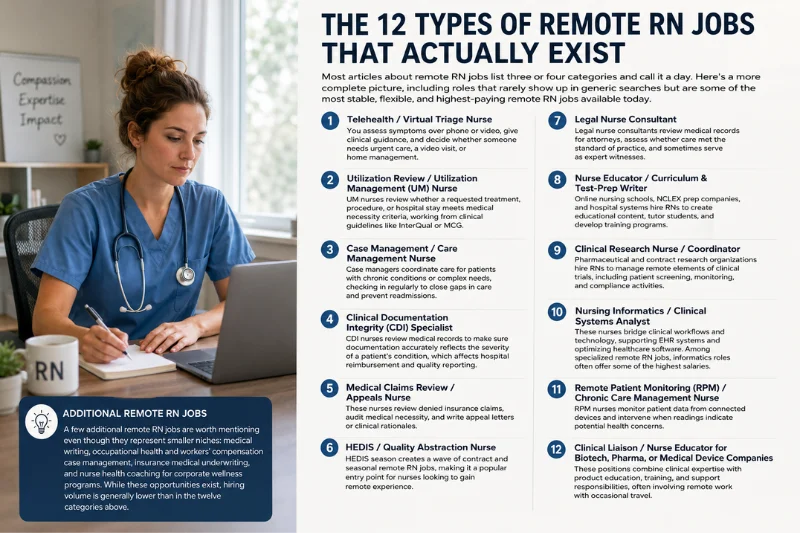
Most articles about remote RN jobs list three or four categories and call it a day. Here’s a more complete picture, including roles that rarely show up in generic searches but are some of the most stable, flexible, and highest-paying remote RN jobs available today.
1. Telehealth / Virtual Triage Nurse
You assess symptoms over phone or video, give clinical guidance, and decide whether someone needs urgent care, a video visit, or home management. This is one of the most common remote RN jobs and often the easiest category to enter with 2–3 years of acute care, ED, or pediatric experience.
2. Utilization Review / Utilization Management (UM) Nurse
UM nurses review whether a requested treatment, procedure, or hospital stay meets medical necessity criteria, working from clinical guidelines like InterQual or MCG. This remains one of the highest-volume remote RN jobs because every health plan needs utilization management staff.
3. Case Management / Care Management Nurse
Case managers coordinate care for patients with chronic conditions or complex needs — think diabetes, heart failure, or recent hospital discharges — checking in regularly to close gaps in care and prevent readmissions.
4. Clinical Documentation Integrity (CDI) Specialist
CDI nurses review medical records to make sure documentation accurately reflects the severity of a patient’s condition, which affects hospital reimbursement and quality reporting.
5. Medical Claims Review / Appeals Nurse
These nurses review denied insurance claims, audit medical necessity, and write appeal letters or clinical rationales.
6. HEDIS / Quality Abstraction Nurse
HEDIS season creates a wave of contract and seasonal remote RN jobs, making it a popular entry point for nurses looking to gain remote experience.
7. Legal Nurse Consultant
Legal nurse consultants review medical records for attorneys, assess whether care met the standard of practice, and sometimes serve as expert witnesses.
8. Nurse Educator / Curriculum & Test-Prep Writer
Online nursing schools, NCLEX prep companies, and hospital systems hire RNs to create educational content, tutor students, and develop training programs.
9. Clinical Research Nurse / Coordinator
Pharmaceutical and contract research organizations hire RNs to manage remote elements of clinical trials, including patient screening, monitoring, and compliance activities.
10. Nursing Informatics / Clinical Systems Analyst
These nurses bridge clinical workflows and technology, supporting EHR systems and optimizing healthcare software. Among specialized remote RN jobs, informatics roles often offer some of the highest salaries.
11. Remote Patient Monitoring (RPM) / Chronic Care Management Nurse
RPM nurses monitor patient data from connected devices and intervene when readings indicate potential health concerns.
12. Clinical Liaison / Nurse Educator for Biotech, Pharma, or Medical Device Companies
These positions combine clinical expertise with product education, training, and support responsibilities, often involving remote work with occasional travel.
A few additional remote RN jobs are worth mentioning even though they represent smaller niches: medical writing, occupational health and workers’ compensation case management, insurance medical underwriting, and nurse health coaching for corporate wellness programs. While these opportunities exist, hiring volume is generally lower than in the twelve categories above.
Remote RN Salary by Job Type
These ranges reflect national data from BLS, Glassdoor, and ZipRecruiter. Actual pay varies by employer, your state’s cost of living, years of experience, and whether the role includes management responsibilities — and a meaningful share of remote RN postings don’t list pay at all, so treat these as planning numbers rather than guarantees.
| Role | Typical Annual Pay Range | Notes |
|---|---|---|
| Telehealth / Triage Nurse | $58,000 – $85,000 | Often hourly; weekend/evening shifts pay more |
| Utilization Review Nurse | $70,000 – $106,000 | Higher end usually requires UM/CCM certification |
| Case Management Nurse | $65,000 – $100,000 | CCM certification adds meaningful pay leverage |
| CDI Specialist | $75,000 – $100,000 | Inpatient coding/CDI experience required |
| Claims/Appeals Review Nurse | $70,000 – $95,000 | Some roles bonus on appeal-overturn rates |
| HEDIS Abstraction Nurse | $30 – $45/hour (seasonal) | Often contract; runs Jan–May |
| Legal Nurse Consultant | $60,000 – $120,000+ | Wide range; many work as independent contractors |
| Nurse Educator / Curriculum | $65,000 – $95,000 | BSN or higher typically required |
| Clinical Research Nurse | $70,000 – $100,000 | Some travel for site visits common |
| Nursing Informatics Analyst | $80,000 – $115,000 | One of the higher-paying remote tracks |
| RPM / Chronic Care Nurse | $60,000 – $90,000 | Fast-growing category |
| Biotech/Pharma Clinical Liaison | $85,000 – $130,000+ | Specialty experience and sales aptitude both help |
For context, general “remote nurse” salary aggregators (which blend all of the above plus advanced practice roles) report a national average in the $75,000–$83,000 range, with the middle 50% of postings falling between roughly $62,000 and $100,000.
What You Need to Qualify for a Remote RN Job
Employers hiring for remote clinical roles are almost always trying to reduce risk, since they can’t physically supervise you the way a charge nurse can on a unit. In practice, that means they screen harder, not softer, than for some bedside roles. Here’s what shows up consistently across postings:
- An active, unrestricted RN license in good standing — no current disciplinary action or board investigation. Many employers also require a multistate compact license (more on this below).
- 2-5 years of recent direct patient care experience, usually in a relevant specialty. Utilization review and case management roles frequently want med-surg, ICU, ED, or case management background; clinical research roles often prefer oncology or specialty experience that matches the trials they run.
- Comfort with technology, specifically EHR systems, basic computer troubleshooting, and the ability to type efficiently while talking to someone on the phone. You’ll be assessed on this, sometimes literally with a typing-speed or computer-skills test during the application process.
- Strong written and verbal communication, since most of these roles replace in-person assessment with phone, video, or written documentation as the primary tool.
- A clean background check and drug screen, standard for nearly all healthcare employers, remote or not.
- Specialty certification, where applicable. A Certified Case Manager (CCM) credential, Accredited Case Manager (ACM), Certified Clinical Documentation Specialist (CCDS or CDIP), or ANCC informatics certification (RN-BC) won’t just help you qualify — they’re often the difference between an entry-level remote salary and one near the top of the range, because they signal you can do the job without months of ramp-up training.
The Licensing Rule Most Nurses Get Wrong
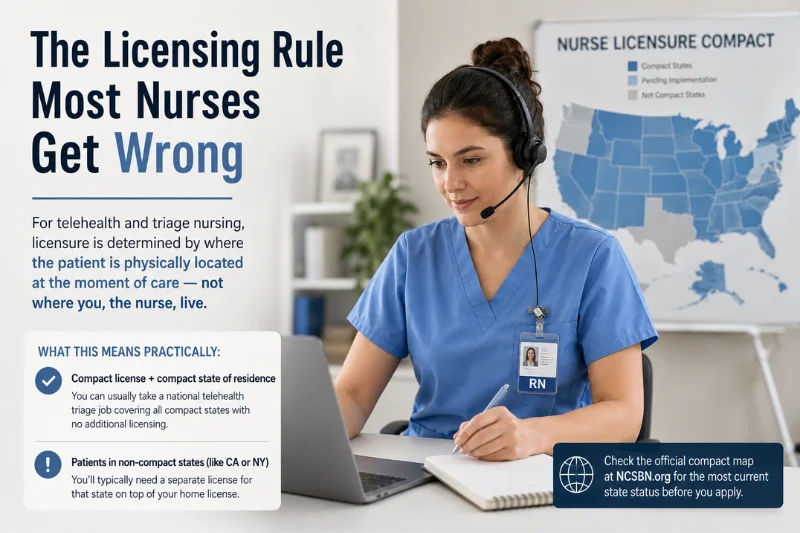
This is the part most “remote RN jobs” articles skip entirely, and it’s the single biggest reason qualified nurses get rejected from telehealth and triage roles they were otherwise a great fit for.
For telehealth and triage nursing, licensure is determined by where the patient is physically located at the moment of care — not where you, the nurse, live. If you’re licensed in Texas and a patient calls in from California, you generally need to be licensed to practice in California for that interaction, regardless of how the company markets the job as “remote.”
This is why the Nurse Licensure Compact (NLC) matters so much for telehealth-style roles. Under the NLC, a nurse whose primary state of residence is a compact member state can hold one multistate license that’s valid for practicing — including via telehealth — in any other compact member state. As, more than 40 states participate in the compact in some form, including large markets like Texas, Florida, and most of the South, Midwest, and Mountain West. A handful of states have passed compact legislation but haven’t finished implementing it yet (Massachusetts, Michigan, Minnesota, and New York are the most-watched examples), and a few states — California and Illinois are the two that come up most often — are not members at all and likely won’t be anytime soon.
What this means practically:
- If you hold a compact license and live in a compact state, you can usually take a national telehealth triage job covering all compact states with no additional licensing.
- If your patients are commonly located in a non-compact state like California or New York, you’ll typically need a separate, individual license for that state on top of your home license — which is exactly why so many telehealth job postings specifically list “must hold CA RN license” or similar.
- Because compact membership and implementation dates change, don’t rely on any single article (including this one) for the current list — check the official compact map maintained by the National Council of State Boards of Nursing (NCSBN) before assuming a state’s status, especially if you’re weighing a move specifically to make yourself more hireable for telehealth work.
Roles that don’t involve direct patient contact across state lines — like CDI, informatics, legal nurse consulting, or curriculum writing — usually only require your standard home-state license, since you’re not delivering clinical care to a specific patient in real time.
Where to Actually Find Legitimate Remote RN Jobs
Spread your search across these four channels rather than relying on just one — each surfaces a different slice of the market.
1. Niche remote-nursing job boards
Boards built specifically around remote and non-bedside nursing tend to have a much higher signal-to-noise ratio than general job sites, because every listing has already been filtered for “is this actually remote.” Look for boards that show how recently a job was posted and let you filter by license state and remote status specifically.
2. Employer career pages, searched directly
Major insurers (UnitedHealth Group/Optum, CVS Health/Aetna, Cigna, Centene, Humana, Elevance Health) and large health systems often post remote roles on their own career sites before — or instead of — syndicating them to Indeed or LinkedIn. If there’s a specific company you want to work for, check their careers page directly and set up a job alert.
3. General job boards, with tighter filtering than most people use
Indeed and LinkedIn do have real remote RN listings, but the default “remote RN” search mixes in hybrid roles, on-site jobs with “remote” in the job title for unrelated reasons, and unrelated healthcare-adjacent jobs. Use the platform’s remote-only filter (not just the keyword), and read the actual job description’s “work setting” field rather than trusting the search match.
4. Clinical staffing and recruiting agencies
Agencies that specialize in case management, utilization review, or clinical documentation placement often have access to roles that aren’t posted publicly at all, especially at the contract or contract-to-hire stage. This is worth pursuing if you have a specific specialty (CDI, legal nursing, clinical research) where a recruiter’s existing client relationships matter more than a generic application.
How to Spot a Remote Nursing Job Scam
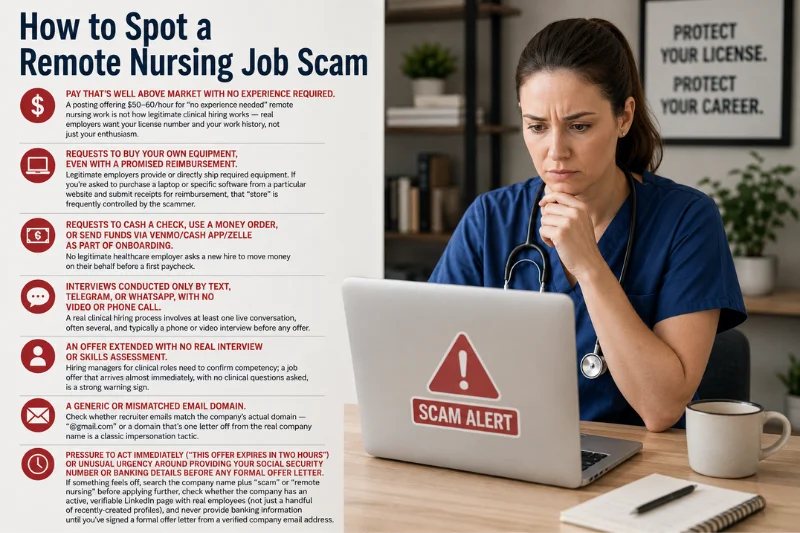
Remote nursing is unfortunately a popular target for job scams, because the combination of “work from home,” “healthcare,” and licensed professionals with stable income makes nurses an attractive mark. Watch for these patterns:
- Pay that’s well above market with no experience required. A posting offering $50–60/hour for “no experience needed” remote nursing work is not how legitimate clinical hiring works — real employers want your license number and your work history, not just your enthusiasm.
- Requests to buy your own equipment, even with a promised reimbursement. Legitimate employers provide or directly ship required equipment. If you’re asked to purchase a laptop or specific software from a particular website and submit receipts for reimbursement, that “store” is frequently controlled by the scammer.
- Requests to cash a check, use a money order, or send funds via Venmo/Cash App/Zelle as part of onboarding. No legitimate healthcare employer asks a new hire to move money on their behalf before a first paycheck.
- Interviews conducted only by text, Telegram, or WhatsApp, with no video or phone call. A real clinical hiring process involves at least one live conversation, often several, and typically a phone or video interview before any offer.
- An offer extended with no real interview or skills assessment. Hiring managers for clinical roles need to confirm competency; a job offer that arrives almost immediately, with no clinical questions asked, is a strong warning sign.
- A generic or mismatched email domain. Check whether recruiter emails match the company’s actual domain — “@gmail.com” or a domain that’s one letter off from the real company name is a classic impersonation tactic.
- Pressure to act immediately (“this offer expires in two hours”) or unusual urgency around providing your Social Security number or banking details before any formal offer letter.
If something feels off, search the company name plus “scam” or “remote nursing” before applying further, check whether the company has an active, verifiable LinkedIn page with real employees (not just a handful of recently-created profiles), and never provide banking information until you’ve signed a formal offer letter from a verified company email address.
How to Get Hired: Resume, Application, and Interview Tips
Most remote nursing applications go through an applicant tracking system (ATS) before a human ever sees them, so the resume itself needs to do real work, not just look polished.
- Mirror the language of the job posting. If the posting says “utilization review” and your resume says “UR,” the ATS may not connect the two. Use the exact terminology from the listing for your skills and experience bullets.
- Lead with outcomes, not duties. Instead of “performed chart reviews,” try “reviewed 30+ inpatient charts weekly for medical necessity using InterQual criteria, reducing average review turnaround by 20%.” Numbers and named tools (InterQual, MCG, specific EHR systems) signal real, current experience.
- Put your license information where it’s easy to find — license type, state(s), and compact status, ideally near the top of the resume. Recruiters scan for this first.
- List relevant certifications prominently, even if you’re still studying for one. A note like “CCM exam scheduled [month/year]” shows intent and can offset a slightly thinner resume elsewhere.
- Prepare for a phone-and-typing skills check. Some remote roles include a practical assessment — a mock triage call, a typing test, or a case scenario — as part of the process. Practice talking through a clinical scenario while documenting it in real time, since that’s the actual skill the job requires.
- Treat the video interview like an in-person one. Quiet room, neutral background, good lighting, and a wired internet connection if possible. Interviewers are quietly evaluating whether your home setup is professional enough for a job where you’ll represent the company on calls with patients or providers.
- Ask about caseload and metrics in the interview. Questions like “what’s a typical daily call or case volume?” and “how is performance measured?” show you understand the role and help you avoid accepting a job with an unsustainable workload.
What Your Home Office Actually Needs to Look Like
Most employers will specify minimum requirements, but the recurring baseline across remote clinical roles includes:
- A private, distraction-free space where patient information can’t be seen or overheard by others — this is a HIPAA requirement, not a preference.
- Reliable high-speed internet, often with a minimum specified upload/download speed (commonly in the 25 Mbps range or higher), and many employers either require or strongly prefer a hardwired ethernet connection over Wi-Fi for call-quality and security reasons.
- A dedicated computer that meets the employer’s specifications — some companies issue equipment, others require you to use your own hardware that meets minimum specs they’ll provide in writing.
- A landline or reliable cell signal, since dropped calls during a clinical assessment are a real safety and liability concern.
- Headset with noise cancellation, particularly for triage and telehealth roles where call clarity affects clinical assessment.
If a job doesn’t specify equipment requirements anywhere in the posting or offer materials, ask directly during the interview process — it’s a completely normal question and answering it clearly is part of how legitimate employers build trust with new remote hires.
Is Remote Nursing Right for You? The Honest Pros and Cons
Most articles on this topic only list the upside. Here’s a more balanced picture, because remote nursing is genuinely a better fit for some nurses than others.
The real advantages:
- No physical patient lifting, less risk of needlestick or exposure injuries, and a meaningfully lower physical toll than bedside work.
- Schedule flexibility is common, though “remote” doesn’t always mean “flexible hours” — many telehealth and UM roles still run fixed shifts to provide coverage.
- Location independence within your licensed state(s), which matters for nurses who’ve relocated, have caregiving responsibilities, or live somewhere with limited local hospital options.
- A genuine path to extend a nursing career for nurses dealing with chronic pain, pregnancy, or other physical limitations that make bedside work difficult.
The real trade-offs:
- Clinical skills can atrophy. If you’re away from direct patient care for years, returning to bedside nursing later may require a refresher or preceptorship.
- Isolation is a common complaint. You lose the built-in social structure of a unit, and some nurses underestimate how much they relied on coworker camaraderie to manage stress.
- Productivity metrics replace direct supervision. Many remote roles track call volume, case closure rates, or chart review counts closely, which can feel more like a call-center environment than nursing, depending on the employer.
- Entry-level remote roles are genuinely competitive. Because demand from nurses wanting to leave the bedside is high, even “easy” categories like telehealth triage often require solid recent experience and a polished application, not just interest.
- Pay can plateau lower than acute-care bedside nursing with overtime and differentials factored in, particularly outside of UM and informatics roles.
None of this means remote nursing is a bad choice — it’s a strong, sustainable option for a lot of nurses. The point is to go in with accurate expectations rather than the version of remote nursing sold by “quit your job and work from the beach” content.
Frequently Asked Questions remote rn jobs
Can a new graduate RN get a remote nursing job?
Almost never, and you should be skeptical of any posting that suggests otherwise. The large majority of remote RN jobs require independent clinical judgment without an in-person team to lean on, which is why employers consistently ask for 2+ years of recent direct patient care experience. The realistic path is to work bedside first, then transition into remote RN jobs later in your career.
Do remote RN jobs pay less than hospital nursing?
Often, yes, especially compared to base hospital pay plus night/weekend differentials and overtime. But several categories of remote RN jobs — informatics, biotech/pharma liaison roles, and senior UM or CDI positions — can match or exceed typical hospital RN pay, particularly once you factor in the absence of commuting costs and physical strain.
What is the easiest remote RN job to get?
Telehealth/triage nursing and HEDIS abstraction tend to have the most openings and the most accessible experience requirements, making them common entry points into remote RN jobs. “Easiest” still means a real, competitive clinical hiring process — not a casual or low-bar one.
Do I need a compact nursing license for remote work?
Not always, but it significantly expands which remote RN jobs you qualify for, especially telehealth and triage positions, since those roles are licensed based on the patient’s location. Documentation, informatics, legal nurse consulting, and education roles typically only require your home-state license.
Are “remote LPN” or “remote LVN” jobs available too?
Yes, in a narrower set of categories — telephonic care management, prior authorization support, and some documentation and coding roles. The overall volume is lower than for remote RN jobs, and many utilization management and complex case management roles specifically require an RN.
How do I know if a remote nursing job posting is legitimate?
Check that the company has a real, verifiable presence (website, LinkedIn, news mentions), confirm the recruiter’s email matches the company’s actual domain, and be wary of any request to spend your own money, cash a check, or interview only via text-based apps. Scam listings targeting applicants searching for remote RN jobs often follow these patterns.
Can I work a remote RN job from another country?
Generally no. Nearly all employers offering remote RN jobs require you to reside in, and be licensed in, a U.S. state, both for legal and licensing reasons and because most roles require you to be available during U.S. business hours in a specific time zone.
What certifications actually help for remote nursing roles?
Certified Case Manager (CCM), Accredited Case Manager (ACM), Certified Clinical Documentation Specialist (CCDS/CDIP), and ANCC’s informatics certification (RN-BC) are the credentials that appear most often in remote RN jobs listings and tend to correlate with higher starting pay because they reduce how much training an employer needs to provide.
Do remote RN jobs come with benefits like health insurance and PTO?
It depends heavily on employment type. Full-time, W-2 remote RN jobs with large insurers, health systems, and telehealth companies typically come with standard benefits packages — medical, dental, vision, 401(k), and PTO — comparable to what you’d get in an in-person corporate nursing role. Contract or 1099 remote work (common in HEDIS abstraction, some legal nurse consulting, and short-term clinical research roles) usually doesn’t include benefits but often pays a higher hourly rate to offset that. Always confirm classification and benefits eligibility before accepting an offer.
How long does it typically take to land a remote RN job?
Plan for longer than a typical bedside job search. Because remote RN jobs attract a large applicant pool relative to the number of openings, it’s common to submit applications for several weeks or even a couple of months before getting traction, even with a strong resume. Building in a buffer of at least 6–8 weeks — and applying steadily rather than all at once — sets more realistic expectations than the “land a remote job in two weeks” claims sometimes found online.
Final Thoughts
The bottom line on remote RN jobs is that they’re a real, sustainable career path — not a myth, and not a guaranteed shortcut either. The nurses who successfully land remote RN jobs and stay happy in them are the ones who treat the search like the clinical hiring process it actually is. They target the specific categories of remote RN jobs that match their background, get their licensing sorted out before they need it, lead with outcomes on their resume instead of duties, and stay alert to the scam patterns that often target people searching for remote RN jobs.
If you take one thing away from this guide, let it be this: don’t search for remote RN jobs the same way you’d search for any other work-from-home gig. Search like a nurse evaluating a clinical role, because that’s exactly what it is. By approaching remote RN jobs strategically and consistently, you’ll spend far less time sorting through noise and far more time building the remote nursing career you’re looking for.