
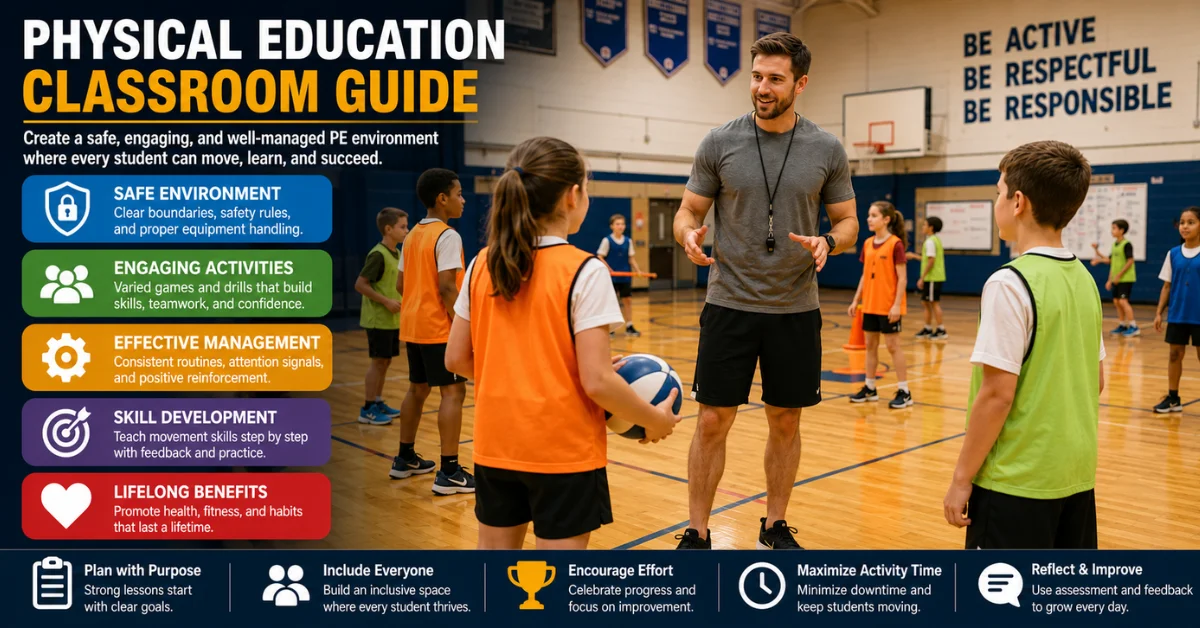
When people search for a physical education classroom, they’re usually referring to one of two different concepts. Most often, they mean the dedicated space where physical education lessons take place—a gymnasium, sports field, or multipurpose activity area where students develop movement skills, teamwork, fitness, and confidence under the guidance of a PE teacher. Others may be looking for ways to incorporate movement into a traditional academic classroom through short activity breaks. While both topics involve physical activity, they serve different educational purposes.
This guide focuses primarily on the physical education classroom as a dedicated learning environment. Unlike a traditional classroom, students are constantly moving, interacting, and participating in activities that require careful organization, clear routines, and effective classroom management. From setting up the learning space and managing equipment to teaching movement skills and maintaining student engagement, every aspect of a physical education classroom requires thoughtful planning. Whether you’re a new PE teacher, a student teacher, or simply interested in understanding how an effective PE environment works, this guide will help you build a classroom where students can learn safely, stay active, and enjoy lifelong physical activity.
What Makes a PE Classroom Genuinely Different
A physical education classroom isn’t really a classroom in the traditional sense, and that distinction matters more than people give it credit for. There are no desks anchoring students in place. Often there isn’t even a wall — plenty of PE classes happen on a field, a blacktop, or a shared multipurpose space that gets repurposed three other ways before lunch. Students are constantly in motion, often spread across forty or fifty feet of open space instead of sitting six feet from you in neat rows.
That single fact — movement instead of stillness, open space instead of fixed seating — is the reason PE management has to work differently than regular classroom management. You can’t rely on proximity the same way when twenty-eight kids are scattered across a gymnasium. You can’t get everyone’s attention by simply raising your voice over the noise of bouncing balls and running feet. Every system you build, from how kids enter the space to how they get a partner for an activity, has to account for the fact that your “classroom” has no edges unless you create them.
Setting Up the Physical Space
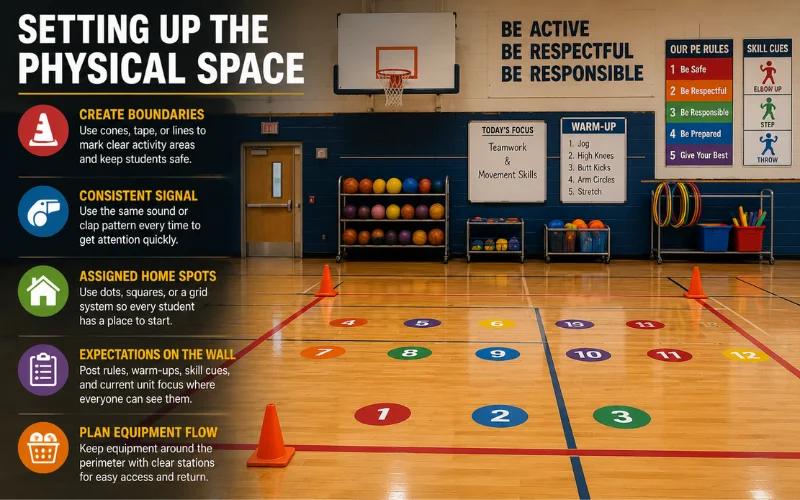
Good PE classroom management starts before a single student walks in. The space itself does a lot of the management work for you, if it’s set up with intention.
Create boundaries, even where none exist
Cones, floor tape, painted lines, or simple landmarks (“the red line is out of bounds”) give students a concrete sense of where the activity space starts and stops. Without visible boundaries, you’ll spend half your lesson re-corralling kids who’ve drifted.
Establish a consistent attention signal
Whether it’s a whistle, a specific clap pattern, or pausing music, students need one unmistakable cue that means “stop and look at me.” The signal only works if it’s used the exact same way every single time — inconsistency here is one of the fastest ways to lose a class’s attention reliably.
Give every student an assigned “home spot“
A simple system — a numbered floor dot, a taped square, or a grid system where kids find their spot using a number and letter coordinate — gives you an instant, visual way to take attendance, deliver instructions, and know immediately who’s missing or out of position. It also gives anxious or easily overwhelmed kids a predictable “base” to return to.
Put your expectations on the wall, not just in your head
A simple rules-and-consequences poster near the entrance does real work: it lets students who can’t yet read body language or rapid verbal instructions see what’s expected, and it gives you something concrete to point to instead of re-explaining a rule from scratch every time it’s broken. The same goes for a daily warm-up visual, a “what we’re working on this unit” board, and skill cue posters (simple, kid-friendly phrases like “elbow up, step, throw” for an overhand throw) that reinforce what you’re teaching verbally.
Plan your equipment flow before the lesson, not during it
Spread equipment around the perimeter rather than in one central pile — a single pile creates a crowd, a safety risk, and a bottleneck. Build a specific routine for getting equipment out and putting it away, and rehearse it like you would any other skill, because it will save you several minutes of every single class once it’s automatic.
Classroom Management Strategies That Actually Work in PE
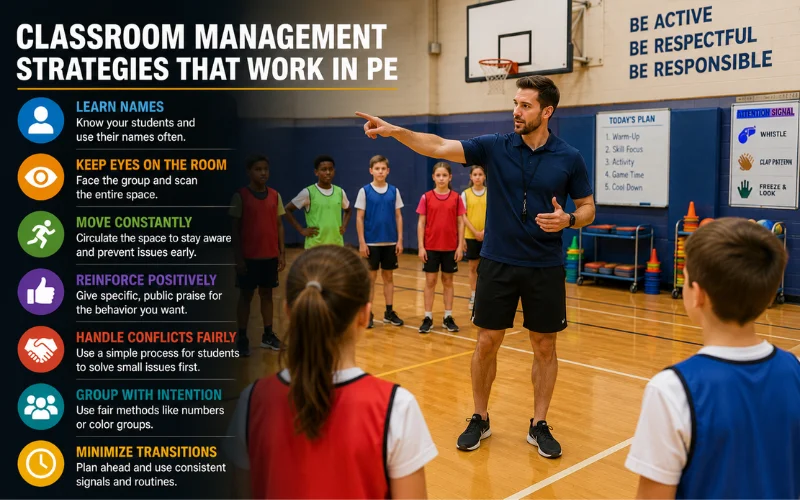
A lot of general classroom-management advice doesn’t translate well to a gym. Here’s what does, based on how experienced PE teachers and researchers actually approach it.
Learn names fast, and use them constantly
This sounds obvious, but it’s arguably the single highest-leverage thing you can do. A teacher who can call a specific student by name from across the gym — “Marcus, eyes up here” — stops off-task behavior before it spreads, without breaking stride or singling anyone out dramatically. A teacher fumbling for “hey, you in the blue shirt” loses several seconds of authority every time.
Keep your back to the wall, your eyes on the room
When you’re teaching or demonstrating, position yourself so you’re facing the group and can see the entire space, rather than turning your back to scan a board or screen. Constant scanning — really seeing the whole room, not just the student directly in front of you — lets you catch small problems before they become big ones.
Move constantly and unpredictably
Teachers who park themselves in one spot lose track of what’s happening on the far side of the gym. Circulating the space, especially toward areas where you sense restlessness building, tends to prevent problems simply through your presence — most students self-correct when they know you might walk by at any moment.
Reinforce the behavior you want, specifically and out loud
Vague praise like “good job, everyone” does very little. Specific, public reinforcement — “I really like how Group 3 got their equipment out and started the warm-up without me saying anything” — both rewards the students doing it right and quietly nudges everyone else toward the same behavior, without calling out anyone negatively.
Build a fair, low-drama way to handle minor conflicts
PE generates more peer-to-peer friction than most subjects, simply because of competition, physical contact, and constant social interaction. A designated, simple process students know to use first — talk it out themselves at a specific spot before coming to you — cuts down dramatically on the small disputes that otherwise eat into instructional time.
Group students with intention, not popularity contests
Avoid having students pick teams or partners by captain selection — it’s one of the more research-backed recommendations in PE pedagogy, because it reliably creates winners and losers in a social hierarchy sense before the activity has even started. Numbering off, color groups, or pre-assigned teams accomplish the same organizational goal without that cost.
Minimize transition time relentlessly
The gap between activities is where PE classes lose the most instructional time and gain the most behavior problems. Have the next activity’s equipment, formation, or instructions ready before you end the current one, and use the same signal-and-routine system for every transition so kids aren’t relearning a new process each time.
Teaching Skills Effectively in a PE Setting
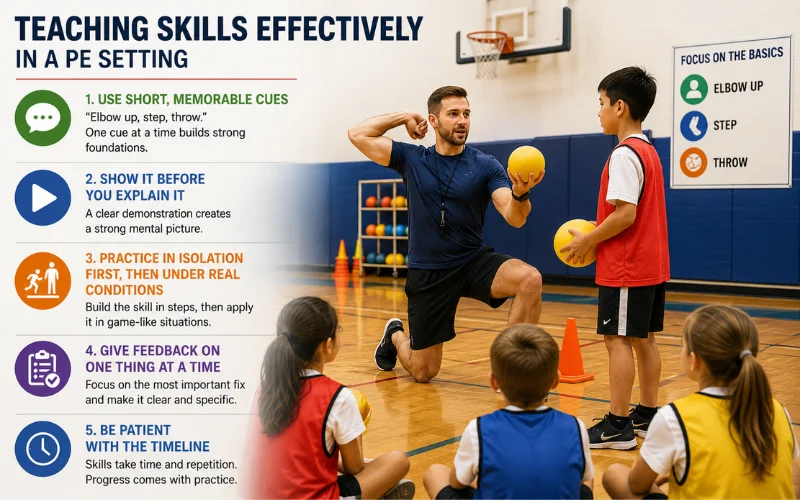
Managing behavior is half the job. The other half is actually teaching movement skills well, which has its own distinct best practices.
Use short, memorable cues instead of long explanations.
“Elbow up, step, throw” teaches an overhand throw far more effectively to a six-year-old than a paragraph of technical instruction. Introduce one cue at a time with younger or newer learners, layering in complexity only once the first piece is solid.
Show it before you explain it.
A clear demonstration, live or on video, builds a mental picture much faster than verbal description alone, particularly for complex or multi-step skills.
Practice in isolation first, then under real conditions.
A student who can perform a skill standing still in an empty gym often can’t yet perform it during an actual game, where there’s pressure, movement, and decision-making layered on top. Structuring practice to move gradually from isolated repetition toward live, game-like conditions is how skills actually transfer.
Give feedback on one thing at a time.
Correcting five things at once overwhelms a learner and usually improves nothing. Pick the single most important correction for that moment, deliver it clearly and specifically, and check that the student actually understood it before moving on.
Be patient with the timeline.
It typically takes meaningful, repeated instructional time — commonly cited estimates run into the multiple hours, spread across many lessons — for a young child to become genuinely proficient at even one fundamental movement skill, like skipping or an overhand throw. If a skill isn’t sticking after one or two lessons, that’s normal, not a sign that something’s going wrong.
Assessment and Self-Reflection in PE
Assessment in a PE classroom rarely looks like a written test, and that’s by design — but it still needs to be intentional.
- Quick daily self-assessment (a simple scale where students rate their own effort or understanding on the way out the door) gives you a fast pulse-check on the whole class and teaches students to reflect honestly on their own performance.
- Anecdotal observation notes, even brief ones, build a much richer picture of a student’s progress over a semester than a single test ever could.
- Fitness or skill benchmarks, tracked over time rather than compared harshly between students, can motivate without turning into a source of shame for kids who are still developing.
- Portfolios or simple records of skills attempted and mastered give families a concrete sense of progress beyond a single letter grade.
What If You Meant Bringing Movement Into a Regular Classroom?
If you landed here looking for ways to add physical activity into a non-PE classroom — a math, reading, or general homeroom setting — that’s a related but genuinely different goal, and it deserves its own quick treatment.
Research consistently links short bursts of movement during the academic day to better focus, improved mood, and even stronger retention of material, especially for younger students and those who struggle to sit still for long stretches. A few approaches that work well without needing any special equipment:
- Short movement breaks between lessons — even two or three minutes of stretching, jumping jacks, or a simple dance video resets attention noticeably.
- Content-tied movement, where students act out vocabulary words, hop between answer choices, or physically move to represent a math problem, combines the academic goal with the physical one instead of treating them as separate.
- Flexible seating options — wobble stools, standing areas, or simply permission to stand at the back of the room — let naturally fidgety students regulate themselves without leaving the room.
- Outdoor lesson extensions, like taking a measurement activity or a nature observation outside, give students a true change of environment along with the movement.
The goal here isn’t to replicate a PE class — it’s brief, low-key, and designed to support the main lesson rather than compete with it for time.
Common Mistakes That Undermine a PE Classroom
A few patterns show up again and again in classrooms that struggle, even with well-meaning teachers:
- Inconsistent signals. If your attention cue works sometimes and gets ignored other times, students learn it’s optional.
- Too much standing-around time. Long lines, slow equipment distribution, and lengthy explanations before activity all eat into the limited minutes you actually have — and idle time is reliably where behavior problems start.
- Punishing the whole class for one student’s behavior. This erodes trust quickly and rarely changes the behavior of the one student causing the issue.
- Skipping the boring infrastructure work. Posted rules, a real grouping system, a genuine attention signal — none of these are exciting to set up, but skipping them is the single biggest predictor of a chaotic class later.
Frequently Asked Questions physical education classroom
1. What is a physical education classroom?
A physical education classroom is the learning environment where students participate in structured physical activities designed to improve fitness, motor skills, teamwork, sportsmanship, and overall health.
2. Why is classroom management important in a physical education classroom?
Good management keeps students safe, reduces downtime, improves participation, and allows teachers to focus on instruction instead of behavior issues within the physical education classroom.
3. What equipment is commonly used in a physical education classroom?
Common equipment includes balls, cones, jump ropes, mats, hoops, agility ladders, fitness stations, whistles, and other materials that support skill development and physical activity.
4. How can teachers keep students engaged in a physical education classroom?
Teachers can use varied activities, positive reinforcement, clear instructions, cooperative games, skill-based challenges, and regular feedback to maintain high student engagement.
5. What safety practices should every physical education classroom follow?
A physical education classroom should have clear safety rules, proper equipment inspections, adequate supervision, warm-up and cool-down routines, and emergency procedures.
6. How should students be grouped in a physical education classroom?
Students should be grouped using fair and inclusive methods such as numbered groups, color teams, or teacher-assigned partners instead of allowing students to pick teams.
7. Can a physical education classroom be held outdoors?
Yes. Many schools conduct physical education classroom lessons on sports fields, playgrounds, tracks, or outdoor courts while following the same management and safety principles.
8. How do teachers assess learning in a physical education classroom?
Assessment may include skill demonstrations, fitness progress, participation, teamwork, self-reflection, observation notes, and performance rubrics rather than traditional written exams.
9. What qualities make an effective physical education classroom teacher?
An effective teacher is organized, encouraging, knowledgeable about movement skills, communicates clearly, maintains consistent routines, and promotes an inclusive learning environment.
10. How does a physical education classroom benefit students?
A well-managed physical education classroom helps students develop physical fitness, coordination, confidence, social skills, healthy habits, leadership abilities, and a lifelong appreciation for physical activity.
Final Thoughts
Creating a successful physical education classroom goes far beyond organizing games or supervising students during exercise. It requires intentional planning, consistent routines, effective communication, and an environment where every student feels safe, included, and motivated to participate. The best PE teachers understand that classroom management and quality instruction work hand in hand—when students know the expectations and routines, they spend less time waiting and more time learning valuable movement skills.
As educational approaches continue to evolve, the role of the physical education classroom becomes even more important in supporting students’ physical health, mental well-being, teamwork, and lifelong fitness habits. By establishing clear expectations, maximizing active learning time, and creating an encouraging atmosphere, teachers can transform the physical education classroom into one of the most engaging and impactful learning environments in a school.